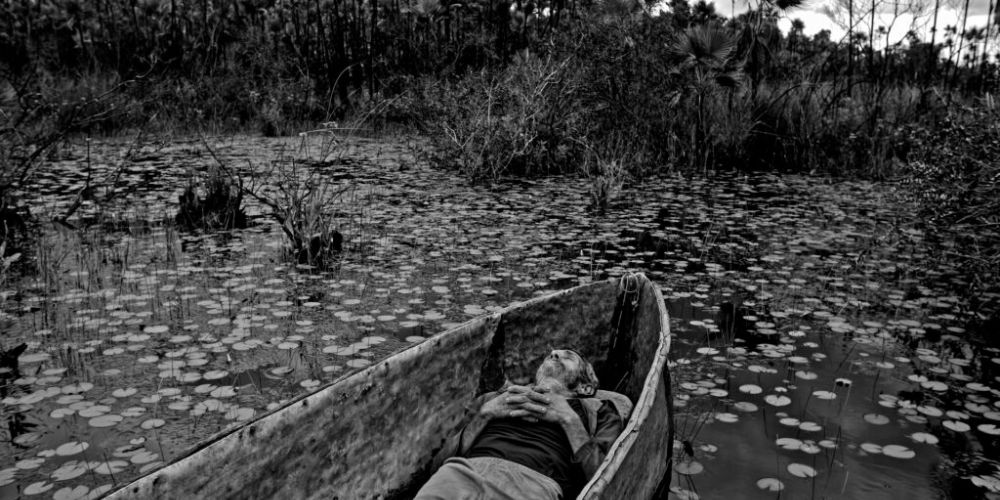
This year’s edition of #MajorDocs, a film festival dedicated to creative documentaries, features To The West, in Zapata — a work whose very essence perfectly aligns with the festival’s curatorial focus. Cuban director David Bim’s marvellous debut tells the story of a family struggling to survive in one of the harshest regions of the country, amid a roaring #pandemic, severe shortages, and social unrest. Stunning in its hypnotic black-and-white cinematography and its distinctive closeness to the characters, the film stands as a tender love letter to family values, as a steady source in the darkest times.
Landi and Mercedes
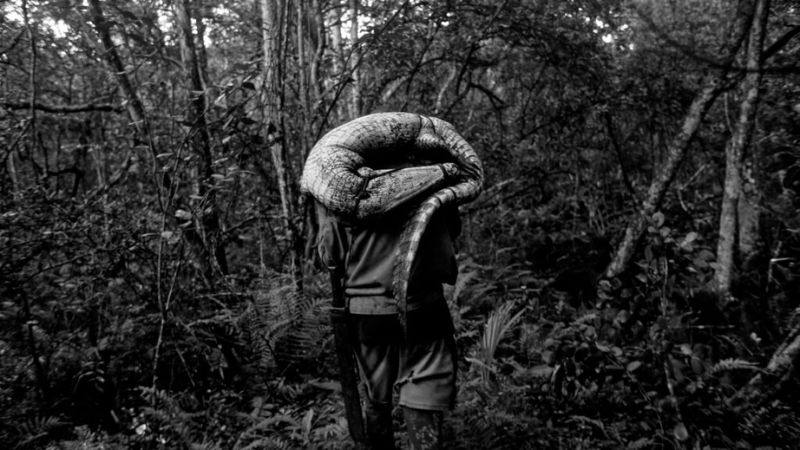
The title To The West, in Zapata, refers to the film’s geographical setting—the swampy, biodiverse region that is also one of the most isolated and impoverished parts of Cuba. It opens with the chapter «Landi,» who is first introduced by a stunning wide shot, walking through the jungle while carrying a tied crocodile on his back. Upon his return to the camp, through a working radio, we learn that it is 2021, Covid numbers are dramatically rising, yet it has been sixty-three years since the #revolution, nonetheless, proposed as a happy occasion. After such a contextual intro and a moment of rest for the hero, comes the film’s most splendid scene. Wading through knee-deep water, Landi sets out for a crocodile hunt, which scatters to the sides as he steps into the centre. Armed only with a wooden stick and a rope, and driven by the absolute necessity of securing his prey, Landi appears stripped of human instinct as such. This over-ten-minute single-take sequence — filled with raw danger and the horrifying beauty of the landscape — captures the human-animal struggle for survival in its purest form. The crocodile, in pre-death convulsions, is ultimately overpowered by Landi, who, after a strenuous effort, ties the poor animal and places it in his rotten boat.
Once Landi leaves the swamps with the butchered victim, the origin of such devastating rigour is revealed. With the arrival in the village, begins the second part of the film — Mercedes, dedicated to Landi’s wife and the domestic environment in his absence. In this little roadside house, Mercedes stays with their disabled son, Denis — a bright boy whose condition indeed demands great effort and attention. Their continuing worries and longing for the absent father are endured in exchange for crocodile meat and skin, which sustain the family a little longer.
Stunning in its hypnotic black-and-white cinematography and its distinctive closeness to the characters, the film stands as a tender love letter to family values, as a steady source in the darkest times.
David Bim
Cuban director David Bim belongs to the new generation of national filmmakers, making a serious effort in expanding the country’s film industry and education. In 2023, he took the Chair of Advanced Studies in Fiction at the Cuban Film School (EICTV) — the first film school in #Latin America#, from which he himself once graduated. Bim’s deep engagement with film education is evident in the approach he took for To The West, in Zapata, which is rooted in long-lasting approximation to the subjects and edited with a clear aesthetic vision in mind.
Bim began developing his debut nearly ten years ago, and as he mentioned in an interview with the FIPRESCI, he first encountered Mercedes during one of his solo trips. Over about 5 years of approaching the family, they built a mutual trust to the point that his presence became, if not invisible, then entirely native, allowing him to capture moments of genuine fragility. It is equally marked by Bim’s readiness to follow danger, accompanying Landi through the water and peril, reciprocating the trust of his guide. As in the imprinted crocodile hunt scene: regardless of whether Landi loses control and puts them both at risk, or the rain threatens to damage his Sony Alpha A7S II, Bim keeps the camera rolling.
But where Bim is most evident as a film teacher is in how he engages with the essence of the slow cinema mode, whose greatest power lies in conveying the experience of lived time within the setting, or, in the given case, one’s destiny. While the first part of the film is overwhelmed by action and tension inside the mise-en-scène, the Mercedes part sedates into philosophical rumination, unveiling the experience of their time shaped by #poverty and, consequently, uncertainty. The durational takes of Mercedes’s housekeeping and her exhausted face, glancing at the son, present time as something unfathomable, closed in the loop of awaiting, reunion, and struggle for economic survival anew. The unvoiced question of the future lingers within the same unclear continuum.
Family Values
To The West, in Zapata can hardly be labelled a purely political documentary — advantageously, it goes far beyond that. Cuba, whose cinematic image is predominantly associated with the exploration of political truth and #propaganda, here expresses these themes rather through a justified sense of exhaustion. This stance is vivid in Bim’s editing rhetoric, who does not miss an opportunity to allow a radio to penetrate the setting. In that way, that stream of propaganda meant to uplift one’s spirit becomes sort of a disturbing white noise, like in this expressive scene where Landi cuts the crocodile to the backdrop of another hypocritical political chatter. Such straightforward juxtapositions are nothing but a demonstrative statement that all hopes for governmental change seem to have been abandoned by those who need them most. From that consciousness, Bim directs all his effort toward crafting a different kind of remark, suggesting that close relations are an inexhaustible source of consolation. To The West in Zapata, thus, is more ingenious as an aestheticised, yet respectful tribute to the power of love and resilience, as even in the grimmest corners of the planet, in dehumanisation and sorrow, familial love still endures.