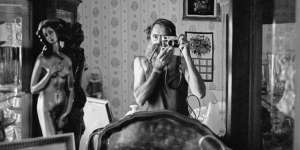
The lure of wild isolation—taking shelter from a world of pain and violence within a tiny English-speaking community on a South Atlantic volcanic island—has tugged at a French doctor all his life. In Tobias Nölle’s film Tristan Forever, co-directed with its protagonist Loran Bonnardot, we delve into a liminal world where dreams meet reality.

<h2
The cinematography is striking from the first frames: a piano strapped to the back of a pick-up truck, its owner crouched beside it before a week-long voyage across the vastness of the South Atlantic to a tiny British Overseas Territory outpost—Tristan da Cunha.
Loran Bonnardot’s story gradually emerges as the merchant vessel he travels on pitches and plunges above towering waves in the middle of nowhere. Bonnardot—who has been visiting the islands since his twenties and maintains a 30-year friendship with Martin, a local fisherman—is stricken with sea sickness. For a doctor who has spent his life tending to victims of war and civil violence across the world as a member of Doctors Without Borders (Médecins Sans Frontières), the motion is a challenge encountered only occasionally.
Bonnardot, who is also a filmmaker, has had enough of an itinerant life tending to the torn bodies of other people’s violence. At 50, he wants to settle down and live a simple life. A native of Paris, which he describes as never having felt like home, he leaves behind a girlfriend unwilling to accompany him to the world’s most isolated human settlement, as well as parents and siblings he rarely sees.
It is a curious choice for a man seen socialising in old VHS clips with friends and colleagues, explaining the source of his fascination: a 19th-century French account of a visit to the volcanic outcrop.
Nölle, a Swiss filmmaker living between Zurich and Berlin, is known for his Locarno Golden Leopard-winning short René—a study of loneliness—and his Berlinale Panorama 2016 feature debut Aloys, about a solitary and distant private detective.
Now returning to the 76th Berlinale edition’s Panorama Documentary Competition with a world premiere, Nölle delves deeper into familiar themes, blending reality and fiction to explore what happens when a man’s inner world collides with the outer world.
The lure of wild isolation… has tugged at a French doctor all his life.
The island teaches by constraint
All seems normal as Bonnardot lands, reunites with Martin, finds lodgings, and begins to engage with the local community of some 230 souls who make up the population of Edinburgh of the Seven Seas—the island’s sole settlement, though never named in the film.
The world of the Tristan islanders is strictly framed by geography and topography. The inhabited area extends just a few miles beyond the town to «the Patches,» a vegetable-growing area dotted around a now-deserted former satellite village.
The island’s economy is based on fishing (mainly sea crayfish known as Tristan rock lobster), subsistence agriculture (every inhabitant must grow their own vegetables), and sheep farming. Specialist items such as commemorative coinage and limited tourism add a little on top of a precarious economy. There is one supermarket, a church, a school, and a small governing body.
Outsiders are not normally allowed to settle on the island, but permanent residency can be granted after 12 months, subject to approval by the island council. Bonnardot wants to secure this valuable stamp in his passport, and this goal drives his determination throughout his first year.
He settles in a house left empty after its owner died, the furniture, television, and kitchen equipment left exactly as they were, and finds work in the local supermarket, where he befriends Glenda, a local single mother. They become friends, and Bonnardot gets involved in giving free piano lessons, giving talks at the school, and occasional physiotherapy sessions for an elderly islander.
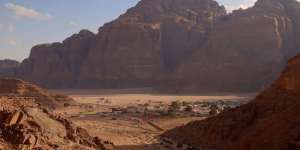
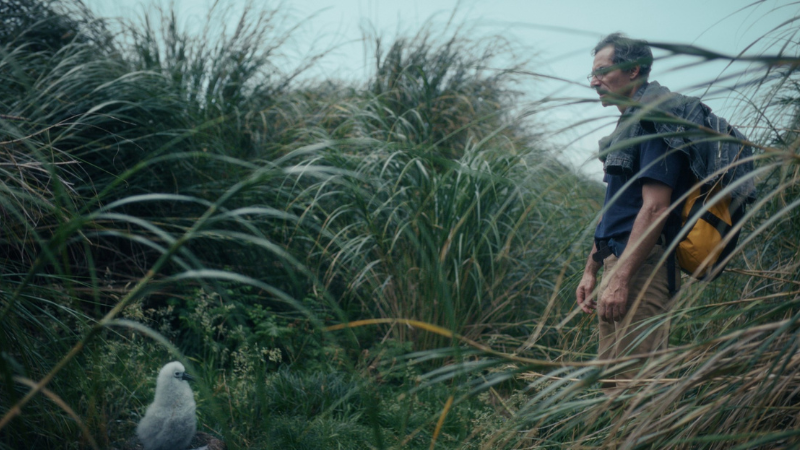
Woven into this simple story, another character looms large: the towering volcanic Queen Mary’s Peak, home to nesting birds, rock-hopping penguins, and sheep. Climbing sometimes with Martin, sometimes alone, Bonnardot often seems incongruous and ill at ease in the misty, wet, and gloomy landscape. He gets lost and needs rescuing; he goes fishing, and his boat takes on water and founders.
There is a strange compulsion in his desire to settle on Tristan that does not quite ring true. Glenda does not really believe he will stay. Seeking a girlfriend, Bonnardot asks her if she knows anyone. «There are not that many single women on the islands,» she laughs, before adding, «I like you, but I have a deep feeling that you won’t stay. It is best we stay friends.»
A burning cabin
Bonnardot protests that he will stay, but after moving to an old and remote cabin that he rebuilds—and then burns down after carelessly leaving a candle near a curtain (in a scene clearly constructed and fictionalised)—and after finally achieving his goal of permanent residency, he decides to leave.
It is the denouement we have been waiting for throughout the film. Bonnardot’s romantic idea of escape—of a life of simplicity and apparent charm—is something the islanders themselves have long questioned. Council meetings that regularly consider his suitability for permanent residency often dwell on the difference between visiting the island and living there.
Archive footage, dotted throughout Tristan Forever, of islanders displaced to England for 2 years following a massive volcanic eruption in 1961, undermines the perceived distance between their mentality and that of the «outside world.»
British newsreels of the time wondered, condescendingly, how those living «a century behind the times» would cope. Yet the islanders could not stand the modern world and soon voted to return to their hardy and isolated lives.
Bonnardot is the epitome of a romantic innocent, convinced that his intellectual notions can carry him through the physical reality of a life far from the madding crowd.
There is no great breakdown, no admission of failure. One day, a cruise ship arrives, and Bonnardot leaves as he came: quietly, almost anonymously. He remains an enigmatic and solitary figure, drawn not so much to Tristan itself as to the idea of escape—of a life that, once tested against reality, proves impossible to inhabit.