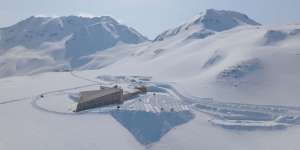
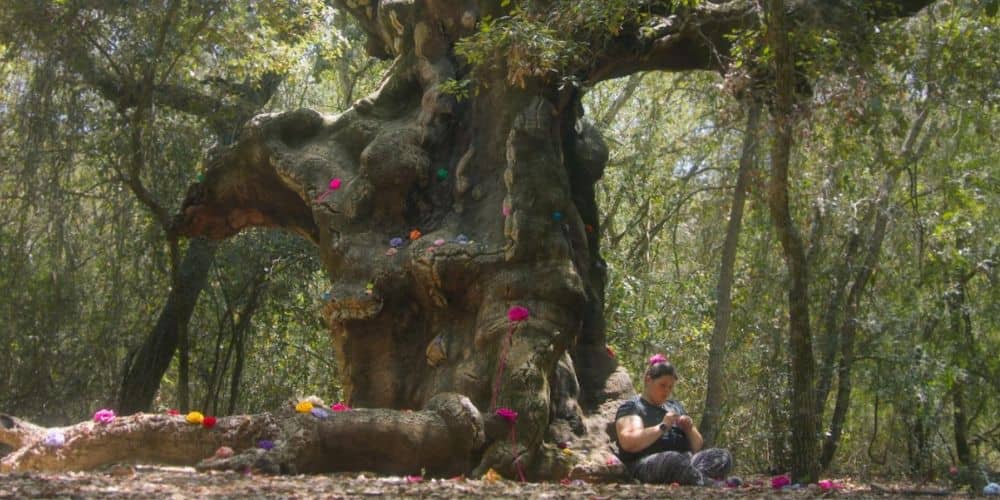
In an isolated house in the middle of a Sicilian nature reserve, twentysomething Valentina lives with her parents – either to take care of them through their increasing loneliness and declining health or because she didn’t gather the courage to move out, perhaps get married, and start a life of her own. This quasi-archetypal family situation, predictable in its narrative arc and ambiguous to the end in its finer details, unfolds slowly through Francesca Scalisi’s intimate documentary Valentina and the MUOSters, screening at #DOK Leipzig# in the following days. Their family dynamic leads us to conclude that nothing has changed for many decades in the Sicilian hinterland, with the flashing and noisy exception of a #NATO MUOS (Mobile User Objective System) ground station near Niscemi that dominates the landscape, regardless of the protests of the local population against the potential threats it represents.
Peripheral activism
Despite the title, the role of #activism and the investigation of the impact on the community of the NATO base take a rather peripheral role and infuse the film through short and self-contained scenes: the family distractedly watches TV when the news bombastically refers to the MUOS; US soldiers appear silhouetted in long shots while Valentina drives her father around; and her dad’s doctor mentions that, adding to the patient’s health concerns, the electromagnetic waves of the radio transmitters very likely influence his pacemaker. A protest scene featuring an anti-imperialistic speech in voiceover is fugitively inserted, but further information about when the base was set up, how legitimate the worries might be that this is harmful #technology and even whether continued protests have any chance of succeeding are conspicuously absent. Perhaps this follows a deliberate decision on the filmmaker’s part to limit us to the vantage point of the documentary’s subjects, but that nevertheless has the unfortunate downside of making their every anxious thought equally (im)plausible – like, for instance, the concern that the community might get dragged into Russia’s potential retaliation against NATO, given that the MUOS detection powers are now used to gather data on the invasion of #Ukraine. It might very well be the case that this perceived threat is unlikely – as were many panicked reactions in the region when the whole continent was shocked to see that the Russian army’s ruthlessness was put to work in Europe—but the fact that potential risks hadn’t been elucidated for so long (since the Niscemi MUOS inauguration in 2012) gives sufficient weight to the locals’ anger at being neglected.
Their family dynamic leads us to conclude that nothing has changed for many decades in the Sicilian hinterland
Victims of globalisation
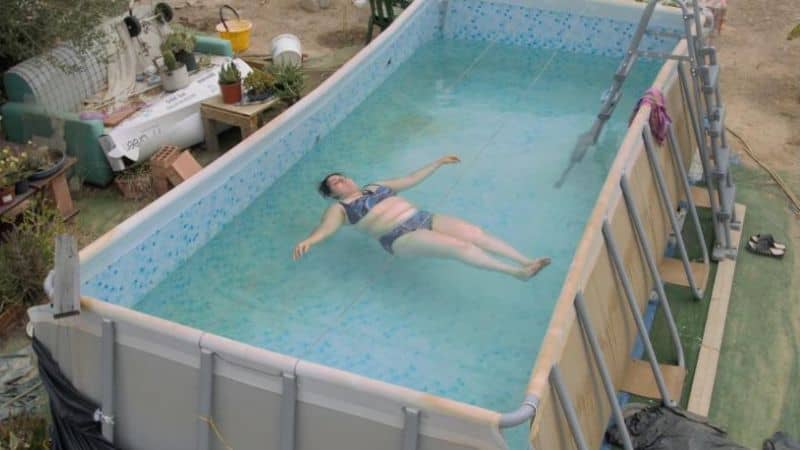
Valentina’s family is the typical vulnerable victim of #globalisation, which makes the film a rather unsurprising viewing experience – but thrills aside, it is surely a worthy vocation of arthouse documentaries to earn empathy for those who are overlooked, who have neither the status nor the glamorous presence for a more prominent role in our audiovisual field. The family portrait that emerges is a tender and touching one. The young woman’s father is a former driving instructor whose current health is too frail for him to drive, and yet he is too headstrong to let his daughter take on responsibility for his mobility; their driving lessons are mostly an exercise in condescension, with the occasional instructor tip thrown in. Valentina’s mother is a homemaker, and if she were to work again, her professional prospects wouldn’t go beyond taking care of elderly clients for little money and plenty of back aches. Valentina’s sister, whose brief family visit allows her to transpire as the personification of modest success, encourages her to focus more on her own needs than her parents’, and gently teases her about her low self-esteem.
We can already guess before it comes up in dialogues why it’s a tough proposition for the family to move despite the ominous neighbouring military base. The mother’s justifications—that they can’t afford to move, that this is their home and, thus, the NATO soldiers are the intruders – sound either like reenacted dialogues (following the filmmaker’s cue to let spectators clearly know where they stand) or the obsessive thoughts of powerless individuals who can, at best, make peace with their situation by ritualistically repeating their point of view. The entire family seems unable to move, but Valentina is young enough to start her life anew, and soon her presence in the house will only be recalled by the crochet flowers she adroitly and lovingly made.
Balancing the harsh notes
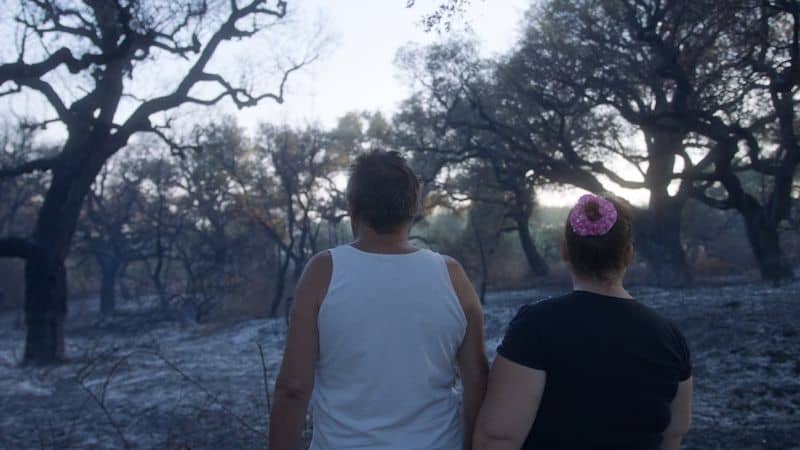
The tone of the film is mostly poetic, and perhaps the most consistent part of the documentary – Valentina’s slow goodbye to the way of life she knew, as it were. While some points are made perhaps overly explicit in the film – regarding MUOS or the parents’ demeaning reflexes –the immersive Sicilian natural reserve balances out the harsher notes. The oaks, the fauna, and the gentle light could, by themselves, maintain the illusion that nothing has to change – until it does.