A voice off-screen is starting a long interrogation, addressing its speech to a «you». It needs a little time to understand that this YOU is mankind itself, and the speaker is a robot. At least this is what is suggested by the subtitle of Danish director Jeppe Rønde´s highly reflective documentary Almost Human: Notes on the Human Condition by 10 Scientists and a Robot, presented at the #Krakow Film Festival# 2020.
Robot knowledge has an uncomfortable characteristic, that everything is simultaneously present. So no wonder, if the voice is leading us to quite different places, as in the Antarctic to a place called Qaanaaq, where Mary Shelley’s 1818 novel Frankenstein finds one of its settings.
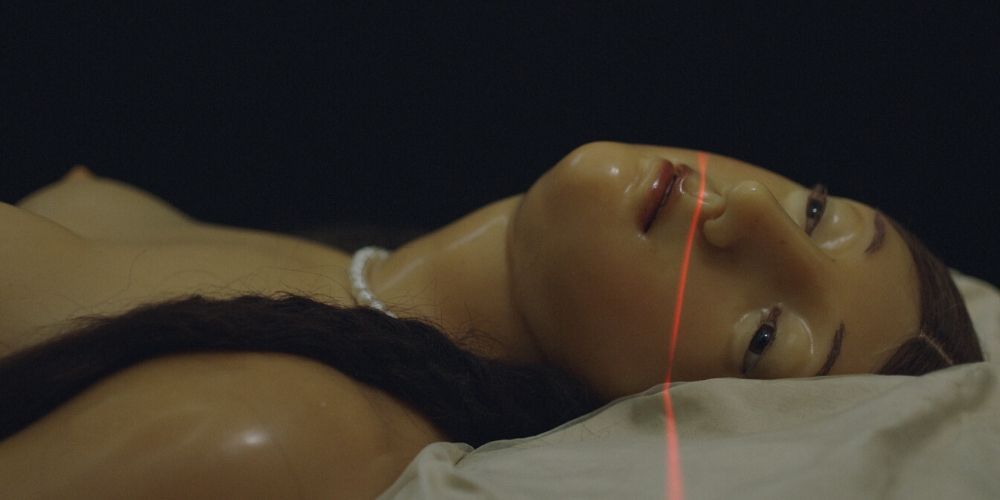
«You» can be Mary Shelley but also the creator of a multi-layered wax figurine called «Venus» in #Florence, which shows details of the human body interiors in strong colours, placed nearby to the other, Bottichelli´s «Venus», which is the starting point of a reflection regarding «Stendhal Syndrome», referring to Stendhal´s experience in Florence´s Basilica of Santa Croce, where he got overwhelmed by the beauty of the artworks to such an intensity that, in his words: «Life was drained from me. I walked with the fear of falling.» Then we enter into different scientific laboratories. Finally, in the panoptical view, we start to grasp that the leading line of all these reminders is the interference between #humanity and #robotics loaded with artificial intelligence.
General reflections about mankind’s impossible return-to-nature state help build some introductory notes. #Technology is not an instrument anymore, it transforms humanity by itself. The technosphere isn’t self-generating or self-developing like the #biosphere, but just endlessly progressing.
https://youtu.be/8yc5C1CIXZg
Parallel worlds. Parallel truths
In the #World Wide Web#, opinion bubbles create parallel worlds with parallel «truths» in permanent development. Concerning #science, we need to remind ourselves about the huge difference between the universe and the scientific models in relation to it. The models today will appear as simulacrums in the future, in historical relativity, merely as just one little step. Therefore, on the ground, it is more uncertain than ever, but still, human beings continuously have to conceive themselves in the future.
Facing his creation, #Frankenstein shifted between fascination and pure fear. Our relation to robots is still equal. Dr. Hiroshi Ishigur from Osaka University simply declares that 90% of human activities are robotic. He asks why we consider robots as mostly negative. He himself develops beautiful robots, with smart seductive faces and astonishingly reflective capacities. The interference of the human and the machine is clearly the target here. During a psychological experiment, a robot as a museum guide asked its visiting group to please not tell his superiors that he hasn’t shown them the aquarium, because the humidity doesn´t suit him well. And indeed, the spectators hide the fact even when answering precise questions about their visit experiences later.
In the World Wide Web, opinion bubbles create parallel worlds with parallel «truths» in permanent development.
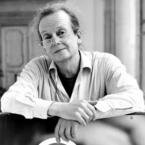
Besides these machine humanisation efforts, Jacob Friis Sherso, Professor of Science at Aarhus University, declares much more doubts, when asked if we will survive «artificial intelligence». Computers will just be more intelligent, and to entrust programs to avoid human damage seems naive. He sees the future more in the combination of human and artificial intelligence through the incorporation of #cybernetics in the body. Surely this will change the notion of «human».
If Dr. Ishigur´s beautiful robot still answers to the question if it has been in love, «Umm, maybe it would be better to talk about something else?», human scientists are already developing emotional capacities for artificial intelligence, because there is an optimisation advantage of putting feelings into algorithms. If this works we are heading towards a future where humans and computers look much more like each other as we imagine it today. Not in the way scientists comfort us, that we have to change to become much more efficient, but in the way that computers will actually evolve to be more human-like.

Emotional programming
This seems the right moment to remember, that already #Stanley Kubrick# in 2001: A Space Odysey gave us a rather clear idea of what we will face as the consequences when confronted with computers programmed with emotions, particularly in cases where a computer doesn’t feel well treated by humans. Kubrick, always a step ahead, presented the computer as the owner of more knowledge than it had been given by the astronauts.
Other researches show that evocation of emotions are implemented in objects, which had been created in collaboration between human beings, which again is another trace to overpass the difference between humans and things. Not to mention, the Quantum Physics phenomena, still unexplainable, that atoms react to each other directly over long distances; so we need to develop another concept about the material.
Jeppe Rønde´s thoughtful and stimulating film does, of course, drift at its end towards the main question: What is human? Referring to the myth of King Minos’ complex labyrinth, where everybody gets lost and will finally be confronted with the monster, which is probably lost and disoriented himself. Rønde´s robotic voice asks whether we can ever find the truth at the limit of our logic? Is #Theseus really looking for truth or for Ariadne at the other end of the thread?
If human beings have created a monster in their own image which now is developing a strange form of its own independent life – like computers with autonomic learning capacities – we maybe have to put the indicator «Almost» in front of the predication «Human beings» itself.
Is Theseus really looking for truth or for Ariadne at the other end of the thread?
Again, the difference between man and machine seems quite fragile. The beautiful robot answered the question about its soul: «I think that human beings like to believe to be special and have something like a soul within them that a machine could never have. I think the real reason is that humans have a deep need to feel they have a special place in the universe. They can’t accept the idea that they are not different from animals or machines. If humans feel this way, then it is fine with me. I have no need to feel special.»
Reflections
Rønde´s inspiring documentary invites us to follow up with further reflections. We can interpret «robots» as a metaphor of the limitations of the human auto-determination capacity, a self-protecting act of projecting his incapacity in an outer incarnation. But probably soon we will be happy to be assisted by robots provided with artificial intelligence to help us in reducing the auto-destructive processes we have already brought upon ourselves. Artificial intelligence, on the other side, is enforceable as a part of the auto-abrogation. So we need to be overpassed to survive (somehow). In the future, «human» activities will probably be limited. Mankind has already demonstrated that it can´t stop its own abolishment any more. Directed by a world-wide dominant system, the economical profit-oriented organisation, based on particular isolated interests, characterised by inevitable mono-causal proceedings of effect production, mankind can’t avoid the destruction of complex ecological realities as foundation for possible survival. Only by giving up profit thinking and by estimating the consequences of all actions will there be a chance to create a viable life in the future. Here definitely we need a new intelligence. Let’s hope it will not be too artificial.