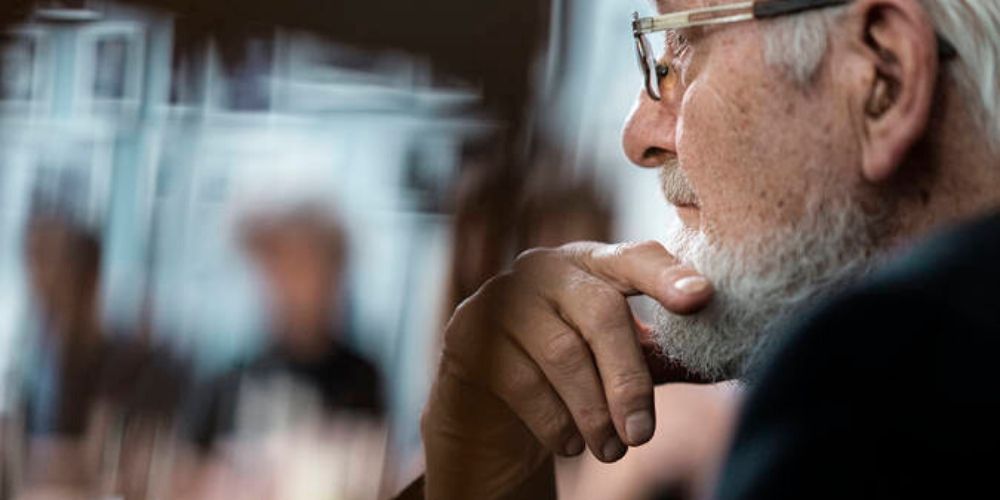
«Is there anyone you wouldn’t talk to?» a woman in the audience of a packed-out #Warsaw auditorium asks the lecturing priest, adding that there is much debate over whether one should attempt to communicate with #nationalists. Father Boniecki, 85 years of age and with popularity in liberal circles approaching the level of celebrity, responds that, in his religious role or simply as an old man, he’d say there’s never anybody one shouldn’t speak with; that a huge transformation of their thinking is unlikely to result, but the «seed of doubt» that might be sown makes it worthwhile to connect. It’s an answer that says much of his character, and the way in which he practices his station: with a gentle, infectious warmth, but also an acute sensitivity to human failings and despair that draws him toward the social margins and the existentially lost as those most in need of healing. A given for a priest, one might suppose. But Father Boniecki laments that in current-day #Poland many #Catholic leaders, or God’s «earthly staff» as he calls them, have forgotten that the foundation of #Christianity lies in such wide #compassion.

A portrait
Director Aleksandra Potoczek’s documentary portrait xABo: Father Boniecki, screening at #Krakow Film Festival#, does not delve far into the socio-political backdrop against which Father Boniecki goes about his role — namely the recent sweep to power of the #populist-right, #anti-migrant and #anti-LGBT Law and Justice party, which clings tightly to the Church. Controversy frequently flares up among #conservatives over his actions in the public sphere. Though not detailed in the film, he was placed under a media gag order for his refusal to condemn, despite the Church’s stance on #suicide, the self-immolation of anti-government protester #Piotr Szczesny#, who in 2017 set himself on fire in front of Warsaw’s Palace of Culture, and died of his injuries. While forbidden by his higher-ups to speak to the press, Father Boniecki is still permitted to write a column for one liberal Catholic weekly, «Tygodnik Powszechny» (the «xABo» of the title references the initials with which he signs his articles.) Instead of his thorny relationship with human institutions, the film is more interested in the priest’s inner struggle with God and his faith. In as much as he humbly, candidly reveals that to us, the documentary is a profound yet understated window onto the deepest quandaries of religion.
Father Boniecki tells a story about a woman who jumped to her death in front of a train in #Paris, leaving behind her baby and a list of all the places she had asked for help but been thwarted. He concludes: «God forbid that I’m ever on such a list. What if I already am?» The problem of despair, and the neglect of the suffering, bothers him deeply — not least, he says, because suicides are often far from mad, but rather feel the pain of being on Earth more sensitively and keenly than most. Everyone carries a proverbial suitcase full of things that were unfulfilled, or went wrong — and these tragedies are an inseparable part of the human condition. We see him consoling the mother of a suicide (yes, God will take him in, as is said in St Peter’s Gospel, he assures her) at one book-signing. He also lends an #LGBT community representative his heartfelt support. He doesn’t pray to or believe in a God who wants to catch anyone sinning, or who requires people to stop being human, he insists. The ideas are simple, and as old as time, on the one hand. But to hear them expressed with such authentic feeling, in an era in which the corrupt mechanics of political power and #capitalism have obscured the existential layer of thought in the public domain, is both a breath of fresh, revelatory air and a reminder that their surface simplicity belies the most complex mysteries of all.
In as much as he humbly, candidly reveals that to us, the documentary is a profound yet understated window onto the deepest quandaries of religion.
Compassion & conflict
«God is.» It’s a line from a character in famed Polish auteur Krzysztof Kieślowski’s 1988 Dekalog, a series inspired by the Ten Commandments that was not morally prescriptive but rather conveyed the terrifying, irreducible mystery at the core of being human, amid life’s unpredictable and seemingly random cataclysms. A bleak agnostic, Kieślowski is not the first person you might expect a priest to reference, but for Father Boniecki he sums up the idea that faith is very simple if one believes. But doubt, he implies, is never far off, implicit in every earth-shattering tragedy. We hear, almost in passing, and with no details, that his father was shot when he was ten, and it seems to hold a key into both his boundless compassion and his inner conflict. He doesn’t know why God doesn’t intervene when bad things happen to good people, he does not hesitate to say, but separate from false loyalty and hypocrisy, there is faith in spite of doubt. In conversation with a nun friend, he admits he suspects he may be missing an entire emotional sphere by eschewing romantic love and says while camping once he was overcome by a wave of loss for this so dramatic he wept. The deepest things do not come easily, we conclude. Nor can you soak them up complacently from state propaganda.