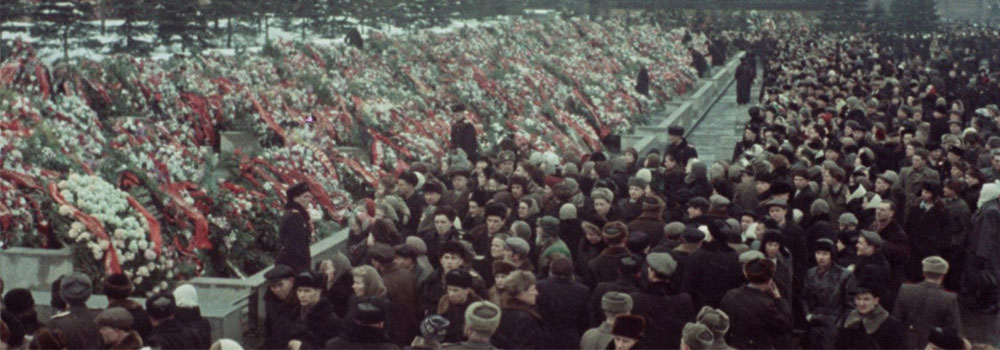
The film has no voice-over, no instructions whatsoever about how to read it. It offers spectacularly beautiful images of people in motion. They are people of all ages and races, professions and social ranks, huge masses of people, moving harmoniously, at the same pace, in the same direction. Like a calm flow. Quietly. No voice is heard apart from the sounds of shoes creaking as they touch the ground, monotonous tramping, making the silence even more tangible. These human bodies and faces have no name, apart from those who are invited to speak.
The director
Like everything in State Funeral by Sergei Loznitsa and composed out of the recordings made during the ceremonies that followed the death of Joseph Stalin in 1953, the selection of those who are presented with their names and who gets to speak, was made with a purpose. So we hear Stalin’s immediate successor Georgy Malenkov promise that nothing will change, and we hear the notoriously feared chief of intelligence, Lvrenty Beria, threatening the enemies. There is a nice twist though. At this public meeting at which, during the burial ceremonies, the successor of the dead dictator is being introduced, the person announcing the speakers is never identified by the name. Yet it is he, the master of this ceremony, who eventually succeeded the dictator, winning the power struggle triggered by his death, becoming the first secretary of the communist party after Stalin and introducing first democratic reforms. Who would not recognize the smiling face of the man who later gained world fame for banging the table with his shoe at a 1960 UN conference, Nikita Khrushchev?
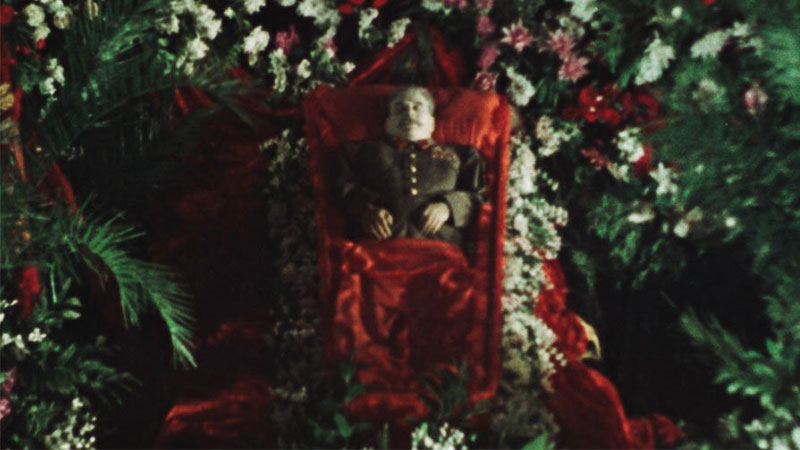
With the precision of a mathematician, Loznitsa reconstructs the funeral procedures. Starting with the arrival of the coffin and the identification of the dead body with the only two close-ups in the whole film – one of the face, and one of the hands of the dead man. «Moscow Calling», the radio announcement of the death broadcasted all over the vast country, followed by a thorough medical report. Foreign politicians arriving at the airport. A continuous flow of people passing by the open coffin. Representatives of the various groups expressing their grief through the microphone. We hear phrases such as «he is dead, but his ideas are immortal», or that gone is «the greatest genius in the history of humankind», or simply, «we shall hail Stalins’ name». But these phrases, too, don’t say much by themselves, they are parts of a larger puzzle.
The Machine
Watching documentaries, I often remember an anecdote about a TV director, who later became one of the best directors of live sports broadcasts. He was directing a live broadcast of the visit of a president of a European country. The president was expected to arrive in a convoy by the road and long before the scheduled arrival, all the cameras with the operators were in place and the director performed the last checkup. Everything seemed fine but the flags were too still and, without thinking, he ordered his colleagues, «Make the flags flutter!» This anecdote is about how one can’t control everything (not the wind). But it also shows how very controlled such recordings are. And this, I believe, is the point of the State Funeral.
Recordings made during the ceremonies that followed the death of Joseph Stalin. «The greatest genius in the history of humankind.»
Told in more cinematic terms, there is a series of gazes that organized what the audience sees in this film. There are the director, Loznitsa, and his editor Danielius Kokanauskis who did a magnificent work of selecting and organizing the archive material in fluid and dynamic way, guiding the attention of these viewers, making them see what they want to show. But before them, there was the gaze of the producers of this archive material, who organized the camera operators, selected their locations to obtain a perfect view without obstructing the smooth movement of people, gave instructions on what to take and what leave out of the frame. And then, there is the first gaze, the gaze of those who organized all these flows of people, who decided who had the privilege to participate, and told them where to be at what time, how to enter, how to exit the stage.
It is simply breathtaking just to think how powerful it must have been this machinery that managed to control such huge numbers of people during these whole five days.
This is also the subject of State Funeral: the invisible, but constantly present mechanism that controls people. More than the personality cult, I believe the Funeral is displaying the machinery: The power of the beast.
If we compare it to a similar filmic endeavor, the Triumph of the Will (1935) in which Leni Riefenstahl documented the Congress of the German Nazi party, one can clearly see this point: while the Triumph features well-organized movement of people indicating the superiority of its subject by simulating «natural» view even in case of the most extreme shots, in the Funeral images and sounds are often not synchronized. For example, neutral or even high angle shots are accompanied by sounds of people’s steps, which is completely «unnatural» (in the sense that one can never hear so precisely individual sounds from afar) and this creates a sinister atmosphere and further underlines the grip of the machinery on people.
The Monster
People featured in State Funeral are not common people of the Soviet Union, they were selected to represent common people of the Soviet Union in a historical moment. As they walk by the piles of magnificent wreaths on display after the funeral, accompanied by a lullaby singing to a kid who will wake up in the morning, the fairytales about sleeping kings come to mind. Only that this time, the hope that the sleeping king wakes up is replaced by the fear that the beast might wake up.
This is a clear political message. As the totalitarian regimes are blossoming all over the world today, the warning that the monster can wake up close to home comes just at the right moment.