Hypervigilance is usually described in clinical language as a body stuck on alert, unable to return to baseline. INTER:ACTIVE 2026, CPH:DOX’ interactive exhibition at Kunsthal Charlottenborg in Copenhagen (11–22 March 2026), treats it instead as an atmosphere engineered by politics, platforms, and market logics, then metabolised as «normal.» The exhibition title, «HYPERVIGILANCE,» does not promise comfort. It names the contemporary condition in which attention is permanently taxed and the work of staying oriented becomes a daily discipline.
Anxiety infrastructure
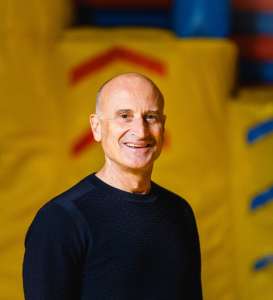
CPH:LAB Head of Study and programme curator, Mark Atkin, describes the theme to Modern Times Review as emerging from «the curatorial process… looking at lots of work… and then pulling threads,» one of which was «quite a high level of anxiety» running through otherwise dissimilar projects. His definition is blunt: «hypervigilance is that kind of state of high anxiety… where you think there is another threat coming, and you are constantly on the alert.» The argument becomes political when he insists on its uneven history. Hypervigilance, he notes, «used to be… the preserve of… migrant communities, LGBTQ plus communities… marginalised communities,» because those communities have long had to anticipate the next hostile gaze. He connects it to the exhaustion of «code switch[ing] just to get on in society,» where one «adjust[s] the way you are… to be able to pass for that moment.» The provocation in this exhibition is that the condition has now become a general social posture in crisis and permanent evaluation.
That diffusion is inseparable from the contemporary governance of attention. Information overload does not produce enlightenment. Instead, it leads to exhaustion and dependence on proxies such as feeds, rankings, and recommender systems. In other words, those applications whose logics remain largely illegible to the people living under them. INTER:ACTIVE refuses critique-at-a-distance and insists on the audience as sensorium rather than simple spectator. «So many of the works use embodied media,» Atkin notes, «storytelling that includes your whole body.» The point is immersion as felt experience rather than «content.» As Atkin puts it, embodied work means «you also remember it a bit in your body», leaving a «body memory» rather than only an idea that can be neatly paraphrased.
Courtyard tribunal
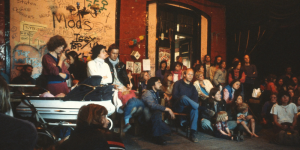
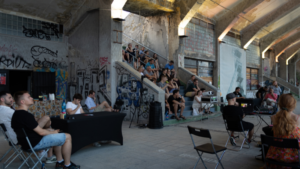
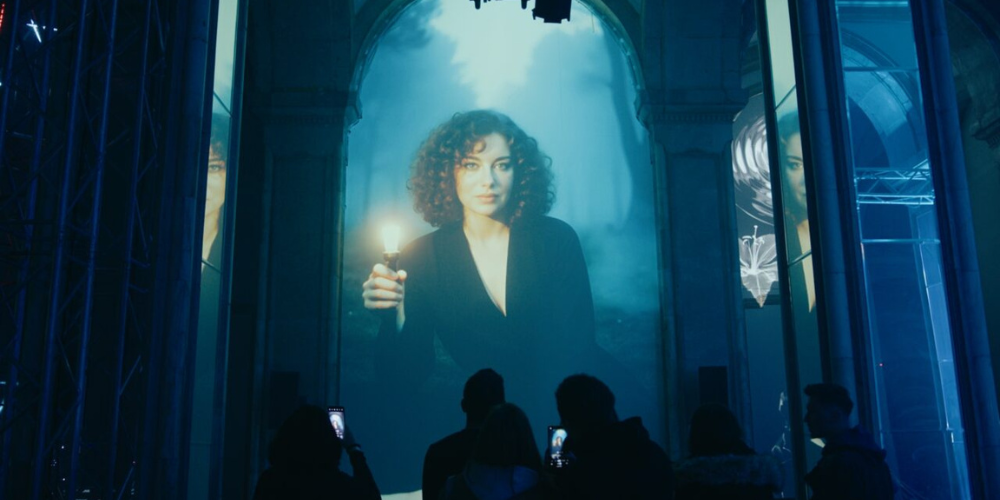
The exhibition’s first provocation arrives before the visitor has even entered the gallery. Daniela Nedovescu and Octavian Mot’s The Pledge is an interactive AI installation in the Kunsthal courtyard. It «invites you to… stand on a plinth,» Atkin explains, while «the AI will assess you… and it will get you wrong.» Crucially, the piece does not keep misrecognition private. Participants are asked to read the system’s verdict into the microphone, weaponising the banal cruelty of AI bias by dragging it into shared space. Hypervigilance here is a civic scenario. You witness both the machine’s judgement and its social afterlife: who laughs, who winces, who looks away.
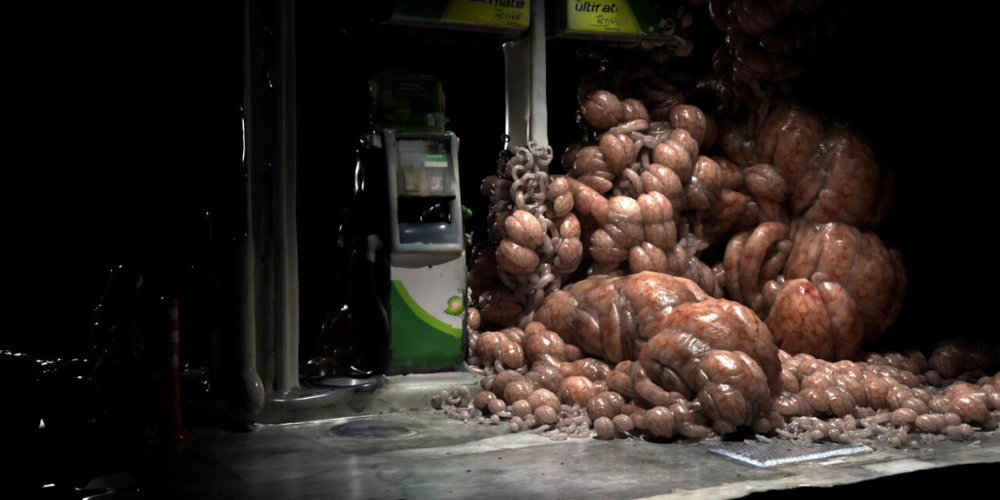
From that threshold, the programme develops multiple vocabularies for living inside threat. One strand is openly genre-based. As hypervigilance «is the nature of a horror film,» Atkin says, «I’m bringing the two [horror and documentary] together.» In a nonfiction ecosystem that often treats horror as too manipulative, INTER:ACTIVE treats it as epistemology. Coded Black, created by scholar Maisha Wester with Human Studio, mobilises the Black Gothic to expose how racism, stereotypes, and dehumanisation not only injure bodies but shape atmospheres, spaces, and expectations. In parallel, Brains in the State of Suspension (Kakia Konstantinaki) uses live cinema and speculative dread to confront the fantasy of disembodied intelligence and its appetite for domination. In the Current of Being (Cameron Kostopoulos), conversion therapy’s violence turns into a haptic encounter that refuses viewers the safety of distance.
«Hypervigilance is the nature of a horror film»
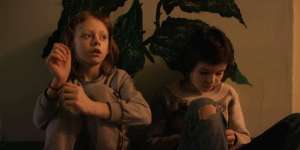
A second strand works through intimacy and agency, with Atkin refusing the easy promise that interactivity equals liberation; «a lot of immersive work does provide you with a degree of agency or even a simulation of that,» he says, naming the genre’s tendency to stage empowerment while control remains elsewhere. However, the programme insists that agency can be rehearsed as relation. Dark Rooms (Mads Damsbo and Laurits Flensted-Jensen) draws on intimate documentary testimony to move from disempowerment to sexual self-possession. No Place at Home (Sam Wolson and Lilli Carré) confronts the bureaucratic manufacture of exile via anti-trans legislation, while Inside: The Childhood of an Artist (Sacha Wares) returns to the sensorial world of Judith Scott, asking what «communication» means when the dominant culture has already decided whose expression counts as legitimate.
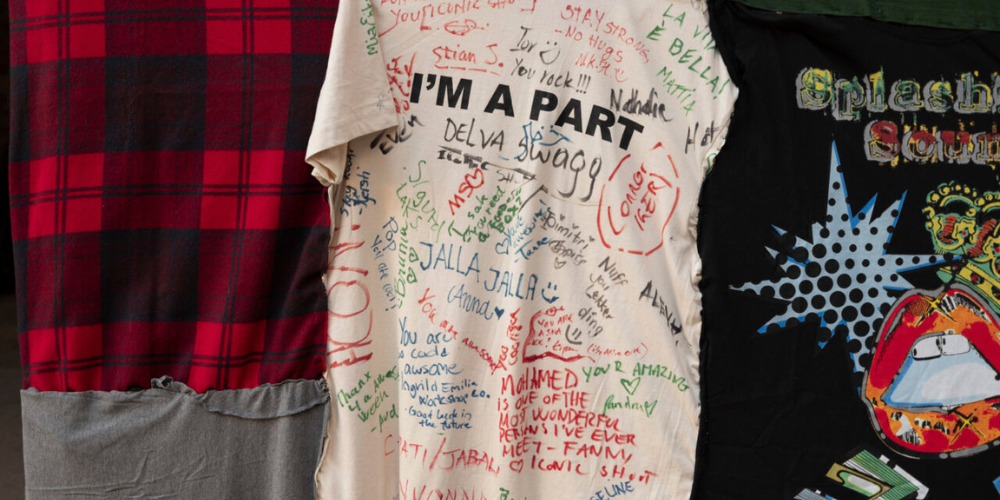
The programme’s most emotionally unforgiving work may also be its most formally delicate. In Mohamed Jabaly’s My Tent Is Not a Shelter, a fragile tent stitched from the artist’s own clothes becomes a memorial for Gaza and a symbol for people still living in tents over the rubble of destroyed homes. Atkin names the contemporary dilemma of image saturation: «We’ve seen so much imagery from Gaza that we probably really want to turn away and not have to endure it anymore.» The work counters that by cultivating «a lightness and tenderness». It is a refusal of the attention economy’s bargain, in which only images allowed to «matter» are those that can still shock.
Hypervigilance, however, is not confined to our planet alone. Cecilie Waagner Falkenstrøm’s Celestis Obscura aligns the Gold Rush with today’s space race, examining how corporate power in asteroid and lunar exploitation threatens to reproduce Earth’s inequalities across the solar system. For Atkin, it reads as «a call to arms,» because «we should be even more hypervigilant… and most people do not even realise the degree to which it is happening.» What was once regulated as a collective domain becomes a purchasable service, and the future itself is converted into private property. INTER:ACTIVE extends this planetary anxiety into other registers too: Tales of a Nomadic City probes the politics of urban transformation, while The Lost Golden Lotus (Chisato Minamimura) reframes Chinese foot-binding histories as an anatomy of modern body governance.
The afterlife of immersion
Atkin’s politics in the international new media ecosystem is also infrastructural. «The obvious barrier is distribution,» he says. Each project arrives with its own tech rider (headset model, tracking setup, GPU requirements), and venues end up improvising one-off solutions rather than building shared standards. Without interoperability, immersive work stays festival-bound, brilliant for ten days, then hard to place in the public world. He expects that to change as venues coordinate and «come up with shared standards,» but the claim implicitly challenges that. If immersive art is to move beyond the festival bubble, it must also move beyond the fantasy that the «new» in new media is the hardware itself. The deeper novelty is ethical: what kinds of publics can these works build, and what kinds of publics do they presume?
Atkin’s biography sits inside that very tension. As a director at Crossover Labs, the long-running curator of Electric Dreams (a festival dedicated to immersive storytelling), and a producer whose work crosses documentary and experimental cinema (including the feature Arcadia), he occupies the junction between what immersive work can mean and what it can become when it must travel and scale.
INTER:ACTIVE 2026 asks whether alertness can be transformed from a posture of fear into a practice of critique. Hypervigilance begins as a survival mechanism but can threaten to become a habit. This exhibition makes that habit tactile and audible, and implies that the opposite of hypervigilance is not peace but amnesia.
_
Featured Image: The Pledge, an interactive ai installation by Daniela Nedovescu