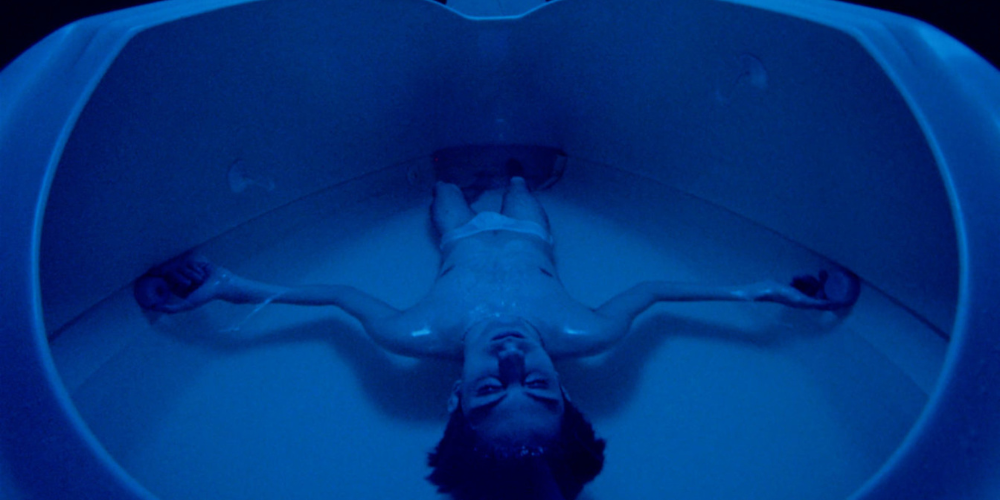
Cutting across already expressive and multithreaded transhumanist discourse accompanying popular culture since the last decades of the 20th century, Cyborg Generation unveils something that future historians will perhaps call the very beginnings of human realisation of a dream to move over the borders and limitations of our five senses. A personal history of Kai Landre takes us into the world of independent explorers, acting beyond already well-publicised multi-million-dollar #Silicon Valley# start-up culture; the world of people who, on their own account, augment their bodies with technology or other species’ organs to modify and widen their perception. They are called the world’s first official #cyborgs, as they live with additional senses that allow them to hear colours, feel the Earth’s earthquakes, or listen to the changes in atmospheric pressure, temperature, and humidity.

Excitement/anxiety
Neil Harbisson, the world’s first cyborg artist; Moon Ribas, the world’s first female cyborg; and Manel de Aguas, defining himself as «transspecies,» meet regularly to discuss their experiences and questions ranging from developing new senses to law regulations. There are various reasons for forming an intention to modify one’s body, some resulting from an inborn bodily incapability, but the film only briefly mentions a few. Cyborg Generation focuses instead entirely on Kai, a young Barcelona-born musician, and his road from a meeting with the cyborgs and forming an initial idea to develop his unique sensory mechanism to its final execution in the form of sensors, allowing him to hear the cosmic rays falling on Earth. The road is long and meandering through meetings, first with engineers and coders and later with medical doctors willing to operate outside the official system. It uncovers a grey area of underground medical practices made beyond the hospital walls and in the cellars of techies working on their next great discovery. All these efforts require determination and perseverance, coupled with conviction of one’s cognitive freedom and knowledge of the current state of law, which does not regulate medical practice in bodily enhancements.
The world reacts to Kai’s endeavour with excitement and anxiety. His friends ask many questions, his sister requests more elaborate explanations, and his parents are worried but also supportive. Kai is a victim of a long, serious school bullying in the name of «natural masculine treats»; of violent oppression enforcing a «proper» picture of a man that branded him the «other.» In becoming the cyborg, he sees an opportunity to, as he puts it, «elaborate on it [weirdness] or I back off, but then I will lose much of who I really am.» This reasoning brings to mind the seminal Donna Haraway’s A Cyborg Manifesto (1985), in which she observes: «These real-life cyborgs […] are actively rewriting the texts of their bodies and societies. Survival is at stake in this play of readings. […] Certain dualisms have been persistent in Western traditions; they have all been systemic to the logic and practices of domination of […] all constituted as others. […] High-tech culture challenges these dualisms in intriguing ways. It is unclear who makes and who is made concerning humans and machines. […] Cyborg writing is about the power to survive, not on the basis of original innocence, but on the basis of seizing the tools to mark the world that marked them as other.»
Cyborg Generation attempts to naturalise the intrinsically revolutionary nature of being a cyborg and inscribe it into our lived experience.
Not innocent
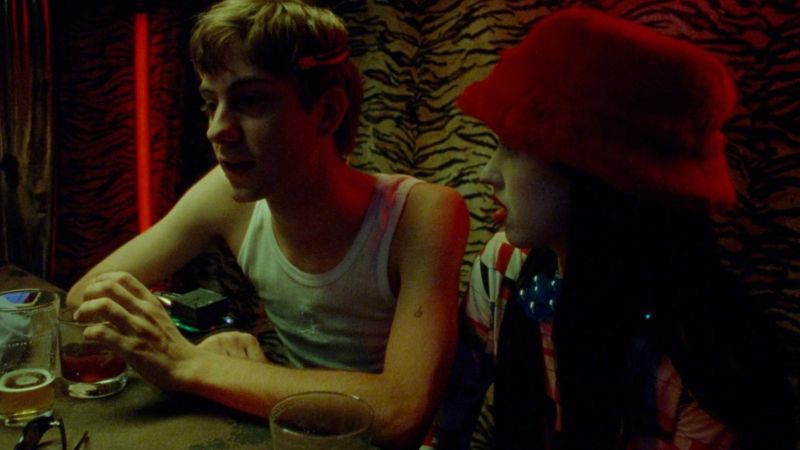
Kai, as the musician, composing music out of his technologically enhanced, exceptional sensory experiences, becomes part of a growing wave of robotic art, which requires a wide spectrum of competencies beyond traditional art and music in this case, including coding, programming, engineering, and physics. He works with electronic music producers, is invited to Princeton to talk about his experiences at the Cyborg Foundation conference, and performs on stage. Through the consequent observation of various social spaces Kai visits here and now, Cyborg Generation attempts to naturalise the intrinsically revolutionary nature of being a cyborg and inscribe it into our lived experience. The subversive elements of being the cyborg are, however, bursting in from different angles as, as convincingly described by Donna Haraway: «There is no drive in cyborgs to produce total theory, but there is an intimate experience of boundaries, their construction and deconstruction. There is a myth system waiting to become a political language to ground one way of looking at science and technology and challenging the informatics of domination in order to act potently.» Inasmuch as we can theorise various experiences, seeing them materialised here and now is stunning and unnerving in a way that does question the foundations of human being, as «The cyborg is a kind of disassembled and reassembled, postmodern collective and personal self. […] We are not dealing with a technological determinism but with a historical system depending upon structured relations among people. […] #Science and technology provide fresh sources of power.» In this struggle to materialise dreams, «Our bodies, ourselves; bodies are maps of power and identity. Cyborgs are no exception. A cyborg body is not innocent; it was not born in a garden; it does not seek unitary identity and generates antagonistic dualisms without end (or until the world ends); it takes irony for granted. […] The machine is us, our processes, an aspect of our embodiment.»
Systemic threats
It seems we live in times of materialisation of fantasies when XX-century cultural artefacts and ideals come back from the lived experiences of the new generations. Donna Haraway suggests that the question of being a cyborg is inherently connected with systemic threats of the Western world that have to be changed, and cyborgs are one of the ways of doing this: «It is not just that science and technology are possible means of great human satisfaction, as well as a matrix of complex dominations. Cyborg imagery can suggest a way out of the maze of dualisms in which we have explained our bodies and our tools to ourselves.» Cyborg Generation acutely captures these phenomena.