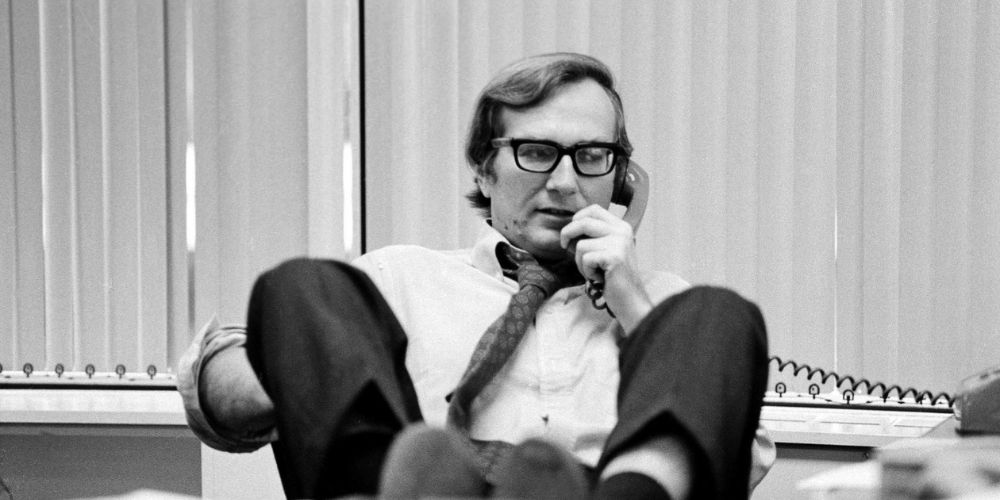
In the opening moments of Laura Poitras’s documentary Cover-Up, the director—herself a veteran of the surveillance wars and a founder of The Intercept—turns the camera on her subject with a question that has haunted the latter half of his career: «Tell me about your sources.» For #Seymour Hersh#, the man who dismantled the official lies of #My Lai#, #Abu Ghraib#, and the CIA’s domestic spying, the question is both a technical challenge and a moral interrogation. Hersh’s response is a characteristic shrug, an insouciant gesture that defines the distance between the «stenography» of the modern press and the adversarial tradition he embodies. In Poitras’s hands, Cover-Up is more than a biopic; it is an autopsy of the American «Deep State» and a study of the Socratic gadfly tasked with stinging it into wakefulness.
The Gadfly in the Room
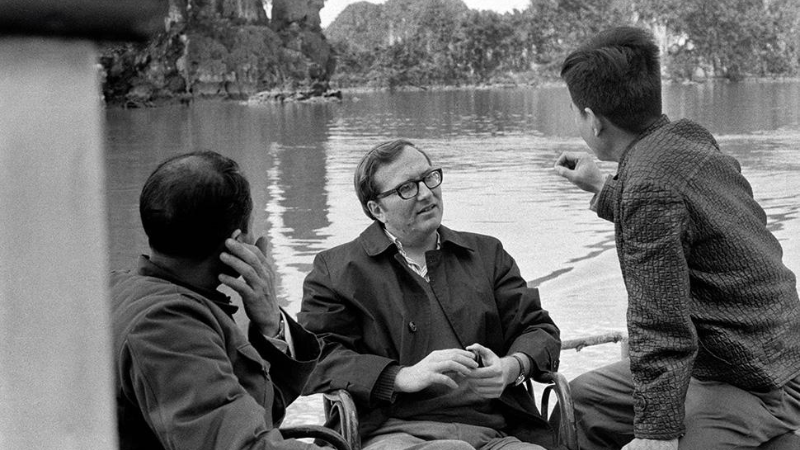
It was here that Hersh’s Socratic transformation began. In the dialogical sense, Hersh ceased to be a transcriber and became an interlocutor. He adopted the role of the gadfly described in Plato’s Apology—the stinging fly that keeps the «noble but sluggish steed» of the state from falling into a terminal moral sleep. By breaking away from the pool, Hersh didn’t just find a story in My Lai; he found a method. He realised that the relationship between a journalist and power should be, as H.L. Mencken once famously observed, like that between a dog and a lamppost.
Realpolitik and the 40 Committee
The film hits its stride when it pivots to the 1970s, an era of «secret foreign policy» administered by the infamous 40 Committee. Poitras utilises a chilling video snippet of the Nixon-Kissinger tapes to illustrate the contempt the era’s architects held for the democratic process. It is within the context of the 1973 coup in Chile that we hear the mission statement of the #Deep State#. Regarding the election of Salvador Allende, Henry Kissinger infamously proclaimed, «I don’t see why we need to stand by and watch a country go communist because of the irresponsibility of its own people. The issues are much too important for the Chilean voters to be left to decide for themselves.»
This proclamation is the soul of a realpolitik that has become the definitive modus operandi of modern American foreign policy. It suggests a world where the «important» interests of a superpower always supersede the self-determination of a sovereign people. (One can see how this doctrine is still functioning today in the aggressive destabilisation of the Venezuelan government and the subsequent kidnapping of its leader). Kissinger’s vision reveals a permanent administrative class that believes it has the right—and the duty—to manufacture history in the dark, far from the «irresponsibility» of the ballot box.
The Domestic Abyss
As Hersh moved from foreign massacres to domestic spying, the film mirrors the dire warnings of Senator Frank Church. In 1975, following the revelations of the Church Committee—which Hersh’s reporting for the New York Times had catalysed—Church appeared on Meet the Press to issue a prophecy. He warned that the technological capacity of the intelligence community had created an apparatus that, if ever turned against the American people, would lead us into an «abyss of horror» from which there would be «nowhere to hide.»
«If this government ever became a tyranny… the technological capacity that the intelligence community has given the government could enable it to impose total control, and there would be no way to fight back.» — Frank Church. Meet the Press, 1975
Poitras, whose work on the NSA in Citizenfour serves as a spiritual sequel to this warning, frames Hersh’s discovery of the CIA’s «Family Jewels» as the initial breach in the system. This was the moment the Socratic gadfly realised the «sluggish horse» wasn’t just sleeping; it was predatory. Hersh’s exposure of domestic surveillance served as proof that the Kissinger Doctrine—the notion that individuals are too «irresponsible» to determine their own fate—had finally come to an end.
The Empire and the «Turd Blossom»
The narrative arc of Cover-Up eventually leads to the most cynical evolution of the state: the era of «reality-making.» The film’s conclusion reminds the viewer of the transition from the secret government of the 1970s to the bold «Empire» of the 2000s. This era is best encapsulated by the anonymous senior advisor in Ron Suskind’s 2004 New York Times Magazine piece—widely believed to be Karl «Turd Blossom» Rove.
The advisor told Suskind, «We’re an empire now, and when we act, we create our own reality. And while you’re studying that reality—judiciously, as you will—we’ll act again, creating other new realities, which you can study too.» This system is the ultimate evolution of the Abyss. It is a state that no longer bothers to hide its actions but instead seeks to render the «reality-based community» obsolete. If the state creates reality, then the stenographer is merely a fiction writer, and the adversarial journalist is a heretic. Poitras shows us that Hersh’s late-career controversies are the scars of a man trying to fight a war against a simulated reality.
Institutional Apostasy: The Missing Chronicles
Poitras notably omits several of Hersh’s most controversial contemporary works from the film. While Cover-Up touches upon Abu Ghraib, it sidesteps his 2015 dismantling of the Obama administration’s narrative regarding the raid on Osama bin Laden in Abbottabad. By reporting that the Pakistani ISI had actually held bin Laden for years, Hersh wasn’t just attacking a «funny narrative»; he was attacking a foundational myth of the modern presidency.
The mainstream press committed an act of institutional apostasy here. They viewed Hersh’s scepticism as a religious betrayal, accusing him of «championing terrorism» merely for his refusal to conform to the media pack’s collective hysteria. Similarly, the film omits Hersh’s recent Substack posts, in which he applied his trademark scepticism to the events of October 7th. By questioning the internal failures of the #Netanyahu government, Hersh once again stood outside the Empire’s new reality. The closer the gadfly gets to the present, the more the «Turd Blossoms» seek to swat it out of existence.
The Trilogy of the Abyss: Snowden and Assange
To understand Cover-Up, one must view it as the spiritual anchor to Poitras’s previous chronicles of state defiance: Citizenfour (Edward Snowden) and Risk (Julian Assange). If those films were dispatches from the front lines of the digital surveillance war, Cover-Up is the ancestral history of that conflict.
By turning her lens on Hersh, Poitras is documenting the man who provided the proof of concept for the modern whistleblower. Yet, there is a poignant, unspoken irony regarding the exiles who followed. While Hersh continues to sting from the relative freedom of Substack, his successors have been effectively sidelined. #Julian Assange# has remained largely silent since his return to Australia—a ghost of the firebrand who once shook the cables of the State Department. Even more striking is the fate of #Edward Snowden#, who has largely disappeared from the public sphere since obtaining Russian citizenship. Absorbed by the draconian political climate of a Russia in wartime, his voice has been muffled by the same authoritarian shadows he once sought to flee. It serves as a stark reminder of the devastating consequences of rescinding freedom.
The Muckraker’s Memory
One of the film’s most moving segues explores Hersh’s Lithuanian roots. His parents’ escape from the Nazi massacres provides the moral bedrock for his career. This history suggests that Hersh’s adversarialism is a genetic imperative; he knows that when the state begins to «create its own reality,» the next step is often the creation of mass graves. His moral intention is never in question, even when his corroboration is.
«The dog and the lamppost: In an empire that creates reality, the only truth is found in the ‘unauthorised’ source.»
Conclusion: The Final Shrug
Laura Poitras concludes the film as she began it, questioning the old muckraker about his providers. In a time when the «Abyss of Horror» has transformed into a digital simulation focused on empire-building, Hersh’s dependence on unidentified sources and his dismissive attitude towards his critics assume a new significance. It is not a lack of rigour; it is the shrug of a Socratic ironist who knows that in a world governed by “History’s Actors,» the only truth to be found is in the unauthorised leak.
Seymour Hersh continues to play a pivotal role. He knows that no matter how many «new realities» the Empire creates, the plumbing of power will eventually fail. He’ll be there to bring the truth back to reality when it does.