Daya Cahen, the daughter of Holocaust-era Jewish parents, has a long and apparently successful CV enumerating documentary films and videos, shorts and other works, lecturing, exhibitions, nominations and awards. Her latest documentary enjoyed support from four foundations, including the Netherlands’ Stichting Niemijer Fund and Cultuurfonds. It is thus rather disappointing that such a thin, almost one-dimensional work results.

Thin web of a complex story
Cahen is director, producer, cinematographer and sound engineer – setting off alarm bells already. Eyes of the Machine spins a thin web from the story of middle-aged ethnically Uzbek school-teacher Kalbinur Sidik, who was forced to teach Chinese at a ‘re-education’ camp for Uyghurs after state-sponsored repression began around 2016.
The experience traumatised her and, when she had a chance to visit her daughter studying in the Netherlands, she did not return. Speaking out about the ‘genocide’ of the Uyghurs put her Uyghur husband on the radar of the authorities. As an Uzbek, Sidik could leave, but her husband was forced to divorce her and record a video condemning her before disappearing – presumably into the anonymous concrete camps high in the barren mountains of East Turkestan (as the Uyghurs call Xinjiang), a region where the independence movement goes back to 1947.
It seems that Cahen never even set foot in East Turkestan herself
Little context
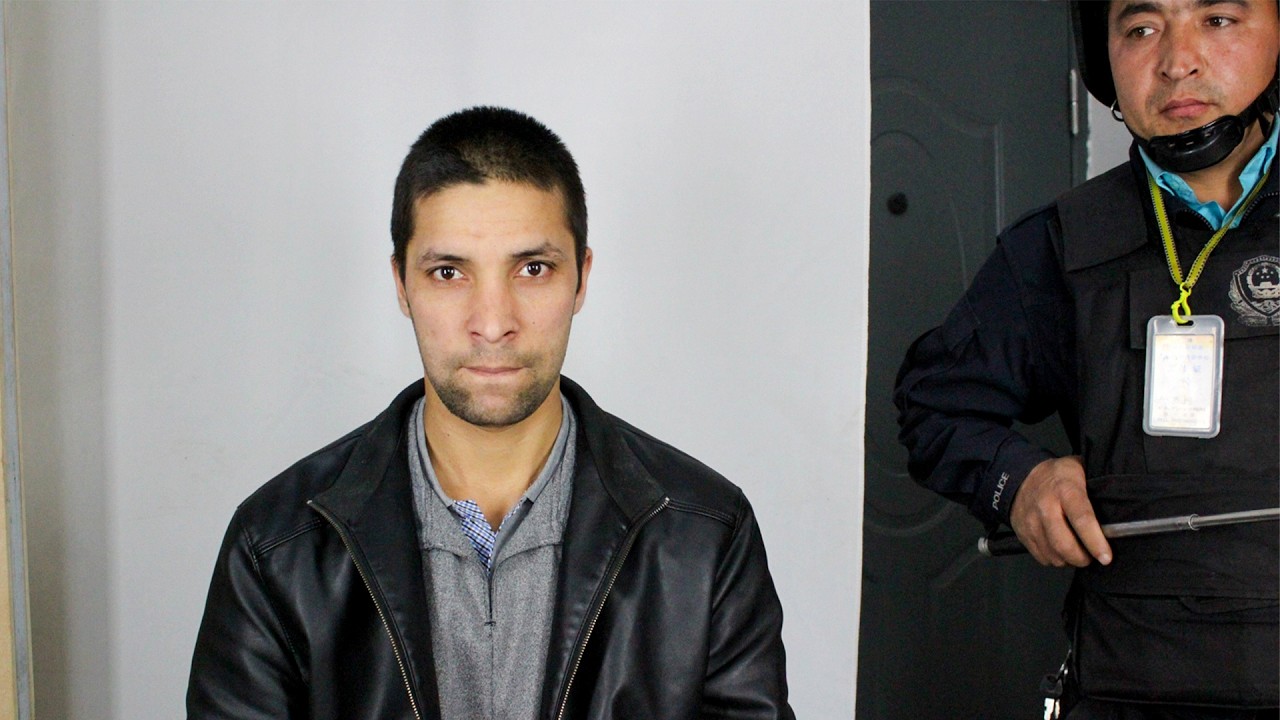
Precious little context is given as Cahen meanders into the story, releasing facts and background slowly as Sidik’s story unfolds from her neat apartment in the Netherlands. When context comes, it arrives in the form of «borrowed» footage from Chinese state propaganda reels and discreetly shot footage from inside Xinjiang. It seems that Cahen never even set foot in East Turkestan herself and simply used footage from available sources. Two on-screen shots in the credits appear to confirm this: one states that fair usage has been applied, or permission sought, but rightsholders should contact her where they feel usage was incorrect; the other thanks «the many visual creators and journalists who produced and gathered the material featured in this film. Without their work, it would not have been possible to make this film and to convey the message I believe is so important.»
This is simply lazy filmmaking. Find one character who can tell her story from the convenience of the Netherlands, and then take everything else from others who have actually done the hard work, taken the risk of filming on location? Mediocre filmmaking at best. The result is a strangely unemotive – and frankly boring film – that fails even to truly convey the horror of what is happening to the Uyghurs. Sidik talks of women having their heads shaved – but Cahen fails to show it. She talks of people being spied on and relationships ruined by periodic «family friend» visits where a Han Chinese national is sent to live with a Uyghur family – to eat, sleep, learn and work together. Sidik claims her husband’s boss at the construction factory where he worked was foisted upon them and insisted on sleeping with her. The filmmaker fails to elucidate precisely what that meant. (Sidik mentions that he snores, and that is about it.)
Vanilla repression
Other documentaries about the repression of the Uyghurs have included secret videos shot inside the prison camp system, and harrowing details about restrictive «tiger-chair» punishment cages, gang rapes and other cruelties. Cahen’s version of repression comes across as vanilla.
Other films have tackled this subject properly, not in the simplistic manner that Cahen takes. Look at François Reinhardt’s forensically detailed Franco-German China: The Uyghur Drama (2021). It contains – as I wrote at the time here at MTR – «an academic semester’s worth of material.»
That film, I noted, had a breadth and depth of detail that takes in the historical struggle for independence, from 1949 when Mao’s Red Army invaded, and East Turkistan’s leaders were lured into a trap that led to their deaths in a plane crash over Russia’s Lake Baikal, to armed resistance in the 1950s and a resurgence of violence in the 1980s and 1990s.
Reinhardt’s film was a disturbing crash course on a stain on humankind’s global conscience at a time when so many ordinary people are dreaming of a better world.
The repression of the Uyghurs is an important topic. It remains among the top global human rights issues. It deserves more attention to the depth and breadth of such films. Sadly, Cahen’s thin tissue of cut-and-paste does nothing to move the story forward and arguably does a disservice to the Uyghurs’ cause.