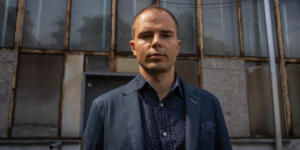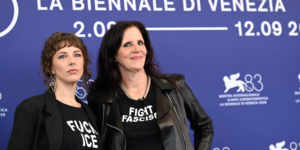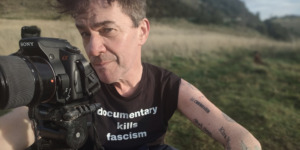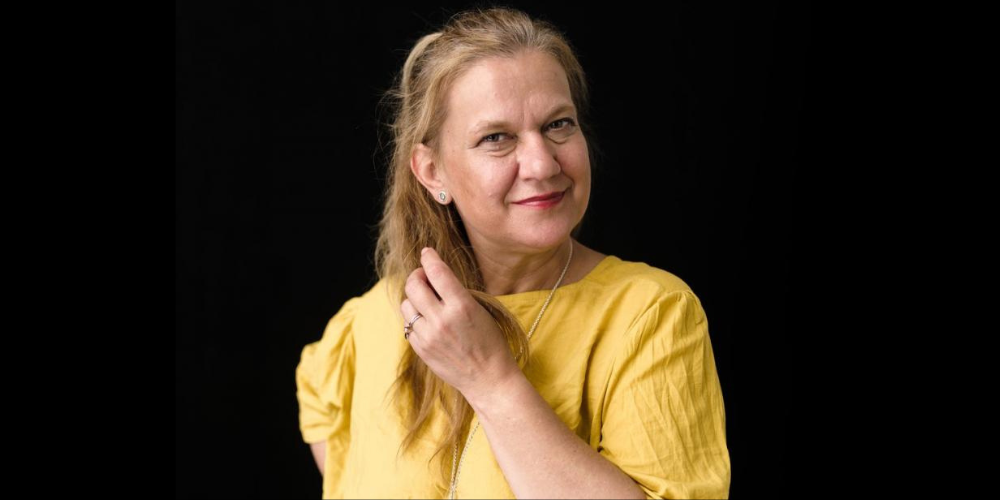
At this year’s goEast Film Festival in Wiesbaden, producer Ada Solomon is the subject of a major profile tribute. Best known internationally for her collaborations with Radu Jude, Solomon has also earned credits across more than 100 films spanning fiction, documentary, and international co-productions, making her one of the central architects of contemporary Romanian cinema. Her documentary credits include Arsenie. An Amazing Afterlife (Alexandru Solomon, 2023), The Exit of the Trains (Radu Jude, Adrian Cioflâncă, 2020), The Dead Nation (Radu Jude, 2017), The Distance Between Me and Me (Dana Bunescu, Mona Nicoară, 2018), and Cold Waves (Alexandru Solomon, 2007).
In this conversation with Modern Times Review, she reflects on retrospection, the documentary ethic inside fiction, the mythology of the «Romanian New Wave», the institutional failures that continue to shape Romanian film culture, the diversification of the current scene, the pressures of streaming-era standardisation, and her priorities as chair of the European Film Academy.
I’d prefer not to go through a career retrospective, as goEast is already doing that in its own way. Let me start there. When you have an honour like this, is there anything you learn about your own work from seeing it presented back to you in this way?
It is amazing. It is really very emotional. To watch films that are now, in this case, almost 20 years old and see that they stand the test of time is one of the biggest rewards. That people are still interested in the subject, that the film remains relevant to the audience, and that the form has not aged badly. It is touching.
It is also emotional because there were directors I had worked with once or twice who then went their own way, or I was there at the beginning. In general, people refer to me as Radu Jude’s producer because we indeed worked on 20 films together. There is no other director I have worked with on 20 films, not even my husband, with whom I probably did about 10 documentaries in different capacities. But with Radu, that number became so visible that sometimes it overshadows the fact that my name is on the credits of around 100 films.
At the same time, that collaboration is central because we started our careers together and built them almost like bricks in a wall, drawing strength from each other’s work and expanding in different directions. But for me, discovering talent was always essential. When you see those early films again, you remember the intuition you had, but also the mistakes that you can now see much better than you did at the moment of making or at the premiere. And because I was lucky to have the vast majority of our films premiering in the biggest events in the world, you do not always see the flaws at the beginning. With distance, you learn better.
I am also very grateful to all the filmmakers I had the opportunity to work with, and they are not only Romanian. I have been involved in the debuts of Italians, a Belgian-Romanian filmmaker, a Norwegian, and a Swedish-Romanian filmmaker. To see all this reflected is very moving.
How far into your work did the co-production, international co-production aspect come in? Or was it always there from the beginning?
It was always there, because the resources in Romania are limited. Even what people call the «Romanian New Wave» is famous for its minimalism, but that minimalist approach was also a consequence of the means at our disposal. Shooting with long takes, wide shots, and so on also allowed a much more productive shooting schedule. It was desire and necessity at the same time, or necessity turned into desire and then into an art form, a specific form of expression. That is what we do in films, and that is part of what made Romanian cinema distinct.
Interestingly, given those limitations on resources and the need for a certain amount of innovation in how you are presenting a fiction film, did documentary techniques ever play into how you were looking at fiction and constructing a fiction film?
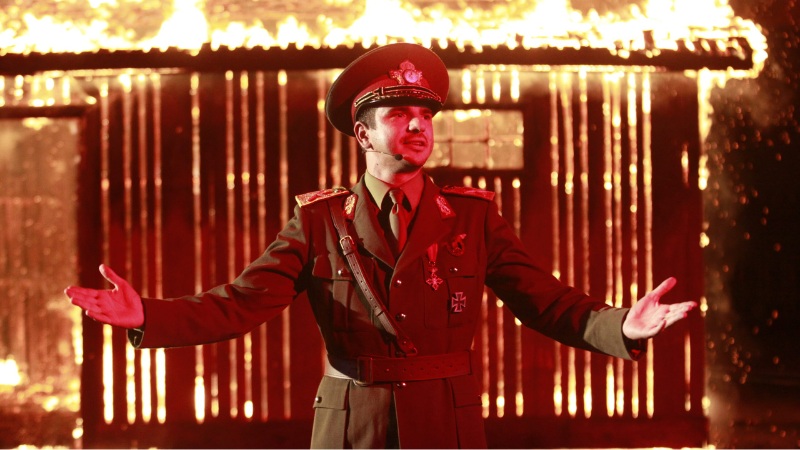
Absolutely. It is not only in Radu Jude’s films, but it is very present in Ivana Mladenović’s films, which stay on that border. Her latest, Sorella di Clausura, which premiered in Portugal at Doclisboa – a mainly docs festival, is also an almost hybrid work. But not only there. Even a film that moves toward magical realism still has touches of reality – I am thinking here of Sebastian Mihăilescu’s Mammalia.
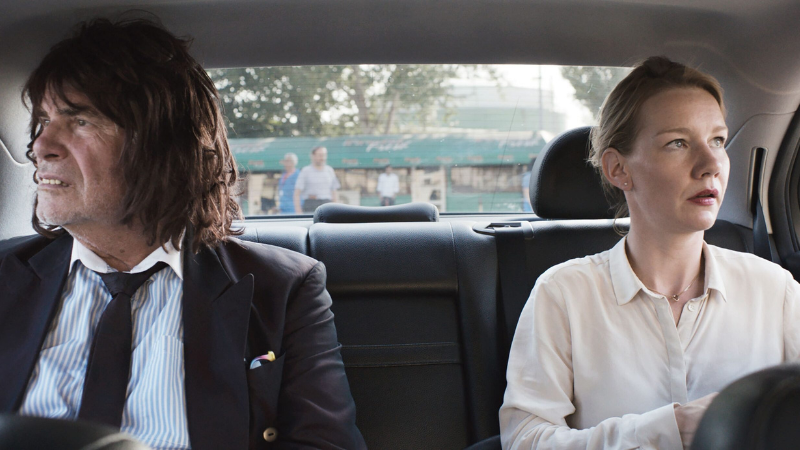
Everything is well documented. You do not want to know how much documentation we put together with Maren Ade for Toni Erdmann. She literally spent more than one year putting things together to understand Romania and to depict Romania in a way that is the foreigner’s eye, the look of the character, but at the same time to be an inside view, not the gaze of an outsider, not that exotic cliché representation.
That was very important for me. In Toni Erdmann, with Maren relying on my input, there are locations and spaces, there is a Bucharest you have not seen in Romanian films. Piața Unirii Park, for instance. You rarely see that in a film. We shot the whole Kukeri sequence there, the big puppet, the furry moment with the daughter in the park. They are in this natural space but surrounded by the noise and life of the city. Every single decision was carefully calculated, discussed, documented, and weighed. There is a great deal of documentary technique, documentary perspective, even documentary ethics.
One thing I noticed in the festival framing of your work is that it emphasises production risks, aesthetic choices, and social impact. Of those three, is there one that is still least understood about you?
I’m not sure how I am perceived from the outside, so it is hard to say. But I am happy to see that civic duty, I feel, is part of my work. I am doing this because I want to bring to the screen everyday problems, bigger issues, smaller issues, but things that are relevant for the world around us, whether they concern history or contemporary life, whether on a smaller or larger scale. In fact, I focus more on the smaller subjects because they help to better see the bigger picture.
Then there is also the exercise of form. I get bored very easily, and I do not want to become dusty and rusty. I saw producers who had beautiful careers and then stayed with the same model, continuing until, at some point, they seemed to be wandering around like aliens because they were no longer paying attention to how the world was changing. They were not participating in that change. They were trapped in their own universe, which was already shifting.
I am lucky because my elder son is a passionate cinephile and editor, and he brings these conversations permanently into the house. He moves between the most underground and the most commercial things. My husband teaches at the University of the Arts and is constantly connected through documentary and visual arts, as well as with students. And then, in microFILM, I now work with Diana Caravia and Carla Fotea, who belong to a completely different generation. I learn a lot from them. I also continue to work with emerging filmmakers, sometimes on short films before their debut features. I’m from Dracula country, I need fresh blood.
You mentioned the «Romanian New Wave», though I know that is not necessarily your preferred term.
At this point, I prefer to call it «Romanian New Cinema» rather than the «New Wave», because it was not a wave. It was not a planned movement by a group of people who had decided together to go there. It came out of necessity, and at the same time, this group evolved in similar but different ways.
Individuals took their own paths. Of course, some of them regrouped, some not really. Radu Jude worked as an assistant for Radu Muntean and Cristi Puiu. Corneliu Porumboiu remains very close to Cristian Mungiu, and Mungiu is now co-producing his new French film. There are these kinds of links, but nothing truly programmatic. It was not a movement in that sense.
«I am coming from the country of Dracula, I need fresh blood.»
Does the international film ecosystem still read it too much as a coherent movement, and in doing so, narrow its view of what Romanian cinema actually is now? «Romanian New Wave» is still the de facto term worldwide. And even if you add a few people from a newer generation here and there, it can still look like the same core group of filmmakers featured at A-list festivals almost by default. How do you see that as a limitation on what contemporary Romanian cinema actually is?
Well, this is my challenge. It is very hard when you come from a tiny country that was nowhere, and then, in less than a decade, you get three Golden Bears from 2013 to 2021. That is very rare. And almost every year, we have one or two titles in Cannes, now also minority co-productions. Now we are involved; before, we did not exist properly.
But everything built around Romanian cinema has nothing to do with the authorities. It is not the country that pushed us. It is the individuals again. And here I mean the filmmakers, of course, but also their partners, their friends, their colleagues from other places who embraced them.
Festivals and film critics played an essential role. I can never praise enough the journalists, the critics, the people from the academic world, the people doing coverage, and the festival selectors. The whole ecosystem of curatorial work, academic work, festivals, and film journalism. Without them, we probably would never have broken through.
And in Romania itself, one important milestone was the creation of the Transilvania International Film Festival. That became one of the first local hubs for international critics and curators to discover Romanian cinema from within the country, not only at big events abroad but in a much more contained, accessible context. Sarajevo was also important. Even though we did not originally belong to that region, we were embraced as part of that community. CineLink, the works-in-progress, the selectors, the visibility. That mattered.
Again, I want to point out that it was the people and not the authorities. That is the bitterness of it. In all these years, almost nobody understood properly what kind of benefit Romanian cinema was bringing to the image of the country. We were heavily criticised here for bringing in an image that was supposedly unfavourable to the country. But the fact that the important international press was writing about Romanian films did not register as something valuable.
When you mention the authorities’ lack of support, I want to ask about funding. Was there private funding?
No. In terms of funding, that is one thing. The options are limited. We have a cinema law. We used to have contests and support for production. Now we also have the cash rebate scheme, which helps. But there was never any strategic thinking about putting Romania on the map, doing public relations, marketing, and strategy. Where are we going? What do we want? How do we open up this success?
Everyone was on their own path, and that was heartbreaking, because it felt like we were in competition, like enemies with the authorities. And that is a matter of mindset. We offered our support to the film centre all the time, to go together to the higher authorities, to fight for our rights, for a law that wasn’t being passed, or for a modification or an incentive we could have. But there was always suspicion. And in the end, the changes were made under the pressure of the film community, not in conjunction with our institutions.
Now the scene is so diverse that it really cannot stay in one hand, but we are still at the same point. We do not have a strategy. We do not even have a medium-term plan. And we have a new law that the Alliance of Romanian Producers worked on through a large, collective brainstorming and writing process. It passed partially. But from December 2024 until now, one year, almost one and a half years, we have not had a contest. Not because there is no money. We have a relatively good budget for production. But we do not have the regulations in place.
That means we cannot plan. Everything is getting more expensive. Our partners cannot wait for us. We cannot promise anything to minority projects we want to join. It is very frustrating, because we are in a great moment, yet structurally we are blocked.
And at the same time, the scene itself has become much more diverse.
Exactly. If you think of the core of what people call the «Romanian New Wave», it is a masculine thing, except for producers like me, whom I also consider part of that moment. There were very few women there, and at another level. But if you look at the last 10 years and the successes of Romanian cinema, then you have Adina Pintilie, Anca Damian in animation, producers like Monica Lăzurean-Gorgan or Bianca Oana in documentary and experimental forms. You have many women producers.
You also have someone like Ivana Mladenović, who is very particular. From my perspective, and I dare to make this comparison, she is as original in her cinematic language in Romania as Radu Jude is, even though she is Serbian but identified as a Romanian filmmaker. Radu is also a particular voice. He draws on some of the forms of «Romanian New Cinema», but he is completely different from, say, Cristian Mungiu.
The same is true of Ivana. Sorella di Clausura is the most punk Romanian film we have made. It is an anti-melodrama, but it is also sweet, caring, and empathic in a way that is less common in men’s writing.
Then you have younger women like Alina Grigore and Andrea Bortun. And things are diversifying more generally. The cinema of Sebastian Mihăilescu is again very particular because it engages in experimentation in everything he does, from the topic to the form, and the references go into a much deeper intellectual world. It is not the direct cinema that you might associate with Porumboiu and Mungiu. It is a much more vivid and dynamic scene than the old label suggests.
And then there is Ioana Mischie, who has developed in many directions. She made documentaries; she has now premiered her first feature, and at the same time, she was selected for the VR competition at Cannes and Venice. The works are mesmerising and have never been shown in Romania. That is very frustrating.
I want to go back to the money question, because people across Europe are saying this is a particularly difficult time for culture. I have these talks a lot, and sometimes I think to myself that I have actually never heard anyone, anywhere say: «You know, finances are fine right now». I am aware that I come from the American system, where public cultural funding is hardly the same. A lot more passes through private funding. From your perspective, both in Romania and in a wider European context, has that private route begun to integrate into the workflow? What is the actual prevalence of that in Romania right now?
If we talk about equity, yes, companies or similar businesses fund some mainstream films, but that is also part of a system that allows such funding through public or state measures. It is not really equity in the deeper sense, not investment as such. There is investment in commercial films, and the revenues are huge, so that makes sense. But that is a different thing.
When we talk about cultural products, about what author-driven cinema represents, we are much closer to the world of the visual arts, to curatorial work, to investment in education through cinema. It is different from commercial entertainment cinema. With local resources, we cannot even touch mainstream arthouse. Maybe Mungiu is moving toward that direction, and his sense of the market is to be deeply appreciated, because he is very knowledgeable there. Otherwise, it is still not possible because we don’t have investors and no framework for someone to invest in our films.
I had a case where we were receiving some financing from Germany, and I realised at a certain point that, while in other European countries it is perfectly possible to have a financing contract, there is no framework in Romanian legislation for such a contract and for what you give in return. Not necessarily because the financier wants their money back, it can be another kind of investment. But we do not even have the legal framework for that.
And then you do not give shares in the film. Sponsorship through a company becomes something shady and complicated. It is very difficult.
More broadly, regarding what you said about never hearing people say the atmosphere is healthy: that is true because we only understand, after the moment has passed, that we were living in better times than we thought. We are now in an economic crisis, but also a social and identitarian crisis. We look back and say, «My God, how foolish we were. We were living in the best possible world, and we were still complaining.»
And at the European level, there is another danger. Culture may still be recognised on paper, but increasingly it is being treated not as a necessity but as a utility. That is frightening. The same thing happens with the standardisation that streamers (and not only) are pushing. That is the other line of private financing. Of course, you need it to survive, and of course, you want to reach a wider audience. But at the same time, forgive me, it can mean selling your soul to the devil. Because of this formatting and standardisation, we do not want to make mass products, soulless films.
«Of course, you need it to survive… but it can mean selling your soul to the devil.»
That is really the conversation right now, art versus content. How do you respect culture without commodifying it inside a capitalistic world? It is really a different understanding of what engaging with cinema is.
To tie this back to your current role as chair of the European Film Academy. Given everything we have been discussing, how do you want to implement your philosophy in this role?
It is a change in position, as I have already served on the Academy’s board and as deputy chairperson for the last 6 years. It is an ongoing process. But for me, one of the priorities was, and is, documentary, and the positioning of documentary as a complete cinema work, recognised as such.
That has already meant changes in the regulations. On the European platform, the nominated fiction features, documentaries, and animations compete together for Best Film. That is really important. And then for the Excellence Awards, the craft awards, documentaries are eligible in areas like image, editing, visual effects, sound, music. We are on a good track there. There is still more work to do, but I do see it as one of the achievements, together with the Academy’s board and team, part of a consistent effort to diversify what excellence in European cinema means.
The other thing that I want to start, and hopefully leave behind, is a heritage project. It is still in a very early stage, but we would like to create a European Film Academy Cinémathèque library, both with 35mm prints of our winners over time and with a digital library where rights could be acquired and access made possible, at least on request, both for members and more broadly as a way into the heritage of the Academy, the heritage of European cinema itself.
And then there is the question of how the European Film Academy is acknowledged outside Europe. We are already expanding this Season of European cinema, for instance, into Asia. But we need to expand toward North and South America as well. In South America, European cinema is highly valued and can be an inspiration. But there is an appetite in North America as well, and I do not think it would be particularly complicated to organise this season of European cinema in major cultural hubs across Canada and the United States.