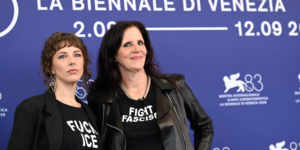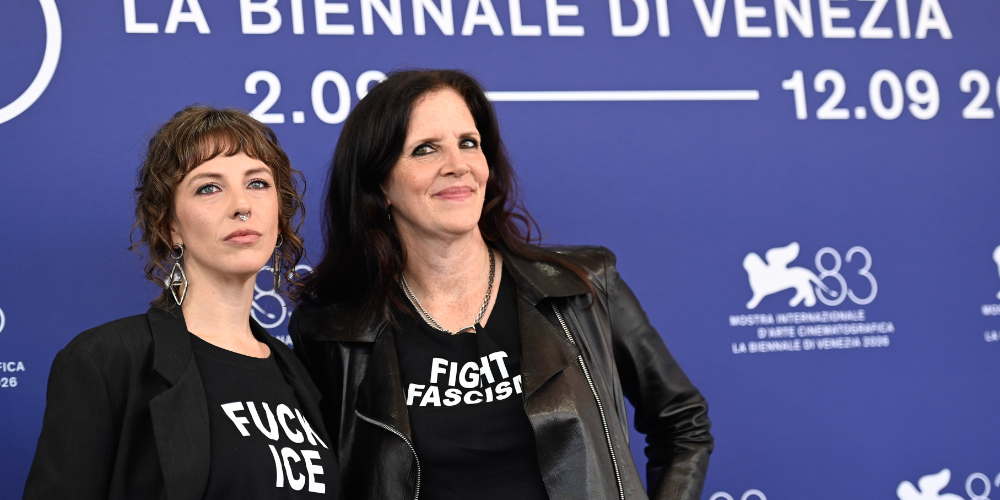
Claustrophobic dashcam footage of a car trailing a suspicious vehicle sets the stage for Laura Poitras and Rachel Lauren Mueller’s unsettling short film They’re Here, which world-premiered at the Venice Film Festival. Through this limiting point-of-view shot, the directorial duo submerge us in the menacing reality on the ground in Minneapolis and its neighbouring cities, where they painstakingly unravel how Minnesotans confront an invading paramilitary force deployed by their very own government.
It’s the winter of 2025–2026, and ICE is here. Operation Metro Surge was described as «the largest immigration enforcement operation ever carried out». One might also classify it as one of America’s most grotesque displays of state oppression in recent years, with approximately 2,000 heavily armed ICE agents deployed to arrest, detain and illegally abduct nearly 4,000 civilians. In official press reports, Donald Trump’s iteration of Immigration and Customs Enforcement speaks of «dangerous criminal illegal aliens» to be removed from the country, by any means necessary. They’re Here cannily presents us with the inverse: the goons of ICE are framed as the actual invading alien force, wearing balaclavas and masks, clad in heavy body armour, and armed to the teeth.
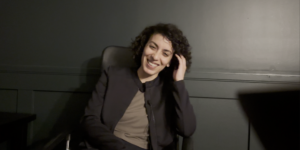
From Edward Snowden in Citizenfour (2014) and Nan Goldin in All the Beauty and the Bloodshed (2022) to Seymour Hersh in Cover-Up (2025), Laura Poitras’ acclaimed oeuvre charts the (in)famous activists who rattle the powers that be. For this short film, she teamed up with emerging documentary filmmaker and award-winning journalist Rachel Lauren Mueller to make a thriller-esque portrait of collectivised Minnesotans who rebel against the ICE occupation of their community. Their protagonist, Edén Villa, an ordinary citizen operating under a pseudonym to guard her identity from the US surveillance apparatus, is depicted as a David mid-battle against a Goliath with a budget of seventy billion dollars.
While modest in runtime, They’re Here is the culmination of Poitras’ sociopolitical and cinematic concerns and one of the best documentaries in this year’s Venice non-fiction section. Especially brilliant is the way Poitras and Mueller infuse crowdsourced footage, OSINT data visualisations, and on-the-ground material with the mise-en-scène of horror cinema. Spreadsheets tracking the number of arrested immigrants, satellite maps rendering the presence of military vehicles, and concealed body cameras are the hyper-digital elements out of which the filmmakers craft an uncanny atmosphere of oppression and rebellion. As in the duo’s earlier individual work, all of it brings invisible systems of exploitation and repression to light while exploring how aesthetics can amplify the urgency of the highly political stories they set out to tell.

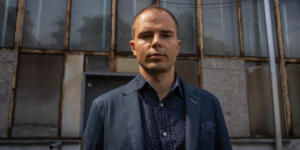
Hugo Emmerzael: In The Pervert’s Guide to Utopias, also playing in Venice, philosopher Slavoj Žižek argues that anyone opposed to state repression should be a radical pessimist. Your film illustrates how productive pessimism can be as an organising tool for rebellion against oppression. What was your state of mind while you were gathering open-source material from civilians on the ground?
Rachel Lauren Mueller: From the outset of the occupation, it was very clear to me that my role as a journalist, documentarian, and cinematographer was to go out onto the street and rapidly archive the actions of these people. That does not change the fact that working on this film was incredibly challenging. Luckily, I felt supported by Laura, as she has considerable experience in making films that challenge state power.
Laura Poitras: I mean, the budget of ICE is over seventy billion dollars, and a bunch of volunteers on their bicycles scare them out of town. Is that pessimism? Is that resistance? I’m not quite sure it is. It certainly is political resistance in action that led to meaningful change. ICE, nonetheless, persists. So I don’t quite know how to respond to this notion of pessimism. The danger in that feeling is that we simply sit back on our couches and withdraw.
As you witnessed ICE’s cruelty in Minnesota, did you learn more about these people, why they joined the agency, and how they are conditioned to wield their power so brutally?
Rachel Lauren Mueller: Learning about ICE agents was not the aim of our film, but I know the bonuses are substantial. The job also offers a narrative of otherness that is easy to latch on to if you feel unsatisfied with your own life. Exploring those questions was never our main goal.
Laura Poitras: Our goal was to approach this not just as a documentary, but as a horror film. ICE paramilitaries appear as monsters: masked, anonymous, armed to the teeth with machine guns, and extremely willing to execute people. These elements inform the language of this piece of genre cinema. While it’s a good question, other journalists and filmmakers are more capable of answering it. Our task was to convey the feeling of how a US city is occupied by a paramilitary force, abducting people in broad daylight with complete impunity.
It’s a horror film that deals with screens and data visualisation, including OSINT platforms, database spreadsheets, and other virtual interfaces. How did you build a visual grammar of dread out of these digital environments?
Rachel Lauren Mueller: Roughly half of our footage is crowdsourced, making it highly reflective of the movement that was happening on the ground. There were tens of thousands of people involved – all without strict organisation or hierarchy. Our task was finding the actual frame of the film. If so many devices are already capturing reality, what can our camera show that is cinematic, yet truthful, without resorting to the grotesque? For instance, it turned out that the dashcam footage at the start of the film was already extremely terrifying in itself.
Laura Poitras: Storytelling in cinema is often grounded in the individual, while we also wanted to communicate the vast scale of this moment. That’s where the data-visualised map made by data journalist Josh Begley came in. He composed it from data collected by plane watcher Nick Benson, who was at the airport every day to write down the tail numbers of planes and count how many people were brought on board. Such a map shows the sheer scale of ICE’s operations, which helps to convey the claustrophobia Edén feels on the ground as we cut back to her own battle. The horror-like cinematic language denormalises state violence that has become all too normalised.
This normalisation can be felt across the globe. Right now, Europe is anxiously watching Germany’s AfD gain ground in the election, mostly thanks to their extreme remigration plans. Do you see They’re Here as an instructional video that can teach the rest of the world how to resist an abuse of power like the ICE occupation?
Laura Poitras: I am interested in processes and blueprints. There’s much you can learn from being embedded in communities that come together like this, and that knowledge is useful and productive in its own right. So, indeed, we wanted it to be a useful film – and not just at the film festivals. We want this to be an antidote to passivity. Because, yes, we live in a time of real terror and authoritarianism. What’s happening in Germany and in the rest of the world is terrifying.
the budget of ICE is over seventy billion dollars, and a bunch of volunteers on their bicycles scare them out of town.
It raises questions about the importance of journalism and cinema in the face of such flagrant state repression. What power do you still see in the union of the journalist and the documentarian?
Rachel Lauren Mueller: I am proud to be working in a documentary register that isn’t mere news journalism, while still being rooted in journalistic practice. It entails not relying on hyperbole or exaggeration. So even though we use the framework of genre cinema, all you see very much stems from reality. The people in the film even told us that we were the first to truthfully capture what this crisis feels like.
Laura Poitras: We’re artists. Working with cinema demands different things from working as a journalist. So granular details and artistic considerations matter just as much as getting this urgent film out as quickly as possible. Cinema has to be relevant when it is released, and keep mattering into the future. Does it always happen? Probably not. Nonetheless, it remains our goal: to translate the material into universal ideas that will resonate further. In our case, that meant conveying this overwhelming sense of menace and terror.
Filmmakers covering stories of violent repression can themselves become targets of said violence. Do you take such dangers into account when you’re facing ICE with They’re Here?
Rachel Lauren Mueller: Luckily, I’m not so well known yet! I can still fly under the radar, although my reporting for The New York Times on a juvenile detention centre did upset a lot of politicians. But journalism is about interrogating systems of power, which I am proud to do. The consequences are an inevitable part of a job I take on willingly. They can even tell you that you’re doing it right.
Laura Poitras: Especially if the state is not happy with you.

Laura, many people have come to understand the world better through your work, as it makes abstract models of digital surveillance and control visible. How do you wrestle with your responsibility as an artist decoding architectures of oppression?
Laura Poitras: It is an incredible privilege to be able to go out there and make cinema that pulls at the fabric of our reality. It’s humbling to document extraordinarily courageous people like Nan Goldin, Edward Snowden, Julian Assange, and Sy Hersh. The Minnesotans of They’re Here are no exception. It’s critical to create a record, to capture that people did resist, and that they found their way of doing it.
It raises the existential question of where hope resides. Where do you take it from?
Laura Poitras: We’ve been talking to a lot of people at the festival, and we are wondering why we keep getting that question. My hope is that the film itself is the answer. As for myself, I genuinely believe in resistance as much as I believe in cinema. I especially believe in the power that arises when you put the two together. Meanwhile, I find strength in the fact that ordinary people, with just their cell phones, effectively stood up to this paramilitary force. Do you want to call that hope? I call it resistance.