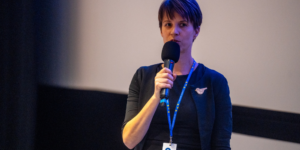

FIPADOC International Documentary Festival meets across 6 days each year in Biarritz, where industry and audiences convene over exceptional non-fiction work. With its 2020 edition occurring 21-26 January 2020, Modern Times Review spoke with the festival’s President, #Anne Georget#.
Can you explain the overall theme of FIPADOC 2020? Why is this theme relevant now?
I would speak of goal rather than theme…and that would be to showcase films with the greatest variety in narratives, formats (we have a shorts competition for the first time), screens of destination (and a new digital documentary experience competition). That being said, besides the classic international and national competition, we present a competition of musical films and we have a major emphasis on Impact, a competition of films dealing with human rights, the defense of the environment and social justice.
As it’s never too early to enjoy documentary, we also devised a selection for the 8+, citizens of tomorrow and their family.
For the first year, our Industry days comprise of two labs: Impact Lab to learn about Impact producing, which is poorly known in Southern Europe, and a Smart Lab to help bridge linear and non-linear production (VR, 360, etc.).
After Germany last year, Sweden is our guest country in 2020 with a selection of the best Swedish films from the last two years and a focus on the Swedish documentary professionals (producers, funds, festivals…).
What do you see as attributing to documentary’s stark increase in popularity?
I think the rhythm of documentary is close to the pace of real life. It bears the complexity of feelings and emotions, the silence, the depth of memories that make the fabric of our existence. By sharing the fate of neighbours, as well as those of faraway fellow humans, documentary brings a grid to both comfort and shake our sense of being. This is why the public is so eager to watch docs, it really makes you feel your own life, in connection to others.
What would you say is the future of the documentary genre? How does this affect the way film festivals will be curated?
It’s a bright future! Because documentaries offer a pause in the fury of facts and images, whether stemming from news or entertainment, which threatens to overwhelm us.
As a consequence, I think curating a festival bears a great responsibility. It can’t just be about good taste. If this is where people can recoup, grow and feel, as I believe they can while watching docs, then we have to make the right choices that offer the material to do so. It goes beyond the film we love, it’s a necessary but not a sufficient condition! I think openness and a certain degree of kindness in this very competitive world are required. It’s a fine line to draw in an immense pool of films, but so much worth the effort!
What was a seminal documentary for you? Was there one that you consider to be integral in your own relationship with the genre?
That’s a tough one! If really I have to pick one, I will cheat a bit and say Patricio Guzman’s trilogy about Chili – Nostalgia for the Light, The Pearl Button (I haven’t seen The Cordillera of Dreams yet). I think the films achieve this portrayal of what we, humans, share: although we come from two opposite end of the world, with very, very different realities and landscapes, our hearts beat at the same relevance of needs for love, awe, truth, nature… It is so hard to convey and so powerful when it is achieved!