When journalists, and with them the public interest, leave the battlefields, a completely different war begins for the survivors — a situation worse than the war itself.
At least, this is claimed by one of the voices captured by Palestinian filmmaker, producer, editor, and graphics designer Anas Zawahiri (*1987) in his work My Memory Is Full of Ghosts, which is currently being screened at the Portuguese Festival Internacional de Documentário de Melgaço (MDOC). Zawahiri situates his work in #Homs, Syria’s third-largest city, which has been the most heavily attacked militarily. Once a thriving centre for trade and cultural exchange, Homs was largely destroyed during a three-year siege by the Syrian #Baath regime from May 2011 to May 2014, after becoming the most important rebel stronghold during the Syrian civil war.
Individual fates
Zawahiri gives a voice to all those who didn’t fly but also to those who want to return. Without seeking spectacular scenarios, he films his protagonists resting, sitting, or standing in an almost meditative atmosphere, sometimes even from a distance. Their stories resonate all the more hauntingly in the background. Anas Zawahiri accentuates individual fates. There is a mother who only sees her children via cell phone, who are increasingly losing touch with their homeland. A blind man tries to protect his house from theft. A young man who returned to Homs in 2015 simply to see his parents again was forced into military service for six years. He lost his material existence, his health, and his girlfriend; more than that, he wished for his death in moments when a seriously injured comrade begged him not to leave him alone on the battlefield.
Those returning, as one voice reports, are trying to immunise themselves against recurring fears and traumas. Others living in Homs report breathing problems caused by psychological factors. What all of them have in common is that they love this city and its houses and alleys, and don’t know how continuing to live here is truly possible.
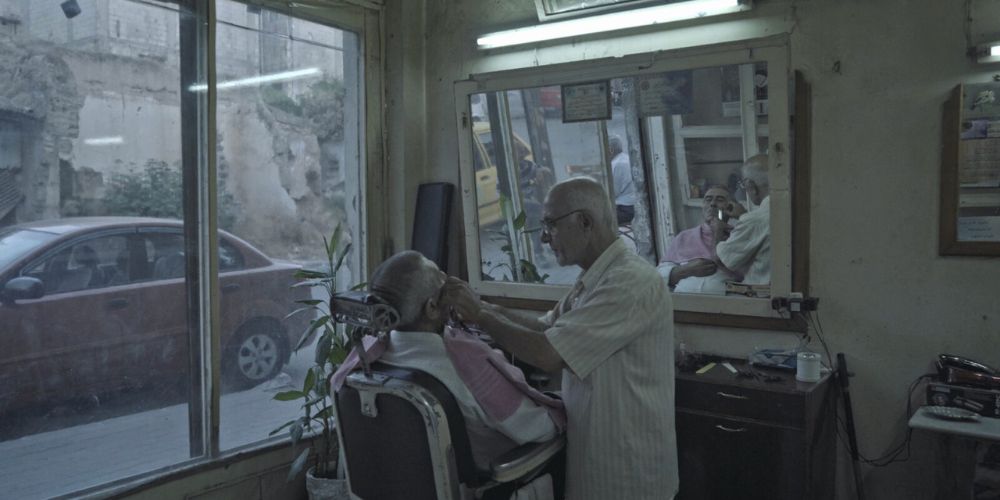
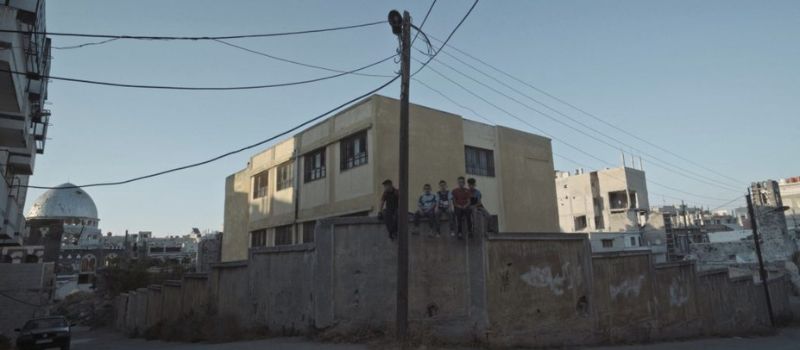
The camera (photography: Hamzeh Ballouk, Nawwar Alboukai) moves past countless ruined houses. Sometimes, only one side of the wall has been torn down. Life continues on the other side. The alleys are covered with rubble. Among the rubble, a few shops have reopened. In front of some cafes, mostly silent, few customers sit. Zawahiri creates a visual inventory of a borderline place. The camera penetrates living spaces, streets, shops, workshops, and drained canals, moving through the sparsely populated areas. He also allows space for chance. A man in a group sitting on the sidewalk squats suddenly and pronounces a song. Despite everything, the life force is inextinguishable.
Their stories resonate all the more hauntingly in the background.
Once, a place of laughter
Once, as we learn from a voice, Homs was a place of laughter that also provided a living space for the poor. Now, one senses a general agony, a profound hopelessness for the foreseeable future. Young people have lost not only their youth but also their future; for older people, survival has become far more difficult. Those left behind often only wanted to protect their possessions. Theft was commonplace. A young woman’s voice reports that her mother was killed in her apartment because she turned away people demanding money at her front door.
The majority of survivors feel dazed and disoriented. Having lost everything, they wander aimlessly or simply wait for time to pass. Others form new communities. Shared suffering creates intimacy. Communication and exchange become essential life support. Some are waiting for a chance to do something; others just want to leave. Even those who return only for a short time wonder what they can do for the city they love.
A young woman’s voice can draw strength from the beauty of the details of simple life, such as knowing that no friend was hurt that day, no bad news arrived, and that a peaceful sleep will be possible this time. This kind of happiness can perhaps only be experienced by those who have experienced trauma.
The final word is a woman’s voice, who laments that the Syrians will now scatter across the planet without being able to do anything for their homeland.
Award-winning
In his short film An Ordinary Day (2020), Zawahiri observed the details of Syrian social life and class differences based on individual stories. Here, too, he limited himself spatially to the radius of a taxi driver. In 2022, in Summer, City and a Camera, Zawahiri followed a group of young filmmakers who spontaneously documented daily and nighttime life in Damascus using the simplest of techniques. Already a multiple award-winner, his current work had its world premiere at the 55th Visions du Réel Festival in Switzerland.