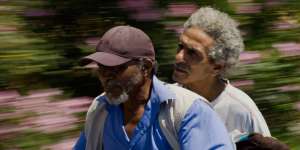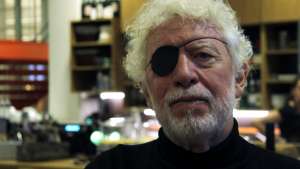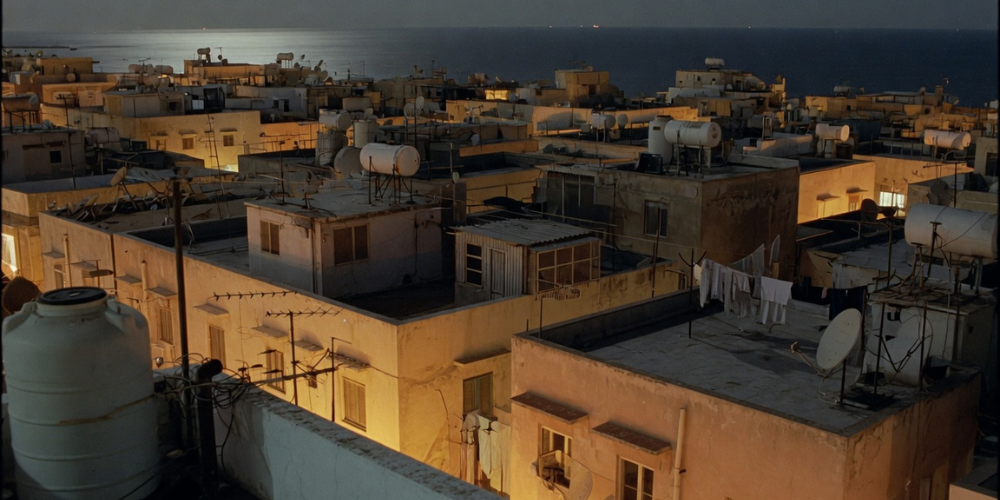
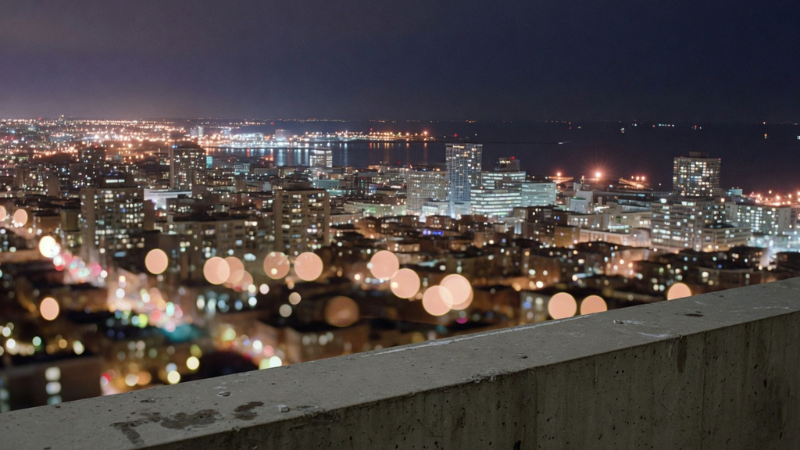
NAZA, Yuval Abraham and Rachel Szor’s film about how Israel’s military sets the civilian toll of its strikes in Gaza takes its title from intelligence shorthand. Naza abbreviates nezek agavi, Hebrew for collateral damage: the number of civilians a strike is expected to kill. Abraham sits with 24 soldiers and intelligence officers on Tel Aviv rooftops at night and asks how those numbers were reached. The film won a special jury prize at Venice in September, and The Guardian, which produced it, will stream it free in November.
Children’s bedrooms
A reply got there first. NAZA: The Real Story, also circulating as NAZA – The Full Story, runs 49 minutes, was crowdfunded through Jewcer, a Jewish crowdfunding platform, and went online weeks ahead of NAZA’s free stream. It keeps the title, the rooftops and the night. Its witnesses are IDF officers speaking in their own words, and in practice only their words are heard. NAZA has an interviewer, Abraham himself. The Real Story has a narrator, who is also its principal witness.
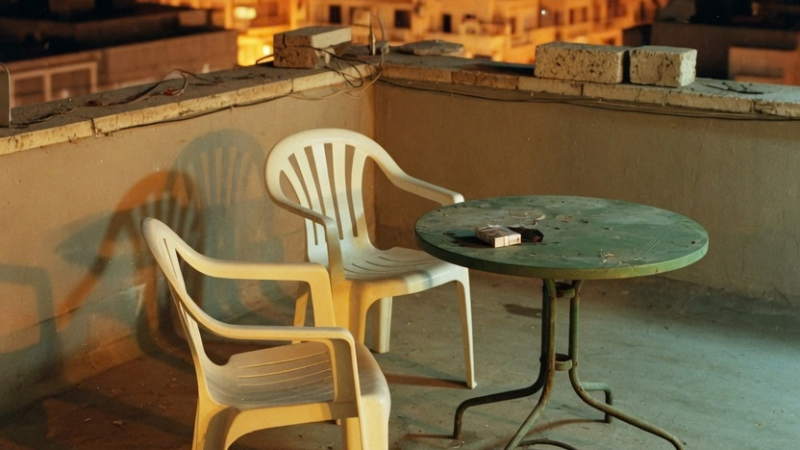
It opens on a man in black sitting in a white wooden kitchen chair on a balcony at night, his back to the camera, a baseball cap turned backward. On-screen text identifies him as Maj. Y (res.), a company commander in an infantry brigade who fought in Gaza from 7 October onward. He narrates the film, gives the largest share of its testimony, and is never asked a question. He begins with a warning about films made «in air-conditioned studios far from the front lines,» where reality is «easy to edit, easy to omit.» The truth, he says, lies in children’s bedrooms and «deep inside the pit at the Kirya,» the command center beneath military headquarters in Tel Aviv. The Real Story itself was edited by its directors, Hagay Gutman and Nik Kluev, who laid a soundtrack of cockpit radio under it. The strike we hear being called in ends with a shout of «Cease fire!»
Anyone who watches both will notice that only one of them asks its witnesses anything.
Teady Bear AK-47s
The pit is NAZA‘s territory. Its witnesses talk about the targeting process: who gets marked, how the expected civilian toll is set, how fast a strike is approved. The Real Story promises the pit and then climbs out to street level. «To understand what actually happens when troops enter a residential home in Gaza,» Maj. Y says, «you have to hear from the ones who kick those doors open.» He is one of them. He and the commanders who follow describe what they found once the doors were open. A film about what happens before a house is bombed is answered with an inventory of houses still standing.
Maj. Y lays out the rules with care, and the rules move as he talks. Striking near a mosque, school, or clinic, he explains, requires «rock solid proof» and sign-offs that can take days. In the same passage he tells us «with 100% certainty» that wherever there was a mosque, a school or a clinic, there was also a terror headquarters, so the vetting, on his account, confirms what he knew going in. He defines an active combat zone as one where more than 75 percent of civilians have left, and says that in such zones «our hands are much freer.» He does not say what freer hands meant for the people who stayed. Earlier, he admits that when a soldier asks why they cannot shoot a civilian walking around, «I don’t have a good answer for him,» because «anyone moving near our forces is a hostile.» Nobody asks what answer he gave in the end.
Near the end, another officer states the governing principle: «if there’s any doubt, then there is no doubt. And you don’t fire.» It is the film’s most quotable line, and it sits uneasily beside the narrator’s view that anyone moving is hostile. It also sits beside the reporting NAZA grew from. In April 2024, Abraham reported for +972 Magazine and Local Call that an AI system called Lavender had marked as many as 37,000 Palestinians as suspected militants, and that officers were cleared to adopt its lists while the army knew it erred in about 10 percent of cases. Ten percent of 37,000 is 3,700 names. One of his sources said officers spent about 20 seconds on a target, mostly to confirm it was a man. Even without knowing whether the machine was right, the reasoning went, statistically it was fine, «so you go for it.» The IDF disputes that account and says strike decisions are made by human personnel only.
The Real Story could have met that reporting on its own ground. Lavender goes unmentioned, as do algorithms of any kind. So does Where’s Daddy?, the companion programme that, by the same reporting, alerted officers when a marked man walked into his family home, so the house could be struck at night with the family inside. A film this preoccupied with what lies under children’s beds has nothing to say about a targeting system named for a child’s question. The doubt doctrine arrives in the voice of an officer whose stories concern screening posts and perimeter lines, the places where a soldier can see the person he is doubting.
The film’s most dependable witness is furniture, and Maj. Y does most of the presenting. In the first minute he describes an anti-tank mine under a child’s bed with a Smurfs rug beside it, and a crib next to a crate of 30 mortar shells. Fifteen minutes later he describes a children’s room with dolls, board games and a tunnel shaft, a sight he says he never expected to see in his lifetime. Moments after that, his voice runs over a phone clip of a baby’s cot «used for terror by ISIS. Hamas. ISIS,» and carries on with ISIS. Two more officers describe shafts under cribs before the film ends. That makes five appearances in 49 minutes, each without an address, a unit, or a date more exact than «right at the start of the war.»
The teddy bear gets a scene of its own. In a school, a soldier filming on his phone turns to a stuffed bear and announces that there is an AK-47 inside it. Then there is, and someone swears. It is the nearest the film comes to showing a discovery as it happens, and the order of events belongs to the soldier: the caption first, then the rifle.
«Approved for release»
When NAZA premiered, the IDF objected that its sources were anonymous and could not be verified, and that their testimony strayed into strategy «clearly beyond the knowledge of junior-level soldiers.» The Real Story‘s officers are all unnamed, and its chief witness is billed as Maj. Y. Its officers outrank junior soldiers, and their knowledge travels further. One, who begins with the medical supplies his unit sent into Gaza, goes on to report that he saw no hunger there, that aid entered in amounts «immense beyond measure,» that practically every house held a copy of Mein Kampf, and that Hamas has pursued one aim since its founding, in Gaza, the West Bank, Syria and Jordan. Earlier, a colleague describing aid convoys mentioned in passing that there was «zero fuel in Gaza,» no mobile service and, in most places, no power. Neither man is asked about the other’s account. Nor is either asked about August 2025, when the UN-backed IPC confirmed famine in Gaza Governorate, the first famine it has ever confirmed in the Middle East.
NAZA‘s witnesses spoke without the army’s permission, after dark, with their identities withheld. The Real Story offers documents «approved for release,» and its narrator sits in the same dark with his back to the camera, under a title whose word counts the civilians a strike is expected to kill. The idea surfaces in a single passage, when an officer explains that lawyers at every echelon assess collateral damage and that soldiers held fire to prevent it. The film closes on Gaza’s incitement: posters, graffiti, Mein Kampf, and a children’s coloring book showing IDF soldiers shooting innocent children, offered as evidence of what Gaza teaches its young. n June a UN commission of inquiry found that Israeli forces had deliberately targeted Palestinian children, who make up about 30 percent of Gaza’s dead; Israel rejects the finding. The film never says how many Palestinians have died. NAZA goes free on The Guardian’s site in November. Anyone who watches both will notice that only one of them asks its witnesses anything.