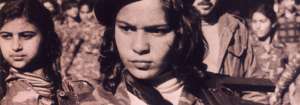
When the descendant of leading European rabbis questions how and why her Jewish religion and its Zionist tendencies have contributed to today’s violent state, the result in Planet Israel is shockingly powerful.
British-American filmmaker Gillian Mosely grew up in a family descended from generations of revered Talmudic scholars and rabbis. Judaism’s long history and traditions were woven into her early life: the Exodus, the sacrifices, the victories and defeats, and the belief—more an emotional and inherited understanding, as if baked into their bones—that the Jewish people had been victimised throughout history and remained victims.
The Second World War and the Holocaust, the six million Jewish victims, the camps, crematoria, and yellow Stars of David emblazoned on Jewish clothing under the brutal rule of the Nazis—all this was still quite recent.
But at the age of 11, Gillian rebelled. She started questioning this story, this sense of victimhood. She began to ask how and why one particular religious group could continually identify as victims across thousands of years, and whether this narrative—a mixture of fact and myth—played a role in both fostering a Jewish sense of exceptionalism and the hostility that is often directed at goyim, the Hebrew term for non-Jews.

«Promised land»
Pursuing her career as a filmmaker (Tinderbox is her critically acclaimed first documentary on the Israel-Palestine conflict), she also began to question claims that Judaism is not only a faith, but also a nationality. Israel, established in 1948 with UN backing amid global sympathy after the Holocaust, claimed to be the biblical «promised land»—a homeland for Jews from any nation, a protective space where they would no longer be victims, and where they could practise their faith without fear of prejudice or pogroms.
In Planet Israel, Mosely—whose idiosyncratic pronunciation of pogrom as «poe-groem» made me do a double take—seeks to understand how and why Israel, under the far-right government of Prime Minister Benjamin Netanyahu, National Security Minister Itamar Ben-Gvir, and Finance Minister Bezalel Smotrich, has become a deeply polarised and violent society. She claims that three-quarters of Jewish Israeli citizens support the war in Gaza, and that large majorities want to see every last Palestinian killed or (82% according to her figures) expelled from Gaza, the West Bank, and even among the 20% of Israeli citizens who are Arab (a view she attributes to 56% of Israeli Jews), citing Penn State University research from March 2025.
She says that only 10% of Israelis have taken a stand against ultra-nationalism, often at great personal risk.
The slaughter of 7 October 2023—when some 1,200 Israelis (and scores of foreign citizens) were killed after Hamas fighters broke through border fences—barely explains these figures. Israeli authorities describe the wholesale destruction of Gaza as a legitimate defensive response.
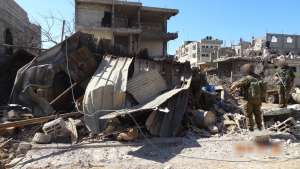
Today, Gaza looks like Warsaw after the Nazis had razed it in 1944.
Israel dismisses the internationally verified, UN-backed figures reporting hundreds of thousands of Palestinian deaths, the vast majority of them civilians, most of them women and children.
Israeli politicians from the top on down support the war, a «performative blend of cruelty and greed,» Mosely argues.
And she claims that much of the Israeli public agrees.
Mosely’s interviews with ordinary Jewish Israelis (including one man with a recognisably British accent) reveal what she portrays as seething hatred and moral indifference.
Some Israeli Jews, she shows, happily take day trips to viewing platforms overlooking the destruction of Gaza, just a mile away, to see for themselves. Imagine, Mosely asks, the international reaction if ordinary Germans had been filmed laughing and revelling within sight of the smokestacks of Belsen or any other extermination or concentration camp in the mid-1940s.

Uncensored
Opening with shocking, uncensored footage of the Hamas attack on 7 October, Planet Israel unfolds as an exploration of the history of the Israeli state, its foundation in 1948 (and the UN’s role in the development of international law and the creation of a Jewish homeland), and its ideological roots in Zionism, where a right-wing «Iron Wall» approach espoused by Ze’ev Jabotinsky prevailed over the softer, and—Mosely argues—more humane socialist Zionism associated with Chaim Weizmann, Israel’s first president.
She then examines how trauma—historical, inherited, and present—affects societies, and how it has been weaponised by Netanyahu’s right-wing government. She draws on psychologists, professors, peaceniks, and religious extremists.
This may sound dry, but it is anything but. Through AI animation, a subtle score, and small observational details (a restless dog, the sound of a lawnmower during interviews), Mosely brings both a personal vision and a cinematic sensibility to her documentary.
She does not ignore the Palestinians, nor seek to make them invisible, as international media tend to: look at the difference between reports of Jewish or Israeli deaths, where people are identified and humanised; reports of Palestinian deaths tend just to be numbers.
The closing sequence of interviews with ordinary Palestinians—refugees in the dust and rubble of Gaza, where 92% of homes have been destroyed, every university demolished, nearly all schools destroyed, and just 1.5% of agricultural land remains accessible and usable—moved this reviewer to tears.
Mosely concludes that Israel is suffering from a collective mental health crisis. Israeli government figures from the State Comptroller (February 2025) state that 38% of Israelis are suffering from anxiety, depression, and PTSD, while only 1% are receiving treatment.
Is it mental illness that leads to Israeli Defence Force soldiers deliberately targeting the vital organs of Palestinian children?
Or is it performative cruelty?
A UN report dated 23 June 2026, found evidence suggesting that «Israel continues to commit genocide and other atrocity crimes by deliberately targeting Palestinian children.»
That Mosely concludes that the descendants of the Holocaust victims have now become persecutors is of little surprise; 40 years ago, I learned about the classic «slot-rattle» whereby victims become abusers. It is a common human reaction to trauma.
The fact that the international community largely ignores—indeed facilitates—this genocidal slot-rattle by Israel and Israelis is perplexing.
In the pocket
That Israel has so many politicians and leaders around the world in its pocket goes some way to explain this: take, for example, the number of the UK’s governing Labour Party who are members of the pro-Zionist Labour Friends of Israel (including the recently jettisoned Prime Minister, Keir Starmer, a man who excused Israel’s cutting off of water to Gaza and hosted Israel’s President Isaac Herzog at No. 10 Downing Street), or who accept funding from pro-Israel lobby groups (Foreign Secretary Yvette Cooper, Finance Minister Rachel Reeves, etc.). The extent of this is astounding.
Some have even accepted free trips to Israel during the war on Gaza: Labour peer Luciana Berger and five MPs went on an all-expenses-paid trip to Israel, where they met Herzog in May 2025.
But why these ghouls take their 30 shekels of silver is not so clear.
Mosely does not get into this, but she does conclude with the words of a 15-year-old Palestinian boy, Muneer Shadi from Bei Lahia:
«I used to play with my friends, but most of them are dead….
We’re dying, and no one wants to look at us.»
Planet Israel is currently on general release in UK cinemas.