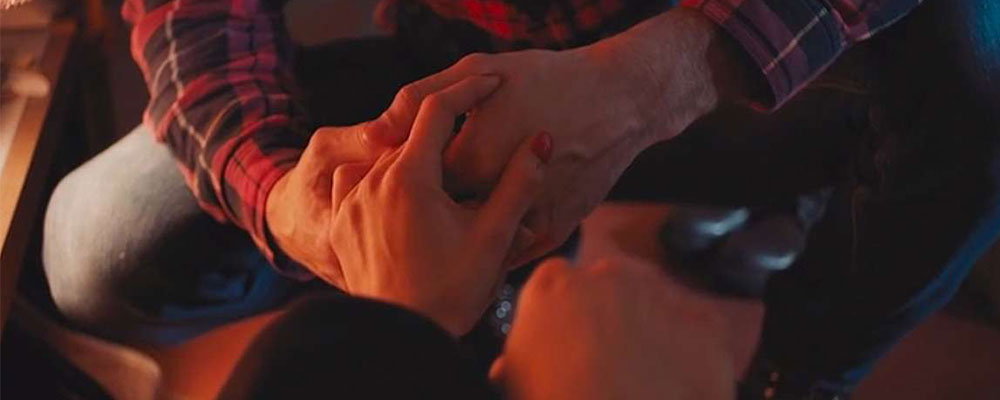
«Gaslighting»: it’s a word that has become commonplace in the media amid the rise of U.S. president Donald Trump, and a leadership style detractors deem geared toward disorienting the public through outright lies. The term comes from the 1938 stage play Gaslight (also adapted for cinema), in which a husband tries to push his wife over the brink of insanity with mind games, dimming the lights in their home and insisting she imagines it all. It denotes an insidious form of psychological manipulation by which targets are tricked into doubting their own perceptions, creating a state of confusion abusers take advantage of to assert the dominance of their own warped version of reality. The word may be losing its sting due to overuse in our fake news era, but documentary #In My Skin# shows just how devastating the weapon of gaslighting can be when used to chip away at a victim’s sense of self in cases of domestic abuse.
Intrinsic to abuse
The film, by German director #Anna-Sophia Richard#, traces the thought evolution of three women over the course of their relationships with abusive partners. We traverse the different stages (initial hope or idealisation; escalating control, fear and devaluation; final resolve, and reassertion of independence) from their perspectives. Understanding is thus conveyed of why many people do not immediately leave violent situations, how brainwashing is intrinsic to abuse, and why victims should not be blamed for staying so long.
Voice-over narrators recount the stories of the three women, all of whom live in Germany yet come from very different walks of life. They text is taken from real-life interviews, with the women choosing to stay anonymous. Actors in shadowy, stylised scenes recreate a sense of their memories impressionistically. The narratives are intercut. As we cross back and forth between them, they merge somewhat, giving a sense that these stories are individual and specific, yet horrifyingly similar in their modes of control — instances of abuse of power that is predictably set in its pathology, and as old as time.
As old as time
One of the women is a teacher, whose psychologist partner seems to be a «calm anchor» — until his demands that she «work on» her behaviour to optimise his happiness leave her walking on eggshells. Something as minor as not caressing him when passing through the house can prompt a meltdown. By the time she books a flight to leave, terrified he will somehow get into her email account and discover her plan, her self-blame is such that she chastises herself on her secrecy, even while frightened for her life («It’s the opposite of mature behaviour, but I don’t know if I’ll make it out alive if I tell him,» she says).
The abusers’ wildly fluctuating behaviour, from loving idealisation to threats and back again, creates irreconcilable confusion
The second is a woman from Cameroon who has come to Germany as the partner of an engineer. He discourages her moves to train as a nurse, limiting her personal allowance to fifty euros per month and undermining her confidence in her abilities with put-downs. With no support system in Germany, she has few options for alternative lodging as his violence worsens, and though she finally confides in her parents, they regard it as unthinkable she should leave. The realisation that her life is in danger gives her the courage to seek out a women’s refuge, in spite of her family’s claim it would bring disgrace upon them.
The girlfriend of a jealous, possessive DJ is the third woman. His bouts of suspicion, accusations of flirting and failed attempts to have her under supervision and contactable at all times occasion volatile and intimidating outbursts. Hiding her bruises, she commits to helping him overcome the «aggressive demons» from his childhood (familial histories of violence come up in all three cases, suggesting a cycle that easily catches hold and is difficult to break). She determines to protect him from criticism — until she recognises the toll it is taking on her confidence and the destructive nature of their co-dependence.
But, there is hope…
In all three cases, the severity of the violence escalates, despite the men’s promises to stop or get help. These toxic relationships are all perpetuated by guilt being instilled in the women; the belief that if only they could do more to fulfill their partner’s needs, the ideal romance they glimpsed or imagined at the beginning of the courtship could flourish. Instead, they suffer a sense of shame, convinced they are not loved, or loveable. It’s typical gaslighting when one of the men says he wants to give his girlfriend «one more chance, even though she hurt him so badly» (despite him being the one to have hit her). Another of the women excuses her boyfriend’s violence, with the phrase that «he hasn’t had it easy, and he wants to change». The abusers’ wildly fluctuating behaviour, from loving idealisation to threats and back again, creates irreconcilable confusion, and such questions as: «How could I be so wrong about him? How can the person who says he loves me above all treat me like this?» But hope abounds, in that all three women get out. Despite the trauma of intrusive memories and nagging fears that persist, their courage means that the truth and love for their authentic selves are able to have the last word.