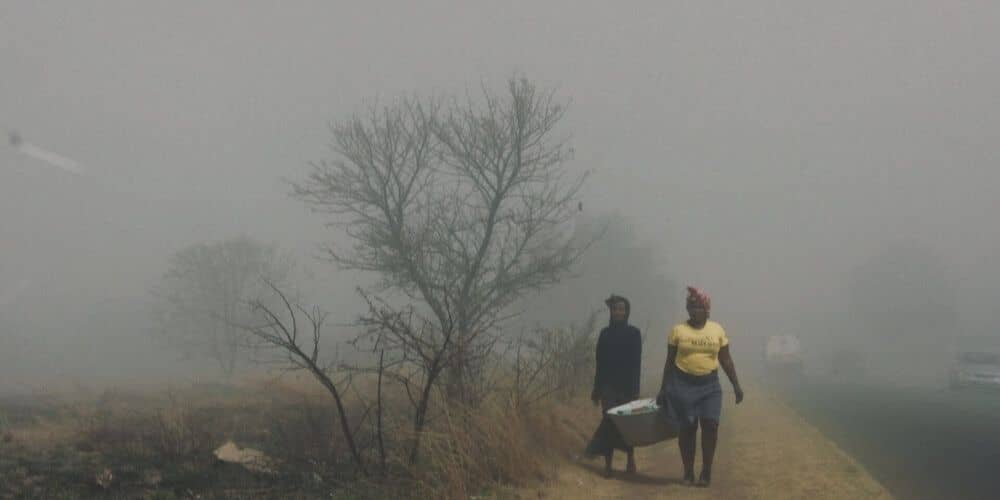
In Tudor Shaft, a community just outside #Johannesburg, the children vomit a lot. They live with their families in makeshift houses without concrete floors — and the earth they live and play on is radioactive. A mining waste dump stands right beside them, and when the wind blows its uranium-heavy dust, once dismissed as harmless «nuisance dust,» coats the settlement. The evidence and anecdotes of health problems are numerous, but the former mine owners have been reluctant to acknowledge a link to a century of mining practices without formal scientific proof from local studies, despite radioactivity levels being fifteen times over the regulatory limit. The dump is just one of 380 radioactive mine residue areas around Johannesburg. The mines of Johannesburg, South Africa’s largest metropolis, have produced a third of all the gold mined in human history. The industry fell apart as the gold started running out, but its dreadful legacy persists, as the city is the world’s most uranium-contaminated.
A threat to humanity
Filmmakers Fredrik Gertten and Sylvia Vollenhoven raise awareness of the problem of mine pollution — which #South Africa# now officially recognises as a national crisis — in the documentary Jozi Gold, screened at festivals including #CPH:DOX in Copenhagen, #Dokufest in Kosovo, Encounters in South Africa, and Films from the South in Oslo. Mining waste has been classified by the European Environmental Bureau as the second-greatest threat to humanity next to #global warming#, and the filmmakers point out convincingly that mining, rooted in practices of #colonialism and #corruption, has polluted not only South Africa’s earth and the water, but also its political system.
David and Goliath accounts of concerned, regular citizens without legal backgrounds taking on corrupt, powerful corporations over their lack of accountability on environmental abuses have been proven over the last few decades to strike a chord with audiences, and Jozi Gold achieves this kind of personal engagement by placing environmental activist Mariette Liefferink, Johannesburg’s own Erin Brockovich, front and centre. Liefferink is a former Jehovah’s Witness, who has lost faith in God and any trust that he will act over injustice, but says her time as a member of the denomination got her so used to being «disliked» by strangers she now has the necessary thick skin for #activism. She has worked for more than a decade on a mission to inform the public about mining pollution and force mine bosses and the government to clean up the devastation and persisting health risks. She has been organising «toxic tours» since 2007 to inform locals of the way in which heavy metals and uranium, which rewrites human DNA codes, have been dispersed into the environment through acid drainage.

Federation for a Sustainable Environment
«I don’t wear gold; I wear imitation gold because I feel that gold is dirty,» Liefferink says as she picks her way through a former mine site in high heels, and fake bling. She’s not your stereotypical-looking civic justice warrior, but that only adds to the appeal, and while she humbly and matter-of-factly professes to be «no intellectual giant,» her intrepid, self-directed research of international reports into radioactivity’s genetic impacts (increases of leukemias, chronic kidney diseases, and kidney failures all having been reported) amid a lack of local, on-the-ground studies has been instrumental in forcing those in power to take seriously the plight of others living in contamination. To that end, she founded her own NGO, the Federation for a Sustainable Environment. As she astutely points out, what good is the existence of scientific papers, if their findings are not actively used for the benefit of society? A case was opened with the Human Rights Commission, so the many thousands of at-risk residents can be properly relocated.
Mining waste has been classified by the European Environmental Bureau as the second-greatest threat to humanity next to global warming
We see how secrecy and a lack of accountability shored up the power imbalances and oppressive practices of mining, which wrote the troubled history of South Africa as an extractive economy, and as a system of #apartheid that mining sustained. Top secret was the fact that for every tonne of gold it mined, South Africa mined between ten and a hundred tonnes of uranium — and residents were kept so in the dark about the dangers they swam in toxic lakes, and even mixed contaminated soil into traditional medicines and facial lotions. Who, now, should be held responsible for the radioactive dust fallout? New mine owners, while thrilled by gold’s ongoing reliability as a stable currency, are eager to distance themselves from blame for the problematic, continued impacts of its past processing. Liefferink persuasively makes the case that it is not the powerless sufferers, the poverty-stricken, economically exploited, and afflicted, who should also now clean up others’ mess. A legal precedent for real justice must be set.