April 2014
The Israeli Defence Forces (IDF) are likely to wait until we leave before taking action. There are about twenty of us foreign visitors in the refugee camp in Jenin on the West Bank. Further up the street is Hamza Abu al-Haija. He is the youngest son of Hamas leader Gamal Abu al-Haij, who received nine life sentences following a terrorist attack that claimed the lives of nine Israelis during the Second Intifada. Twenty-two-year-old Hamza has not seen his father since he was ten years old. According to the IDF, Hamza is said to have picked up where his father left off. On my tour of Palestine and Israel, this theme keeps cropping up – that the adults are ruining the young people’s future.
The incident was violent. When they came to arrest him, Hamza fired back, but all he hit was a dog that had been set on him.1 When he ran out of ammunition, he fled out of the window. The soldiers first shot him in the legs, then finished him off. After they had left, some unarmed friends carried the body away, before being shot and killed by Israeli snipers. This friendly camp, where people had shouted ‘Welcome!’ as we walked around a couple of days earlier, was transformed into a battlefield that Saturday morning. People were throwing stones and firebombs at the intruders in the Palestinian-controlled area. In the end, fifteen Palestinians suffered gunshot wounds.
Who was Hamza, really? The Israeli journalist Gideon Levy met him a couple of weeks earlier during a visit to the camp and describes him as a friendly young man.2 Three months earlier, Hamza had witnessed his unarmed friend being shot and killed by soldiers who had forced their way into the house where they were staying. He himself barely managed to escape through the roof. When Levy said his goodbyes, Hamza had said: ‘I’ve got nothing to worry about’.
Grotowski in the West Bank
Hamza is one of far too many young men who lose their lives in the West Bank. In the camp, we watch the documentary Arna’s Children (2004), which, using twenty-year-old video clips, shows how children grow up amidst killings and military violence, often without fathers, in homes being demolished by Israeli bulldozers.
Arna Mer-Khamis was an Israeli human rights activist who founded The Freedom Theatre in the refugee camp. She instilled dreams and hope in the children. Everyone loved her dedication; to many, she was like a mother. Of the nine children we follow as they become young adults in the film, the hope for a dignified life turns to bitterness and a struggle against the occupying power, Israel. The film cuts to the children as 18–19-year-olds with weapons in their hands. Half of them are killed. One of them is a young lad we see sitting in his home, which has just been razed to the ground. It is a look one never forgets. Fifteen years later, he announces an impending terrorist attack in Tel Aviv.
Arna’s commitment is not enough; the children are simply having a dreadful time under the occupation. The film is directed by her son, Juliano Mer Khamis, who took over the theatre after his mother’s death. He, too, did not live very long – like his mother, he was perhaps too liberal and outspoken for those around him.
But for many in today’s refugee camp, The Freedom Theatre still offers hope for a better future. Faisal, an actor at the theatre, believes that the next intifada will be cultural. His life in the camp found meaning through the theatre. The actors are also invited out into the world. Soon they will be travelling to Norway, where the group is due to perform The Island, a play that explores the characters of Creon and Antigone from Greek mythology – a tragedy unfolding between a father and his child.
The actors explain that Konstantin Stanislavski’s method of emotional immersion and Jerzy Grotowski’s experience-based expression are among their sources of inspiration. The latter is known for breaking down the distance between the stage and the audience, but also for drawing insight from forgotten physical rituals, such as those still found in Haiti and Africa. Grotowski was also the inspiration for Louis Malle’s film My Dinner with André (1981), in which the American theatre director André Gregory speaks passionately about such rituals and physical experiences from his travels, and how they brought him back to life. These experiences were drawn from his own life. Gregory also introduced his friend Grotowski to the US, along with his idea of breaking down the distance between the stage and the audience.
The Freedom Theatre also performs ‘Playback Theatre’. We are asked to share our recent experiences. Asmaa, who is American-Egyptian, recounts that last Sunday she had been walking towards the Damascus Gate in Jerusalem’s Old City when a crowd came running towards her and gunfire rang out. Asmaa saw several women fall around her. Three actors then re-enact the experience on stage in front of us.
Forced to buy back their own water
In Israel, we constantly come across young, uniformed Israelis walking about with their fingers on the trigger. Here, young women and men in their late teens embark on three to four years of ‘compulsory military service’ and active military duty. And forty per cent of them spend one month a year in the military right up until they are in their mid-forties.
Israel is a military state with a mindset characterised by constant control and the use of weapons. Former Defence Minister Ehud Barak once said at an arms fair that 150,000 Israeli households derive their income from the security and military industries. As the documentary The Lab (2013) reveals, arms exports doubled in 2009 to over 40 billion kroner a year. The products are invariably ‘tested’ on Gaza. Last year, I asked Ehud Barak whether it might not be so strange that someone who is kept down for a long time eventually fights back in order to survive. He replied that it was not so long ago that we were Vikings, and asked why we Scandinavians are so intensely concerned about Israel’s occupation.
The journey continues deeper into the Jordan Valley on the theatre’s Freedom Bus. Here we meet Palestinians who are holding on to their traditional grazing lands. Most now live in tents, after their family homes have been razed to the ground time and again by Israeli soldiers. They have documents proving that the land is theirs, but it is confiscated for ‘security reasons’. On a longer walk, we are stopped by soldiers and told to turn back. We are heading into a so-called military zone amongst the green, fertile meadows. According to the Palestinians, the soldiers usually point their rifles directly at people, but not at foreigners. Argument is futile; five minutes before reaching our destination, we had to turn back and walk for a couple of hours. Then the bus broke down, after driving round all the small gravel tracks in the valley between the tents. We spend the night under the open sky, in a half-ruined building.
These so-called military training areas are gradually turning into settlements, or ‘colonies’ as they call them down here. There are fertile areas on the border with Jordan that require ‘military protection’. One plot of land after another is being annexed, surrounded by barbed wire and guards. The settlers drill down to the groundwater, create beautiful oases and gradually drain the rest of the area. The Palestinians have to buy back the water that is being stolen from beneath them, which is brought to them in small tanker trailers. Whilst a couple of elderly shepherds tell us about the water situation, a military vehicle drives up to us, sits there staring, and then drives on along the gravel tracks. We can constantly hear gunfire in the background. In the meadows, we see young Israeli soldiers running around shouting and waving the Israeli flag. People from The Freedom Bus urge us to hurry, so that we are not stopped again by the soldiers.
The harsh reality
Many people have been killed in the West Bank in recent years. According to a new report from Amnesty, soldiers are not punished for completely unnecessary abuses. 3 Between 2011 and 2013, only one soldier was sentenced to a few months’ imprisonment, without even being discharged from the military. An investigation into 25 killings of Palestinians shows that these individuals did not pose any threat to the soldiers’ lives whatsoever. Amnesty refers to these as deliberate killings (including of children) and war crimes. During the same period, at least 261 people were seriously injured by live ammunition (including 67 children) and more than 8,000 were seriously injured by rubber bullets.
Israel is a country with ‘fathers’ such as Prime Ministers Ben-Gurion, Yitzhak Rabin, Shimon Peres, Ehud Barak and Benjamin Netanyahu, all of whom have links to the military. Do they understand what militarisation is doing to the country? An IDF spokesperson believes that the world and Amnesty do not understand the difficulties faced by Israeli soldiers. Yet a thousand Israeli soldiers from the organisation Breaking the Silence have come forward with testimonies to the contrary. Young Avichai Stollar recounts that he followed in the footsteps of his grandfather, father and brother, who all chose a military career. Not only was this expected of him, but he also saw military service as part of being a good person. But after serving in the West Bank, where he arrested hundreds of Palestinians, he realised that it was not about Israel’s security. The task was to harass the Palestinians.
My tour ends in Tel Aviv. Here, EPOS/The International Art Film Festival is screening the new documentary André Gregory: Before and After Dinner, a portrait of André Gregory, made by his wife Cindy Kleine. In the film, the theme of the sins of the fathers resurfaces twice:
Gregory’s father was a Jewish collaborator who enriched himself under Hitler’s Nazi regime. André’s parents were constantly embarking on luxury holidays, which meant he grew up with a succession of governesses. His father, the collaborator, always knew when it was time to flee the war – to Paris, London, the USA. The son describes his father as completely emotionless. He always felt uneasy in his father’s presence. In opposition to his father, he chose Grotowski and the theatre. On camera, Gregory breaks down several times and describes his relationship with his late father as a burden.
Gregory keeps returning to the preparations for Ibsen’s The Master Builder (1892) – the play about the ageing Solness who fears and suppresses his younger rivals. Ibsen’s later plays often deal with well-established men who have failed – failed love, longing for youth and unfulfilled lives. After holding back for 14 years, Gregory stages the play for four weeks for a small, invited audience.
What the fathers of Israel and Palestine leave behind for the new generations is even more pertinent in another film at the festival: Recycling Medea by the Greek director Asteris Kutulas is based on Euripides’ tragedy Medea, about how the Greek hero Jason destroys his wife Medea when he betrays her for another woman. Recycling Medea is a choreographed dance set to the music of composer Mikis Theodorakis on a stage in Athens. The dance is intercut with scenes from the street outside, where young people are protesting against the elite ruining the country’s future. Police forces clash with the demonstrators.
Medea feels terrorised by Jason’s autocratic power, and sees her only way out as killing those she loves most – her children – as well as her husband and his new wife. She represses it all and cannot remember what she did. The director inserts some fragments of text: ‘No future. The country is killing its own children. […] No future. The country is dying.’
Medea kills the innocent young people when her own world is destroyed. When life becomes unbearable – as it is for many Palestinians – monstrous acts are committed. But who is actually the terrorist? In the film, Theodorakis says that he was a member of the resistance during the Second World War, in the civil war that followed, and later against the military junta: ‘The murderers called me a terrorist, something I’m proud of!’ The film concludes with a fourteen-year-old reading an entry from Anne Frank’s diary: ‘Ideals, dreams and bright hopes awaken within us time and time again, and each time they are trampled underfoot by harsh reality.’4
A new generation
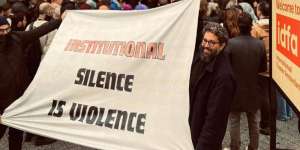
The resistance movement shministim5 has re-emerged in Tel Aviv. Young Israelis are refusing to join the military. They see no military solution to the Israel-Palestine conflict. In a letter to Prime Minister Netanyahu, the conscientious objectors state that their struggle for human rights is an act to preserve Israel’s democratic character. In the 1970s, the shministim sent letters of protest to ‘Mother of the Nation’ Golda Meir. In 2008, another large group sent a manifesto to Defence Minister Ehud Barak. Among them was Omer Goldman, who went against his own father, Naftali Granot, the deputy head of the Mossad.
The young Israeli Bar Levy, one of this spring’s new shministim, says he has witnessed how Israel treats Palestinians in the West Bank. He opposes the military’s war crimes. The shministim refuse to submit to a masculine and militaristic ideal; they refuse to let power take precedence over justice.
In Tel Aviv, I meet a representative of a new generation of politicians: Knesset member and key leader during the social protests of 2010, Stav Shaffir. She recently criticised the Israeli national budget for concealing nearly half a billion kroner in transfers to the West Bank occupations. As a member of the Finance Committee, she demands full transparency in the actions of the government and parliament. She is accompanied by a hundred young volunteers, who represent a new hope for Israel. She assures us that if her party – today’s Labour Party – comes to power, its first priority will be to resolve the conflict arising from the occupation.