In Threads of a Revolution, Janet Biehl, the younger lover of 1970s US radical and grassroots political philosopher Murray Bookchin, reveals how his ideas influenced radical experiments in community living in Kurdish northeastern Syria, decades after his death in 2006.
Abdullah Öcalan
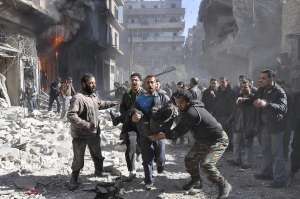
Through the lens – and inspiring sketches of Janet Biehl that pepper the film – we learn about the little-known efforts of the Kurds of Rojava, an autonomous enclave in northeastern Syria, where grassroots citizen democracy forms the basis of a gender-equal society. Rojava was founded in 2012, after a female-led army saw off an offensive by ISIS, where defeat would have meant death or being sold into sexual slavery for women. Hated by Turkey, which continues to attack it, and has already absorbed part of its territory, Rojava draws heavily upon Bookchin’s ideas of social ecology and community organisation, via the leader of the Kurdish Peoples Party, Abdullah Öcalan.
Although Öcalan remains imprisoned on a Turkish island, Rojava’s Kurds are determined to live by the ideas he championed.
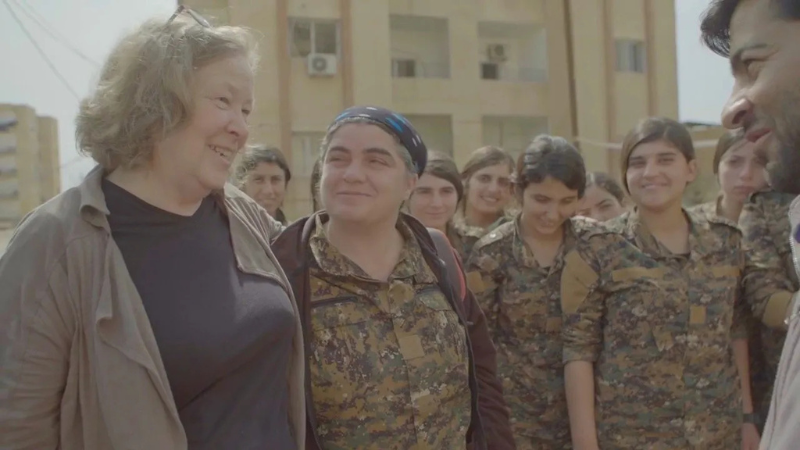
Biehl, who met and fell in love with Bookchin late in his life, travels to Syria to explore how ideas she had only known in theory can be put into practice.
Threads of a Revolution celebrates a brave movement that remains vulnerable to external enemies.
Gently feminist
Biehl’s gently feminist approach, emphasising the gender revolution at the heart of the Rojava political model, opens with a visit to a women-only village, Jinwar, where women who have lost husbands martyred in the fighting, or fled abusive partners, have created their own shelter from the times. She visits neighbourhood councils and the regional executive – run by a woman – and talks to men who accept the new gender equality. There is little effort to seek out critical voices, and this is largely a celebration of how the idea of the man she loved can work in practice.
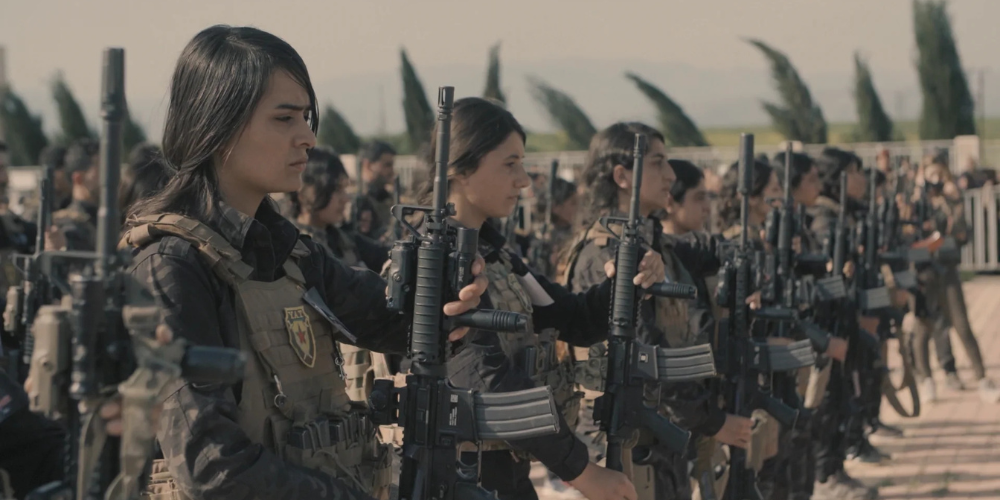
With touching portraits of the family of her guide and interpreter, a close look at the brave young women of the female armed corps, the YPJ, and a visit to an Arab town beyond Rojava, where the ideas of social ecology are taught to young women, Threads of a Revolution celebrates a brave movement that remains vulnerable to external enemies.
For those who find the idea that a US anarchist (Bookchin was a co-founder of the New England Anarchist Conference) can influence a Middle Eastern society, or indeed any old-world society, the depth of US radicalism in the 1960s and 70s may come as a surprise. Bookchin was just one of a range of influential figures on the American left at a time when grassroots organisation was strong. Saul Alinsky’s Rules for Radicals (1971) was a groundbreaking prescription for social change. The people of the ICE-besieged neighbourhoods today are running workshops using ideas from this period to push back against a newly fascist federal state.
Sitting somewhere between a personal portrait of a left-wing thinker’s muse, a window for her passably good ink and water colour wash sketches, and a skim through a revolutionary idea put into practice in Kurdish Syria, Thread of a Revolution is – well – a little threadbare.
The cinematography and pacing work well enough for a 55-minute film, but there is a chance lost for a much wider and deeper study. Where are the panoramic views that give us some idea of the land in which the Kurds now live? We see plenty of dusty, scruffy villages and war-battered buildings, but nothing really of the geography or topography of the place. The interviews consist primarily of people praising Bookchin’s ideas, interspersed with grainy VHS footage of him from the 1970s and 80s, often with a younger version of Biehle by his side.
Post-ISIS Syria
Threads of a Revolution serves as a taster for those interested in the politics of post-ISIS Syria, but does not broaden out this brave experiment in Rojava, especially as much of the film documents is now seriously underthreat from the new Syrian government. Therefore, as the film was shot in 2019, there is no probe into how post-Assad Syria may approach the independence of the region, or the context within which Turkey continues to attack it.
The film might have been stronger and more engaging if Biehl had engaged with some contemporary proponents of social change and grassroots democracy, and how the Rojava model could be spread to other parts of the Middle East.
Perhaps that was beyond the scope of what she wished to explore. As a confirmation of the power of Murray Bookchin’s ideas, Threads of a Revolution works, but it is more hagiography than historiography.