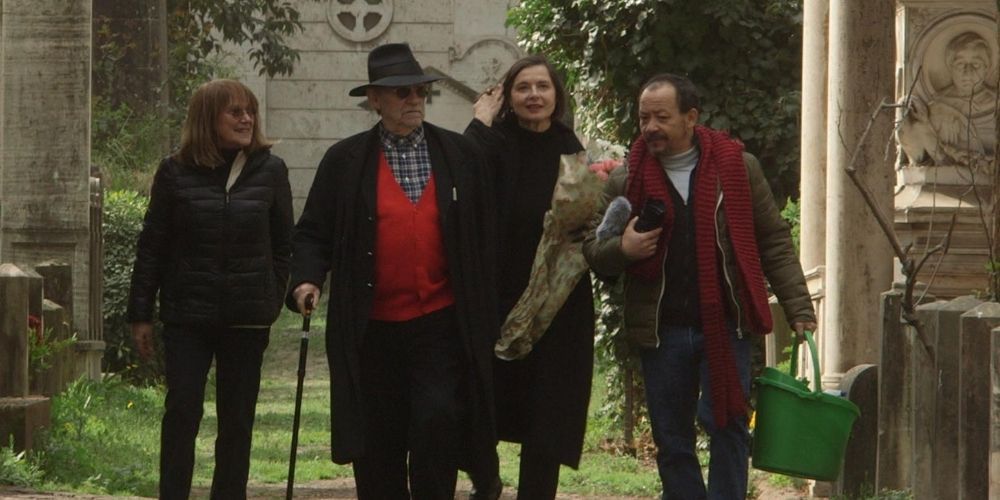
At first, The Rossellinis seems a rather ordinary documentary about an extraordinary subject: the family legacy of #Roberto Rossellini#, one of the most innovative film directors of the 20th Century. It starts with archival shots of the director’s funeral, introducing the director’s grandson Alessandro, the narrator, and director of the film, and proceeds with home-movie style shots of him visiting his relatives and asking about their feelings about being «a Rossellini». For those viewers who are a bit familiar with the topic, talking about Rossellini and his family is everything but ordinary. With the words of Alessandro, who at the age of 54 decided to become a film director: «grandpa was cutting edge, not only in cinema».

Radical ideas
Roberto Rossellini was one of the key directors of Italian #neorealism, a cinematic movement known for introducing, among other things, filming on location. In the film, Alessandro’s focus is on this formal innovation. Early on, we see the great director saying: «When I shot Rome, Open City and Paisa, shooting a movie outside film studios, it was considered madness.» Neorealist and Rossellini’s films in particular also distinguished themselves for addressing politically and socially challenging themes and introducing radical ideas into post-war Italian society. Europe 51, for example, is a portrait of wealthy Roman socialite Irene (Ingrid Bergman) who, after her young son commits suicide, decides to devote her time and money to the city’s poor and sick, only to be declared insane by her husband and family.
For decades, Roberto Rossellini’s personal refusal to accept the social and legal rules regarding marriage was considered similar to Irene’s desire to help the weak: a rebellion. In this, as it is made very clear in The Rossellinis, the great film director «non scerzava», as they say in Italy. He wasn’t kidding. Alessandro is a son of Renzo, a child of Rossellini and Marcella de Marchis, officially his first wife. After that, Roberto formed a family and had three children with Ingrid Bergman, a Hollywood icon. In 1948, she wrote a notorious letter to Rossellini saying she is ready to work with him. Alessandro does not mention this letter in the documentary, but he does explain how, after the films shot with #Ingrid Bergman# failed to bring revenue, Roberto escaped to #India for a year where he started a relationship with a young scriptwriter Sonali Senroy DasGupta, his friend’s wife, who was pregnant at that time. Roberto adopted their son and had another daughter with her.
Three families
In the film, we see members from all three of Rossellini’s families. Alessandro explains that there was «no divorce in the 1950s» (In Italy, divorce was first introduced in 1970) but makes no effort to further explore that. He also does not clarify, for example, how it was legally possible that after Ingrid Bergman left Rome and moved with their three children to Sweden, the director took the children away and forced them to live with nannies in Rome. Instead, he visits his relatives from the Swedish and Indian families, as he calls them, to inquire about a hypothetical disease, a «Rossellinitis», which is supposedly common to all members of the director’s family and manifests itself in the belief they are born to make films. Yet, as contemporary films are full of names from the golden age of Italian cinema, starting with Christian De Sica (son of #Vittorio De Sica#, Rossellini’s colleague) and Alessandro and Jacopo Gassmann (sons of Vittorio Gassman), this kind of clientelism is rather common in Italian mediascape and can’t be a particular Rossellinian thing.
Indeed, the film does not follow this path either and «Rossellinitis» proves to be a mere pretext to let his relatives talk. But what may at first appear as a weakness is actually this film’s greatest strength. What I most appreciate about this film is exactly the minimalist modesty by which Alessandro Rossellini creatively subverts the classical rules of narrative. That is, the ban of repetition and the need for depth. The director twice repeats how the family saw Rossellini differently from how the world did. Normally, this would not be «allowed» but in this case, it produces a confirmation: the director was idealised both outside and inside of the family. Instead of pursuing one theme and searching for in-depth information, he collects symptoms on the surface: gently letting his relatives speak, yet carefully selecting what he shows. This way, he gradually reveals a reverse portrait of the great film director as a racist and sexist patriarch.
it is a eulogy, homage, and praising of the female Rossellinis, the women who actually made «the Rosselinis» possible
An ode to women
The film will be screened as the closing event of the Critics Week at this year’s International Venice Film Festival. The mainstream media are already anticipating more praise for the anti-conformist who scandalised the rigid morality of the 1950s in his work and life. They surely will be disappointed, but without revealing too much, let me add that The Rossellinis is not a critique of the great neorealist, nor of traditional masculinity whose representative he was. Isabella Rossellini already did this in her short film My Dad is 100 Years Old that caused a family dispute, particularly by projecting the closing shot of Rome, Open City on a big naked male belly (shown in this documentary too). Rather, it is a eulogy, homage, and praising of the female Rossellinis, the women who actually made «the Rosselinis» possible by providing the foundations for his masculinity. Be it by their (non-paid) emotional labour or by actually performing on the labour market and providing economic means for the family subsistence.
The Rossellinis provides the means for the great film director, through all of his children and grandchildren, to once again fulfill his anti-conformist vocation, this time by showing that patriarchy persists even in the absence of what traditionally is supposed to provide the material base of its supremacy, that is, the economic power. His grandson Alessandro deserves particular credit for showing the women who made it possible – their goodness and beauty, but also their intelligence and strength.