There are a few select books whose titles end up becoming catch-all terms for crucial, broad trends that everyone agrees on but which no one has been able to properly articulate until the books are published. Nicolas Bourriaud’s Esthetique relationelle (‘Relational Aesthetics’) has taken on this meaning in recent art history. Further back, we have works such as Guy Debord’s La société du spectacle (‘The Society of the Spectacle’ or ‘The Spectacular Society’) and Herbert Marcuse’s One-Dimensional Man.
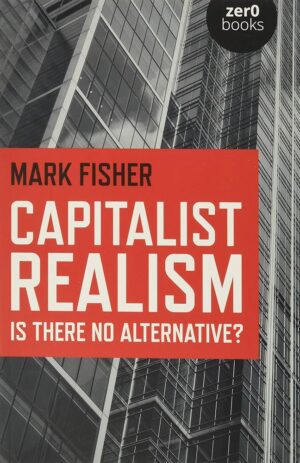
Mark Fisher’s book entitled Capitalist Realism belongs to this small select group of books that become such exemplary contemporary diagnoses. In Fisher’s case, «life goes on, but time has somehow stopped,» as he puts it. #Capitalist realism# is a term for the #late capitalist# world, where it is not possible to imagine a different and better world – it is what it is. Even when something happens – think #9/11, the financial crisis, or the #coronavirus pandemic – it doesn’t really change anything. Things just keep happening. It’s as if the future has disappeared.
Fisher’s book was originally published in 2009 and is now being re-released in a new edition by Zero Books, the publishing house that Fisher himself co-founded in 2008 in an attempt to produce short, inexpensive books that would not conform to academic conventions and forms, but contribute to a critical discussion of the contemporary world and its limitations. Fisher’s own book is the best example of the form: the short, pithy contemporary analysis that incorporates popular culture and political theory in an attempt to punch even a tiny hole in what is perceived as a completely closed political and cultural public sphere.
From postmodernism to capitalist realism
In many ways, Fisher’s analysis of capitalist realism can be understood as an update of Fredric Jameson’s #postmodernism analysis from the 1980s. Following Jean-Francois Lyotard’s self-criticism of #Marxism as a grand narrative, Jameson attempted to come to terms with a historical development characterised by a transformation of art and politics. Whereas modern art thematised experiences of alienation and blasé urbanity – or, like the Soviet Russian avant-gardes, attempted to contribute to the creation of a new post-capitalist world – postmodern art was a cool or ironic affirmation of the existing world.
The challenge for Jameson was to perform a historical analysis at a time when it was no longer possible to analyse historically. History had stopped. The grand narratives – not just Marxism but also the other modes of analysis that emerged as part of the #Enlightenment – no longer worked. Nevertheless, Jameson attempted to describe postmodernism in Marxist terms, describing it as the cultural logic of late capitalism, the superstructure of a new phase in capital development.
Fisher’s capitalist realism stands on the shoulders of Jameson’s analysis of postmodernism. Whereas Jameson’s mapping of a new phase of cultural production with its reference to the Trotskyist Ernst Mandel’s Spätkapitalismus (‘Late Capitalism’) had an authoritative, Marxist tone, Fisher’s book was at once lighter and more sombre in tone. The chapters were originally written on Fisher’s k-punk blog and later edited into a book. Jameson’s postmodernism book was a 500-page tome, and Capitalist Realism is less than 100 pages long. Fisher himself describes the difference between the two books as a matter of vantage point. Whereas Jameson could still refer to something rapidly disappearing, Fisher’s own situation was more bleak. The strange shift in the title of Jameson’s book – late capitalism equals postmodernism – is now complete. According to Fisher, society is no longer late capitalist because the term capitalism itself no longer makes sense.
The political connotations that Marxists like Jameson attach to it have disappeared. The point of the statement is that it is easier to imagine an end to the world than an end to #capitalism. Capitalism appears even more unchallenged in 2009 than in 1984, before the fall of the Berlin Wall and the dissolution of the #Soviet Union#, when Jameson’s first theses on the postmodern were published. Fisher’s book was written just after the financial crisis, which, as we know, did not result in political change in many places.
Stagnation and consensus
Fisher gave words to the feeling that things just kept going. That it was impossible to imagine any alternatives to what already existed. Former Danish Prime Minister Anders Fogh Rasmussen, whose government embarked on a culture war that included Danish participation in the invasions of #Afghanistan and #Iraq, the fight against so-called ‘taste judges’ and xenophobic immigration policies, always said, «there is nothing to come after.» Fogh Rasmussen’s statement summarises quite well the feeling of stagnation and the suspension of politics as a struggle.
French philosopher #Jacques Rancière# calls this state consensus. Where everything is in its proper place and politics is left to administrators and the system itself. It was this sense of the disappearance of the political that Fisher was trying to describe with his book. That the political had been transformed.
Terms like class struggle and #proletariat no longer referred to anything. The situation was paradoxical: the class struggle had been so one-sided in favour of market capitalism that the notion of alternatives was no longer present. Fisher described it as «an impersonal, abstract and fragmented system with no answer or centre.» A system that, with invisible barriers, sets the boundaries for actions and thoughts. In a Danish context, we got an excellent example of this depoliticisation after the demolition of #Ungdomshuset in 2007, when local politicians dismissed the subsequent protests and demonstrations due to a lack of education for young people. Politicians refused to recognise young people as legitimate political subjects and turned them into children whose parents and educators had not done their job.
Jameson’s postmodernism book was a 500-page tome, and Capitalist Realism is less than 100 pages long.
A sympathetic reformism
In terms of intellectual history, we can see Capitalist Realism as a late exponent of British cultural studies, with Fisher becoming an heir to #Raymond William# and #Stuart Hall#. They were both leading figures in the #New Left# and were part of the nuclear movement in the 1960s. Williams and Hall analysed the transformations that took place in the decades after World War II, where a former working-class culture was partially absorbed into the capitalist welfare state but also challenged by new subcultures such as bikers and punks.
Whereas Hall and Williams not only had an extra-parliamentary public sphere to play in, but Hall also appeared on numerous #BBC programmes, Fisher was largely confined to a blog and precarious teaching work at a high school. Perhaps that’s why Fisher, in Ghosts of My Life. Writings on Depression, Hauntology and Lost Futures (2014), Fisher looks back nostalgically to an earlier historical period and asks himself whether it is possible to reclaim public institutions such as the BBC and Tate. The challenge, of course, is that the ‘long march through the institutions’ was originally an attempt to dismantle them. It’s as if Fisher forgets that. Nostalgia opens the door to a sympathetic reformism, saving what can be saved. Paradoxically, however, it ends up confirming capitalist realism and closes the door to more radical alternatives.
Fisher’s book is an analysis of the prevailing ideology at a time when there are supposedly no ideologies anymore. Where Hall used Gramsci and Althusser, Fisher draws on Žižek and #Alain Badiou#. One of the reasons Fisher ends up there is probably due to his starting point in the infamous CCRU at Warwick University in the early 1990s. Here, philosopher Nick Land and a group of students experimented with a bizarre post-structuralist philosophy of excess, which, as we all know, ended up as a radically reactionary philosophy that today is worshipped by figures such as the late fascist businessman Peter Thiel. Fisher was part of the group at CCRU but moved towards post-Marxist ideological critique in the 2000s.
Is there an alternative?
Along with books such as Michael Hardt and Antonio Negri’s Empire (2000), Franco Berardi’s After the Future (2011), Slavoj Žižek’s Living in the End Times (2010) and David Harvey’s A Brief History of Neoliberalism (2020), Capitalist Realism was an attempt to produce a critical reading of a historical epoch we often refer to as neoliberal globalisation. The term capitalist realism became so popular that it almost rivalled neoliberalism as a comprehensive contemporary description of the years from 1989 to a few years ago. Fisher’s strength was very much the quasi-phenomenological description of the experience of frozen time, of being caught in a time loop. How neoliberal capital took the form of a wall-to-wall ideology, or an affective regime where the naturalness of capital had been internalised and appeared unassailable. If, in the 1950s, Sartre could say, somewhat hopefully, that communism was the untranscendable horizon of time, market capitalism now constituted an invisible horizon.
The description of the new emotional structure also includes considerations about how the left wing, which Fisher understands to be a part of, should act. In continuation of Žižek, Fisher describes lived moments and experiences that do not end up in capitalist realism but point beyond it. The book’s subtitle contains a question mark: Is there an alternative? Fisher challenges Thatcher’s TINA, ‘there is no alternative’ doctrine. The despair over the situation and depoliticisation thus goes hand in hand with attempts to describe moments where integration into neoliberal capitalism is rejected – or cannot help but leave small gaps. Fisher often describes these as little outsides, where strange phenomena emerge that potentially express resistance. Fisher often describes these as mental crises, where capital reproduces itself, and its subjects break down. Capitalism is a crisis capitalism that works better the more things break down. But at the same time, the crises – economic, ecological, and mental – are, if not a break with the reproduction of capital, then at least a record of its destructive capacities. Whereby Fisher points to the need for something else.
Fisher’s book was first published in 2009. Since then, we have seen the most widespread protests in many decades move across the world in a fragmented pattern from the North African revolutions to the southern European sit-in movements, and Occupy to #Maidan and Ferguson in 2014 to the frontrunner protests of 2019 in Hong Kong, the Sudan Commune, and Gilets Jaunes in France – to the #George Floyd# revolt of 2020 in the US. In 2022, we saw violent protests in Sri Lanka, Haiti, Iraq, Iran, Kazakhstan and China, among others. Scandinavia is pretty much the only country that has missed out. Here, petty #nationalism seems to reign unchallenged. Fisher’s book remains relevant as a description of the political and mental misery the protesters are trying to end. As a contribution to a new critique of ideology that emphasises that the ‘end of history’ was nothing more than a class project that can actually be challenged. As millions are already doing on the streets.