It’s the first night. A 23-hour journey from Norway. It’s tropically hot in the hotel. I’m the only guest in this run-down, fashionable Southern hotel with wide floorboards and white-painted, wrought-iron-railed balconies. As I crawl under the mosquito net in the four-poster bed, a fist-sized black shadow scurries across the floor. I instinctively run after it, throw a small towel over the beast, and stamp it to death. I feel the crunch beneath my bare foot.
I arrived in Haiti – the poorest country in the Western Hemisphere – via Miami. Via the opulent Art Deco of South Beach. Via the shops, sunglasses, beach buggies and big spenders of this city of facades. From the USA’s wide asphalt avenues to Haiti’s narrow, potholed streets. From grid-like Miami to the chaotic metropolis of Port-au-Prince. At the airport, I was guided past the chaos through the VIP lounge and to my private driver, for a three-hour drive down to Jacmel. The doors had to be locked from the inside as the car passed through the slums, the throngs of people and the street vendors, before the jeep crept out of the city, over the mountains and on to Jacmel in the south.
IT’S MORNING. I’m here by the sea, in Jacmel, for a few weeks to film. To make a portrait of Jørgen Leth – filmmaker, journalist, poet and former Danish consul. His Danish film crew are on site – they’re working on The Erotic Human Being. They’re staying in the consulate residence; the Danish flag is flying atop the barbed-wire fence. I walk through the gate, along the edge of a 15-metre-long swimming pool, across the marble floor behind the unlocked steel grille, past the servants’ quarters by the kitchen, past Haitian sculptures and paintings, up the stairs and up the next spiral staircase to the third floor. There sits 71-year-old Jørgen behind his mahogany desk, in front of the open, enormous oval doors and the terrace, in the room with blue-tiled walls. His gaze is fixed out over the palm trees, towards the blue-green sea. Has this aesthete, this bon vivant, figured it out – worked out how this sensual, life-affirming country – where ecstatic voodoo is often prescribed as medicine – can remedy his more melancholic tendencies, inherited from Danish Protestant culture?
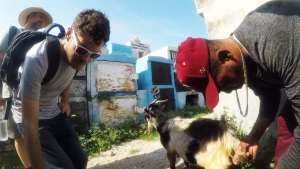
In the streets, everyone knows ‘Monsieur Jørgen’ as a generous man. Apparently, they come to his door every day asking for a little financial help. The guide I manage to find has known Jørgen since he himself was a little boy playing with the consul’s son. We head out into the town, talking to people. I realise I’m the only white man out and about this morning. The black people stare. I tuck my little video camera into my pocket. I film surreptitiously. We make our way through squalor and poverty. We trudge over earth and stones left by the tornado that ravaged the area some time ago. In one street, rubbish is suddenly strewn everywhere – the downpour the night before had caused it to wash down and spread out. And here, everyone wants money from you. “Why are you photographing the rubbish?” a man shouts at me. He asks for money, but Michel, my guide, calms him down. That’s what Michel is paid to do. He knows everyone, smiles and says hello. A menacing bloke to whom he owes money becomes pushy. We manage to get away. The UN jeep that has just patrolled past, carrying four soldiers in light blue helmets, bulletproof vests and loaded rifles, underscores the situation.
But in the street, most people are smiling: “Deep-fried banana slices?”; “Papier-mâché parrots?”; “A glass of homemade rum?”. They hardly ever see tourists any more.
The next day, my nephew Jonathan – the film student who jumped on the plane – is filming. We head to Michel’s home, to the slum area where he lives with his daughter. He’s honoured that we want to visit him.
The night’s fresh floodwaters have added to the mud we’re wading through as we make our way down the alley. The smell is strong; the water is teeming with bacteria. The alley is full of children and adults – two out of three adults are unemployed. Michel shows us into his home, or rather the room behind a rotten door, beneath a corrugated iron roof full of holes. A bed, a stool, a headless doll. The room is four square metres; a couple of packets of biscuits sit on the stool – he and his daughter don’t eat every day. His daughter has one toy – my five-year-old back in Oslo has a few hundred. Does this dark room have electricity? Water? A radio? No. And his wife ran off with a man who had a car.
I give Michel a new T-shirt I bought at GAP in Miami. He gets slightly annoyed: ‘I could’ve got four second-hand ones for the same price!’ On the wall hangs a school uniform in a plastic bag. Below it stands his five-year-old with her usual two plaits, mud splattered up her legs – unwashed.
THE NEXT MORNING. I’m having breakfast. Suddenly, a gaunt old man is standing over me. He stares me in the eyes over my omelette. He cries out in despair, “j’ai faim!” and points insistently at his stomach. I give him a few crumpled banknotes. Later that day, Michel comes over and tells me how happy he is – his daughter is full! What’s more, he could afford to send her to school for the first time – her school uniform had been hanging there unused since last autumn. He had barely managed to scrape together the monthly rent of 120 kroner. It makes me think about how much I could actually have given Michel.
We make our way up to the market in the town centre, away from the beach, towards the smell of fish and meat, into the throng of people, where I hold my handheld camera at eye level, weaving my way between the stalls.
Dead chickens with feathers and claws, sardines, beans, spices – just like the clamour of the buyers and sellers, the flies are everywhere. The fish, packed tightly together in cardboard boxes, have been imported from the US. I make my way out, catch my breath, and suddenly notice the wrecked cars in the street.
We stop some children in school uniforms and persuade them to have their photograph taken – but suddenly a four-wheel-drive vehicle carrying Haitian petty criminals pulls up and demands money. We make our escape, back to the hotel.
EVEN WITHOUT THE JUNKIES ON THE CORNER, the pimps and menacing beggars after dark, Haiti’s intensity is potent medicine for a European.
Take, for example, the Italian Enrico and his wife, who came here in the 1970s: they used to ride romantically along the beach like two aristocratic hippies – until he met a Haitian woman. She went back; he ruined himself so he could live here for the rest of his life. Similarly, there’s the Frenchman Francesco, who built a small bar on the beach with Saturday cinema screenings: I often see this funny and quirky man, now in his sixties, kicking a football around with the lads on the beach before his evening swim. Jørgen, the third elderly European here, has emigrated here, away from welfare-state Denmark and ‘European women’ – as a mature adult, he has described the latter in one of his autobiographical books merely as potential friends.
THE WOMEN OF HAITI are a chapter unto themselves. I decide, in the spirit of Jørgen’s aesthetic, to investigate – as an anthropologist or ethnologist – by meeting the women and doing a bit of ‘fieldwork’. I invite Marie Antoinette to the beach. She is not a prostitute, but works at the reception of the empty neighbouring hotel. I’m curious, but unlike Jørgen, I have no intention of losing my anthropological composure, in the way he allows himself to be sexually seduced in the film The Erotic Human. Unfortunately, Marie’s English isn’t much to write home about; we struggle to communicate. I decide instead to film her: her face towards the sun, towards the light, towards the blazing fire, or her skin against the rubbish on the beach, the darkness against the waves. We sit down again. In response to my fresh attempt at communication, she asks me if I can help her out with 80 dollars for a passport. ‘Maybe.’ She lives with her aunt and her son, an aunt she’s always arguing with – could I help her move out? ‘We’ll have to talk about that later.’ She wants to be a translator, to work with languages. ‘Oh, really? Well, perhaps you should go abroad to get some practical experience,’ I say. She explains to me, looking deep into my eyes, that she wants to go wherever I go. She is very beautiful. Clearly, as a white European, I can dictate the course of her life if I wish.
I don’t like this and change the subject, asking her which films she likes: “Demi Moore.” So I can forget about Godard, and mention Sean Penn. She shakes her head and says in English-German: “Aarnoold Schwaartzeneggger.” I give her 20 dollars for the photo shoot, and leave it at that.
YOUR SHOULDERS ACTUALLY SLUMP here in Haiti. There’s something about this chaos, the way things sort themselves out as you go along. Here, you don’t ring a taxi company; you hail a bloke on a moped on the corner. You sit right up against his back and feel the road and its bumps and potholes beneath you. Or you sit shoulder-to-shoulder with ten others in the back of a tap-tap – a colourfully painted pick-up truck that serves as a minibus. And if you go to the bank, you first stand in a tight queue for a couple of hours behind three guards with shotguns; eventually, everything dissolves into chaos, but then someone calls out to you, order is restored, and you get your cash.
At the local nightclub that same evening, the muscle-bound bloke in front of me shouts, ‘Do you want a girlfriend?’ – he was practically dancing on top of me with a big smile. At first I thought he was offering himself, but then he beckons his sister over. I say no. But the dance called ‘kole-kole’ – ‘stuck together’ in Creole – is fascinating. Later, round the corner, at a cockfight, we sit just as tightly stuck together in a cluster of twenty men, screaming, waving money and arms whilst the bloodied cocks hit the ground, only to spring back up again with their eyes gouged out.
The next morning on the beach, I meet some white Christian aid workers from Minnesota in the US who are swimming with 30 small orphaned children. Side by side, they cuddle all these naked children they’re holding in their arms in the water or down on their laps in the sand. White skin against black. Is it actually the white people who need this contact?
And chaotic Haiti has its voodoo culture: here they do not go to a doctor or a psychologist, but dance, perform rituals with rooster feathers and spirits, and sing their problems away – the so-called white voodoo.
I recall Jørgen, who the evening before – during one of the regular, delicious dinners at the consulate residence – told us that he isn’t in Haiti to teach the others anything, as typical aid workers believe they do. Rather, it is they who are to teach him how to live.
I FINALLY LEAVE JØRGEN’S Jacmel and head for the capital, the melting pot Port-au-Prince. To the city that, just three years ago, was a chaotic gang-ridden hell (see separate article). The city where young gangs killed with impunity. In the 1990s, people were burnt alive in the streets – with burning car tyres trampled over their bodies and severed genitals shoved down their throats. This lush and beautiful country is also destructive and violent. In a way, it reminds me of Hiroshima mon amour – love, alienation and a harrowing tale of war.
I walk down the market streets, through the teeming pavements of the harbour area, where a lively throng of people sell food, clothes and every conceivable kind of old junk. On every corner, meat sizzles in iron pans over charcoal.
I catch myself feeling a sense of delight. You’d be hard-pressed to find anything more alive than this. People are calling out to one another. The air is thick with heat and dust. People are hoisting sacks of rice, passing by, hawking their wares. Intense stares. Adults with smiles often graced by a tooth or two. I pull my camera out of my pocket, position myself at a narrow crossroads and film in all four directions – but have to run away as a bloke tries to snatch the camera from me.
Here I’m staying at the capital’s Hotel Oloffson – a story in its own right. The hotel where gangsters, aid workers, writers and politicians stay, party and dine – the sort of people seeking excitement. The doors around the hotel are labelled with the names of former guests such as ‘Mick Jagger’, ‘Graham Greene’ (the novel The Comedians is about the hotel), ‘John Gielgud’ and ‘Jørgen Leth’. Apparently, it’s supposed to be named after a Norwegian, but I assure the hotel owner that the name is Swedish. Over a drink, he tells me that Clinton popped in a couple of days earlier, whilst in Haiti with the UN Secretary-General. When Clinton asked how long he’d been running the notorious hotel, the reply was ‘22 changes of government’. Clinton replied that he and Hilary hadn’t been able to afford this then-fashionable hotel back in the 1970s.
Today, the Oloffson is run-down, as confirmed by this Thursday’s RAM session – a lively voodoo beat with the hotel owner and his singing wife, African drummers and the fifty of us dancing: the old building shook whilst old paint dust rained down over the crowd of gangsters, women seeking connections and aid workers.
THE AID WORKERS ARE also a story in their own right. The next day, I head out with Ingvill from Northern Norway to her voluntary school project in the slum. The school, with the Norwegian name Troll, provides schooling for 120 destitute children thanks to funds raised. It’s admirable what Ingvill and her Haitian husband are doing. They’re really making a difference, making things happen, whilst the rest of us just write about it or hand over a few banknotes.
I go down into a slum area with her; we pass the rubbish and the river where the pigs are rooting about, before entering shacks where ten people huddle together in the same room at night. We meet the mother with her four daughters; the eldest lies paralysed in the room’s only bed. Ingvill has taken them under her wing at the school, given the mother and her sick daughter work, and is providing the three younger sisters with an education. I see the tattered wheelchair standing on the slope – every day the sisters have to carry her down the path, across the rubbish-strewn river, through the alleyway, out onto the street and up to the school.
Ingvill tells me that she also works with the Minister for Women’s Rights. When I ask about gender equality, she replies that here it is more a matter of survival. Girls and women have few rights. Boys and men often have sex without condoms. In the school class behind us sit a couple of 13- or 14-year-olds who are already pregnant. Others were born with AIDS.
HAITIANS DIE YOUNG, but they have fathered many children along the way. Half the population is under 20. Young, committed, strong-willed and optimistic.
On our last evening at a free concert in the garden of the French cultural centre, the optimism is palpable. The Haitian star Belo sings to around 500 Haitians and a few white people – he blends Bob Marley’s reggae with voodoo beats. The lyrics say that the hard times are now over, that the future belongs to them. The young people sing along, clap and dance so wildly we almost lose our balance. When the concert ends, a massive downpour suddenly breaks out. I run down the street with the Canadian aid worker Lucie; we get soaked to the skin, my shirt clings to me, my shoes squelch. We shout with joy, whilst the rubbish around us runs down the pavement, and we throw ourselves under a roof. We then seek shelter in a café – I go into the stinking loo and wring out all my clothes. It’s warm. We sit amongst the locals and are served soup. In this tropical heat, I dry off within an hour. Later we meet the network, about twenty aid workers at a night café. They tell me, the curious Norwegian, all about what they’re doing there: Joris from Belgium is working to develop agriculture, to help Haiti become self-sufficient. He explains to me the oppressive structures here, how the new free zones are having a negative impact. It’s Karen’s birthday and she sings for us; she works in the hospitals. Her husband Peter has just made a documentary about three women who cross the border illegally to find work. He also teaches Haitians how to create websites. Others smile enthusiastically and tell me they work for Médecins Sans Frontières. Several have found Haitian partners. They’re set to stay there for several years.
THE DAY AFTER, I’M HEADING home. On my way out through the airport, I have to shake off three porters demanding exorbitant tips before I can take off. I’m relieved to be leaving. But I have a nagging feeling – am I suffering from a kind of heartache? Do I want to go back? Do I want my life to change? Do I want to escape my Apollonian background, the indirect world of media and visual culture, only to throw myself into Haiti’s Dionysian life, into the intoxication and sensuality – to leave the rational, moralising Western world, orderly and modern Scandinavia, and perhaps throw myself into this directness – its hardship, pleasure, food and eroticism?
Back home in Oslo, the film adaptation of The Comedians, starring Richard Burton and Elizabeth Taylor, happens to be on the TCM channel. But the hotel in the film wasn’t designed by Oloffson, and 1970s Haiti seems artificially alien. It reminds me of the Western film A Passage to India, where ‘the Others’ are viewed from the outside, and the ‘good Indians’ are those who most resemble us.
Jørgen has lived there for fifteen years, both in the capital during the politically chaotic times, and in the more peaceful Jacmel. He is both on the inside and the outside. As his old French colleague Chantal told me: Jørgen has literally ‘penetrated’ Haiti.