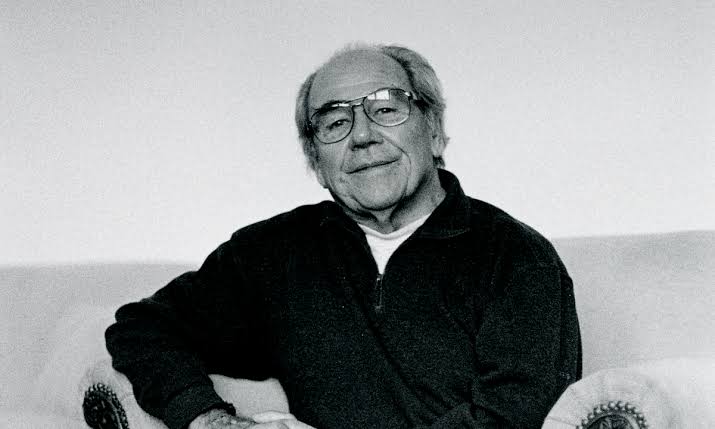
But why spend time on this wry social critic? You’d have to search long and hard to find an equally great pessimist. Baudrillard has had his say, and so emphatically that most people grew tired of hearing that existence is devoid of meaning: ‘Death’ should already have occurred. But bread and circuses prevent us from realising this.
Nevertheless. A couple of us thought it was worth inviting the now 71-year-old man to Oslo – sixteen years after this fatalist was last in Norway. Baudrillard is now involved in photography, and we have organised an exhibition of his photographic collection at the Stenersen Museum from next Thursday; he will give a lecture at the University Library the following day (see separate advert), and will be featured in next week’s Morgenbladet.
But was Baudrillard correct in many of the claims and analyses he put forward when he was in his fifties? Did he go too far, or was he wrong?
As early as 1968, he pointed out that our surroundings were being transformed into a functional space, and that television was turning us into media slaves. Baudrillard, the ‘machine stormer’, proclaimed that people were being programmed and simulated by the functional imperatives of technology. Human beings were thus a source of noise that communication systems sought to tame. Technology meets ideology and vice versa; cultural and psychological depth is being steamrollered out of existence.
But isn’t this the eternal irritation with everything new?
Consumer society
A couple of years later, Baudrillard continued with a critique of consumer society. Your needs are manufactured – consumption is the old logic of production transferred to an advanced, systematic and individual level. The logic of consumption takes hold of the body and desire; the universal consumption of signs takes over. Take, for example, pop art, advertising and sexuality: works of art and consumer goods are blended together in pop art. Advertising plays its own inviolable game beyond true or false. And sexuality is transformed into an investment object and health capital. Ritual consumption organises you.
And Baudrillard continues to publish books. Now the media world of the 1970s is criticised for being characterised by simulation at every level, in its ultimate consequence a hyperreality. On the symbolic level, the exchange value of things soars sky-high above their use value – fashion is sold as symbols. Here, it is not only goods that are produced, but also your desire. You yourself are a producer as you shape your role on the social stage. If one reality is not enough for us, then following the death of modernity we simply produce more realities. And what of the intellectuals? Well, the critics simply produce more and more theory.
Theory has reached its limits; oversaturated with knowledge, reality dissolves, and we lose our sense of reality.
In Baudrillard’s view, we have become puppets at the mercy of the metaphysics of production. Enough is enough.
His counterstrategy is therefore absolute anti-productivity; we must spend more time on meaningless things.
Baudrillard does not give up. At the very moment when the philosopher Jean-François Lyotard declared in 1979 that the world had become postmodern, Baudrillard describes a world in its death throes. His claim is that concrete ideology prevails in the West – all that counts is the all-too-visible. At the same time, ironically enough, democracy’s enormous Enlightenment project is on the brink of collapse: the masses, who were traditionally meant to be enlightened through moralisation, socialisation and raising of awareness, did not end up liberated and enlightened by reason. When we seek to know and see everything, we end up in total transparency; we are merely dazzled by white light. This orgy of ‘realism’ allows clarity to reign; the Enlightenment is running overtime. Our desire has been satisfied; the orgy is over.
The question, therefore, becomes what we do after the orgy. At the very least, Baudrillard attempts to provide an answer by writing a new book. In Seduction, he once again attacks the ideology of the concrete; after all, the man himself is an expert at negating reality.
Sexual reason
According to a new study by the Market and Media Institute on changes in values over the last 15 years, we are cultivating pleasure and freer sexual morals. That’s good. But according to Baudrillard, sexual reason has taken over as the moral compass in our culture, a culture characterised by premature ejaculation. Society has become obscene; it is the anatomy of the body that reigns supreme. We are preoccupied with the right to pleasure. The genitals demand, the genitals have rights – a right that leads to many a sexual long-distance race. The overt explicit nature of pornography follows the logic of male dominance; its utility value is on the rise. In a phallocentric body culture, the gaze demands pornographic close-ups of the genitals. Everything must be exposed; the entrails are next. This logic of production demands that everything be brought into the light. Like the logic of capitalism, which demands rapid circulation and turnover, frequent sexual relationships become elements of production in a libidinal economy.
‘Pro-duce’ does not mean to manufacture, but to bring forth. Everything must withstand the light, be put on display. In Baudrillard’s words: ‘Everything must be produced, everything must be read, everything must culminate in the real, in the visible and in the figures of efficiency; everything must be rewritten as power relations, as conceptual systems or as calculable energy; everything must be said, accumulated, catalogued and counted’. No wonder, then, that today’s major producers are the media industry – production in the very best sense.
All right, much is amiss, but dear Baudrillard – where is the alternative?
His solution lies in seduction. For the opposite of ‘produce’ is se-duce: to lead away, to beguile. Seduction in its classical sense is symbolically conditioned – rituals, defiance, sexuality as a game. A sensibility towards the artificial as the innermost essence of every culture.
The game of seduction plays out on the surface, in the realm of simulation, far from the truth.
It sustains the world as a principle of uncertainty. Masculine fortifications and conceptual systems falter as soon as their dizzying transience is recognised. The established social order and conceptual world reveal themselves as fragile formations that can be suspended or reversed. The art of seduction knows this. Seduction masters the ever-expanding symbolic universe. This is not about the struggle between the real and the artificial, the surface and the depths. Freud’s tall tale of ‘repression’ is rejected. The play of the surface is all that exists; there is no such thing as a hidden world or subconscious. Baudrillard is not too shy to cite the transvestite as an example of a seducer beyond the fiction of anatomical gender. For in reality she plays, or overplays, with the signs, parodying gender as such.
Social meaning
What we call true or meaningful is formed between the hidden and the obvious, the veiled and the revealed, the pleasant and the uncanny. Social meaning is not something pre-given that is brought to light from beneath the surface. Meaning and signs are created in an interplay between people; in the world of seduction, we can choose to follow the rules of the game or walk away from individual games. In the game, one challenges the other; in these intense ‘games’ of life, transcendent laws do not apply. The fascination with the games lies close to the fascination with the abyss, with its challenges, but not least with the vertigo that comes from looking down into the abyss. And herein also lies the aesthetics of disappearance. This is the insight of seduction. Baudrillard’s point is just as relevant now as it was 21 years ago.
Baudrillard has been proven right in a number of his analyses. But Baudrillard is done with theory. His work in the 1980s centred on stripping theory of its meaning, on putting the theoretical at stake. According to a recent interview with Baudrillard (in the Swedish magazine Hype), his thinking resembles a principle of uncertainty, where something always eludes us, something that always resists our attempts at interpretation. The melancholic Baudrillard is dismissive of postmodernism as a ‘form of emotionless affirmation, a hysterical belief in an existence without negativity’.
But what are we to do after Baudrillard?
His latest books, America and Cool Memories, are, according to him, a way of not writing. Baudrillard states that he is tired of philosophy, tired of the intellectual in general. Theories wear him out. Ten years ago, he said he was interested in photography as a way of moving away from writing – an unpredictable journey through the world that makes no attempt to describe it. His next book was to be a photobook featuring trees, rocks and landscapes – not of people, but of environments.
This will be on display in Oslo next Thursday.