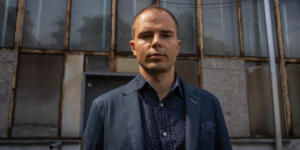

DOX met Hans Robert Eisenhauer twice, first in Strasbourg – at ARTE’s new home near other, prestigious, glass-covered European institutions – and next at “Documentary in Europe” in Italy, where Eisenhauer delivered a speech about European public service television. A shortened and edited version of the speech follows this talk with TUE STEEN MÜLLER.«
Hans Robert Eisenhauer: If you take public service in countries like France and Germany, I think that the importance of documentaries has even increased in the last ten or fifteen years. Sometimes on generalist channels like the ARD and ZDF, the documentaries appear later in the evening, whereas on ARTE, 3Sat and Phoenix they are shown in prime time. Especially in Germany and France, documentaries represent a large number of hours and are not reduced, as you also have specialist channels like Odyssée, Planète and France5. At ARTE we show around 2000 new hours a year – from Grand Format to La vie en Face to History and Science and many other programmes.
Eisenhauer is a true believer in television as a key tool for modern societies to spread information that enables viewers to take part in the democratic process. He is not afraid to use big words when he stresses that the aims of public service are Information, Entertainment and Education. Documentaries fit perfectly into that picture.
HRE: Documentaries tell people what is going on in the world. We have to keep the attention on the themes and we have to defend the independence of ratings. Even at ARTE, we have to watch the ratings but we also have to take care that we don’t only do things we know are successful.
Tue Steen Müller: … without ignoring the realities:
HRE: There is a tendency in documentaries to view them more like an entertainment programme. I hate this word Infotainment. People have to be entertained, of course, but they can be, too, if I give them knowledge.
TSM: ARTE broadcasts docu-soaps every night?
HRE: I like the French word better: “Feuilleton Documentaire”. Sometimes, docu-soaps allow us to do more careful studies, for instance of the lives of German soldiers in Afghanistan. We can go deeper. However, they are rather expensive programmes because of research, casting of protagonists, dramaturgy and protagonists. Frankly, it is difficult and will get even more difficult for ARTE to live up to high quality in this field, in my view. In general, however, the problems do not lie with the genres but with the subjects. The more a channel is pressured by ratings, the more problems the documentary themes will have. For example, it is much more difficult in Germany to programme a theme night about African subjects than a subject that is closer to home. I am a bit afraid that we have to make a choice between themes that are closer to the subjects and the others. It is dangerous if we avoid opening our minds to things in the world.
 TSM: So you must feel sad and lonely when you sit in a hotel room, switch on the television and see that 80% of the programmes are quiz and talk shows!
HRE: I also like to watch entertainment. I watched nearly all of the football matches in Portugal. The generalist public channels have to go for that as well. If you give up on entertainment and don’t go for the mass media side you will also fail on the information side and lose a strong market share. You have to have a strong information system and entertainment alike. But the question is, of course, how low the level should be!
TSM: Is football public service?
HRE: Yes, absolutely. ARTE is the official culture partner for the World Cup 2006 in Germany. We will do documentaries about football-related subjects and will hopefully have a live broadcast from one match on our channel directed by Jean-Luc Godard!
TSM: So ARTE is a niche…
HRE: No, ARTE is not a niche! Lots of our programmes are shown on ARD and ZDF. Many of the documentaries we support entirely with ARTE funds go around the third German channel. We are an additional offer, but our programmes also appear on the big channels. For example, the latest Pepe Danquart film, Höllentour, opened successfully in German cinemas. This was a co-production between us, Swiss television, WDR and Filmstiftung Nordrhein Westphalen. I was the commissioning editor, as I was for a ninety-minute documentary on Willy Brandt, a co-production involving ARTE, NDR and Nordrhein Westphalen. These are not niche programmes, they will be placed in prime time.
ARTE is, in my view, the last real generalist channel because we are showing all the different genres: fiction, documentaries, dance, opera, theatre, news, reportage – everything except live sports, talk shows and live entertainment.