Orlando Pantera was a pioneer of the Cape Verdean dance music style known as batuque. Whether true or not, a friend describes the first time he heard Pantera play a chord using a guitar made from a large oil can and strings. This is the kind of intriguing anthropology that Catarina Alves Costa delivers in the biographical music documentary named after the late virtuoso.

(Almost) everyone knew him
While Pantera’s fame was cemented by his tragic death just the day before he was due to record his much-anticipated debut album, the film avoids the conversation of his death, instead unravelling different perspectives of Pantera’s musical genius and charitable lifestyle. Apart from music, he volunteered at youth centres, spent time with his Cape Verdean community, and often travelled to Portugal. He was never in a rush, and the film’s slow and steady pace honours this way he lived, delicately portraying periods of his life through archive and interview, including footage of Pantera himself.
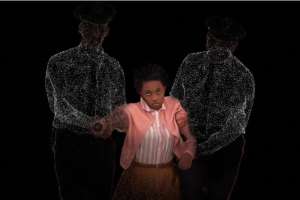
Almost everyone knew him, except his only daughter. Through this film, Darlene Barreto becomes a perspective character to the various stories about Pantera from childhood friends, community members and fellow musicians. While it is complicated for Barreto to hear what kind of parentage she lost, it is also cathartic and restorative for her to learn more about her father. In this way, the documentary’s focus becomes a beautiful exploration of Barreto’s personal journey through Cape Verde, its customs and culture, with her father’s legacy as a backdrop.
This is his carefree personality, which is as unexpected and untroubled as his music.
Laugh and keep playing
Often, the film takes a moment to portray the forest, the vines, and the people dancing on the street. There are long takes of music, a man playing the accordion, a woman singing an ode, a young girl learning to shake her hips. This is a film that understands that Pantera was part of its community, drew inspiration from its winds, and genuinely transformed the lives around it through music. He is shown as a deeply unselfish and patient man. When he makes mistakes in his music, he laughs and keeps on playing. He gives opportunities to fellow musicians from diverse backgrounds, such as a Martiniquais jazz player based in France. Even when the world becomes bigger for him, he remembers his home, the life of the village, the sounds of his upbringing.
It is this authenticity that carries over into the documentary’s music, all drawn from early recordings of Orlando Pantera himself. His style was unrefined but resonant, with polyphonic textures and polyrhythmic melodies at an andante tempo. The vocals are interesting in that they are very complex and domineering over the guitar melody, but a skilful singer finds a way to blend them both into music that invites listeners to dance. It becomes clear that batuque is a challenging artform, but Pantera simply plays casually.
This is his carefree personality, which is as unexpected and untroubled as his music. Yet, this is also why he did not speak much about his illness, acute pancreatitis, in his final days. Some characters in the film mention that he would give subtle hints, such as messages about how they could live without him. But they only came to understand this after his passing. His music, as well, is left behind as a gift which musicians have refined and interpreted. But, almost universally, Pantera is respected for both his musical proficiency and his character. We see this passed on to his daughter, who opens with curiosity about her father and closes with the same earnestness that Pantera displays throughout the film, as if it were inherited. A character remarks that her smile is just like her father’s.
Relaxing tones
When Pantera speaks to the camera, it is clear he was a delight. He delves into his music, his creative inspirations, and his passion for his community. At one point, he talks about raising funds for his debut album. Despite still needing a lot more money, he says he is sure it will come with a cheerful smile. At this point, he was already facing severe illness, but it was not evident at all.
The documentary adopts this relaxing tone, with characters echoing that while his death extinguished a bright light, Pantera’s inspiration continues. Even though he never recorded his debut album, his music remains present. This may be an uncomplicated message, but the documentary wants to make that precise. There is meaning and value in the simple life. It is as musical as it is earnest.
«Your essence assails my heart», sings a musician in the closing scene, while a fellow musician renders a contemporary interpretation of batuque composition. It is not said if this song is her own or Pantera’s. But that is not so important. Pantera will always be a legend. His music is Cape Verde. Cape Verde is his music.