The film opens with a scene inside an automobile: a father is talking to his young son about deep, troubling issues the child cannot yet hope to understand. The father asks the boy, «How much is two and two?» The boy replies, «Four.» The father goes on, «There are people who will tell you the answer is five. Usually, they’re called governments. Great leaders. It becomes very important to them that people believe the answer is five. They’ll tell you lies. They’ll torture you. They’ll kill you. At the moment of death, you must still insist that the answer is four.» Then we hear ominous tones from Wagner’s Götterdämmerung, and the movie begins in earnest.
We look more closely and see that the father is Eric Arthur Blair, aka George Orwell, and that he is talking to his son, Richard; it’s a scene from the film The Crystal Spirit: Orwell on Jura (dir. John Glennister, 1983). Jura is an island of the Inner Hebrides where Orwell and his family have gone so that the author can pen his novel, Nineteen Eighty-Four. Orwell might as well have been speaking to his younger self in the car, a wise figure addressing his naive counterpart.

Orwell: 2+2=5, directed and written by Raoul Peck (nominated for an Academy Award for his James Baldwin biopic I Am Not Your Negro), assembles Orwell’s letters and essays—voiced by Damian Lewis, who starred in Homeland, the series that normalised post-9/11 surveillance culture—alongside film adaptations, contemporary footage, and commentary from figures like Chris Hedges and Edward Snowden to argue that we’ve not only arrived at Orwell’s dystopia, we’ve exceeded it. Peck understands that Orwell has been weaponised by didactic forces across the political spectrum, his work reduced to Cold War propaganda or vague warnings about «Big Government.» But Peck refuses that comfortable distance. His thesis is stark: the rat cage strapped to Winston Smith’s face has gone from metaphor to operational protocol. It’s NSPM-7. It’s the drone strike. It’s the secret list with your name on it, and you’ll never know until the algorithm decides you’re a target.
Peck employs only Orwell’s own words—letters, diary entries, and essays—to construct his narrative. «I do not think one can assess a writer’s motives without knowing something of his early development,» Orwell writes in voiceover. «His subject matter will be determined by the age he lives in.» There are no contemporary historians explaining Orwell to us, no academic voiceover imposing retrospective coherence. Lewis reads Orwell, tracing his own roots from Eton snob child to the faux class advancement of his father’s military posting in Burma, then to his emergence as a self after the traumas of the Spanish Civil War, where he witnessed the equal brutality of left and right totalitarianism embodied by fascists and communists alike. The film becomes a visual memoir, a process of figuring it all out through recall. We hear Orwell wrestling with what he saw, not what he concluded. This formal choice matters: Peck refuses to deliver Orwell as settled wisdom. Instead, we encounter Orwell as a man radicalising in real time, his political consciousness formed not by theory but by watching the boot come down on human faces—and eventually recognising that he’d worn the boot himself in Burma.
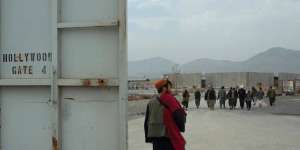
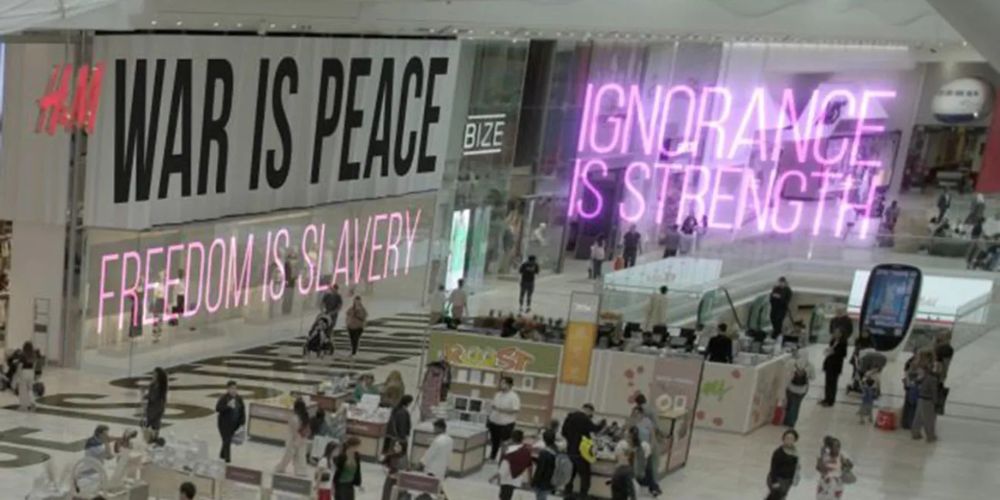
Peck structures the film around the Ministry of Truth’s four tenets—«War is Peace,» «Freedom is Slavery,» «Ignorance is Strength,» and ultimately «2+2=5″—interspersing them throughout alongside scenes from the animated Animal Farm, where the proletariat beasts strain to comprehend the high-minded rhetoric of their elite leadership, the pigs Napoleon and Snowball. These are complemented by contemporary post-Orwellian euphemisms: «pacification,» «collateral damage,» and «kinetic military action.» Images of fire-bombed Tokyo and devastated Berlin dissolve into equally obliterated Gaza and Mariupol; Myanmar’s burning villages echo across decades. Peck’s montage doesn’t argue for equivalence so much as continuity—the machinery of doublespeak and state violence operates across eras with remarkable consistency. The language changes just enough to maintain plausible deniability. The math remains constant: 2+2=5, if the Party says so.
At the heart of all this imagery and Orwell’s voiceover analysis is the struggle over language itself—its power, its meaning, and its capacity to construct shared reality. Ideally, we communicate with the Other and together negotiate the parameters of what’s real and what’s true. However, slogans, memes, jingles, and tweets rapidly turn communication into clichés, depriving words of their true meaning and turning them into weapons. «Freedom» means surveillance. «Peace» means perpetual war. «Security» means execution without trial. This is the thematic core of 1984 and Animal Farm: keep the proles from education, especially critical thinking, and they’ll believe anything. Marx taught us that whoever controls the machinery controls the narrative. Peck shows us the elites who’ve spent lifetimes and fortunes forcing 2+2=5 down the throats of the underclass—not through overt violence (though that too), but through the patient degradation of language until objective truth becomes a category error. You can’t resist what you can’t name. You can’t organise against what you can’t articulate. The Ministry of Truth doesn’t burn books anymore—it just makes them impossible to read clearly.
In America, where the great experiment in representative democracy once held high hopes—especially after George Mason forced the Bill of Rights into the original Constitution—one of democracy’s necessary sentinels is the mainstream media. As Thomas Jefferson put it, «Our liberty depends on the freedom of the press, and that cannot be limited without being lost.» Without First Amendment guarantees, the Constitution would be nothing more than a guarantor of private property owners. However, as Orwell eloquently observed, the people can exploit this freedom. Peck shows us how: we start by warring on an abstract noun (terrorism), then gradually expand the definition of what constitutes terrorism until it includes dissent itself. The prole animals watch, uncomprehending, as the pigs rewrite the barn wall overnight. Yesterday, «terrorism» meant hijacking planes. Today it means protesting, organising, questioning—or simply being designated as such on a list you’ll never see.
«Our liberty depends on the freedom of the press, and that cannot be limited without being lost.»
Sales of Nineteen Eighty-Four spiked 9,500 percent in the week after Trump’s first inauguration, according to Penguin USA—a panic-driven recognition that something had shifted. Peck takes special aim at Trump (though other global populists appear: Modi, Meloni, and Le Pen), and it’s fitting given Trump’s militaristic escalations pursued while courting a Nobel Peace Prize. «The friends of totalitarianism in this country usually tend to argue that since absolute truth is not attainable,» Orwell’s voiceover tells us, «a big lie is no worse than a little lie.» In one devastating sequence, Peck displays a New York Times piece from 2017—nothing but a long catalogue of the president’s documented lies and misinformation, scrolling endlessly. The visual effect is numbing, which is precisely the point. When lies accumulate at this velocity, fact-checking becomes theatre. The opposition exhausts itself cataloguing falsehoods while the machinery grinds forward. 2+2=5, not because anyone believes it, but because correcting it every single day is unsustainable. Eventually, people stop checking the math.
The film lingers on Orwell’s experience in the Spanish Civil War, and Peck understands why it matters. Orwell went to fight fascists as an idealistic socialist, joining the POUM militia. What he found shattered him: not just the expected brutality of Franco’s forces, but the ruthless dishonesty of the communists he’d come to support. In Dorian Lynskey’s biography The Ministry of Truth, we learn that Orwell witnessed Stalin’s purges replicated in miniature—show trials, disappearances, and the rewriting of who had fought where and for whom. The Left’s press lied as readily as the Right’s. Even the rats got to him: startled by a rodent in the trenches, Orwell opened fire and nearly got his unit killed in the retaliatory firefight. Later, those rats would become Winston Smith’s ultimate terror in Room 101. But the real betrayal came after: traumatised and disillusioned, Orwell returned to England and compiled his list—38 names of writers and intellectuals he deemed communist sympathisers, which he handed to British intelligence. Alexander Cockburn, the notorious polemicist for The Nation, where he penned the column «Beat the Devil,» called him «a rat,» and the epithet stings because it’s accurate. Orwell became the informant before he wrote the warning.
This brings us to December 2025, where the architecture that Orwell warned against—and helped prototype—has been perfected. Investigative journalist Nick Turse revealed that the Trump administration refuses to rule out summary executions of Americans designated as domestic terrorists under National Security Presidential Memorandum 7. NSPM-7 is the rat cage. The list is secret. The criteria are classified. You cannot know if you’re on it. The military has already killed 95 civilians in the Caribbean and Pacific under this «designated Gen. Gregory Guillot of U.S. Northern Command testified before Congress that he would conduct similar strikes within American borders if ordered, as part of the «terrorist organisation” framework. The rat cage strapped to Winston’s face has been bureaucratised, digitised, and operationalised. It no longer requires interrogators—just an algorithm that sorts citizens. This requires a clear understanding of the targets and a chain of command that is willing to execute the order. Orwell’s 38 names have become NSPM-7’s classified database. Winston screams, «Do it to Julia!»—but Orwell had already done it to his comrades, decades before he imagined Room 101.
Peck closes with a warning Orwell couldn’t have imagined: AI will amplify the effects exponentially. The rat cage transforms into an autonomous system that functions at a speed and scale beyond human comprehension.
It operates constantly, using facial recognition to identify your vulnerabilities before you even realise it. We’ve already seen this technique at work in Gaza, where AI systems sort civilians into targets with algorithmic efficiency. The algorithm doesn’t need Room 101’s interrogators; it just needs your data trail, your movement patterns, and your social graph. Freud understood this inevitability in Civilisation and Its Discontents—we’ll never reach moral equanimity as a species because there are too many rogues, too many who know how to manipulate reality into fiction, and too much will-to-power. The fight against 2+2=5 isn’t winnable; it’s permanent. But Peck’s film refuses despair even as it rejects false hope. The value of Orwell: 2+2=5 lies in its insistence on the witness naming the cage even as it closes. The father tells his son in that opening scene: at the moment of death, you must still insist the answer is four. Not because you’ll survive. But someone else might remember that the truth was possible.