
Confusion
The man behind sold-out performances both at the Berlinale and Copenhagen’s CPH:DOX is old school: He learnt how to be a director in Berlin during the 1980s, by masters such as Alexander Kluge, Chris Marker, Harun Farocki and Jean-Luc Godard. When I catch up with him in Berlin, he explains worriedly that the next generation of film makers is in the midst of the confusion of our time. Haitian Raoul Peck is a warm person, something not only his handshake gives away. Every time I have encountered him, including at Oslo’s Film from the South festival some years back, he has displayed a burning political involvement. For this reason I decided to film his Berlin Masterclass (which you watch at the end of this article).

I Am Not Your Negro portrays James Baldwin and his rolemodels: Medgar Evers, Martin Luther King jr. And Malcolm X. They all fought for black rights, and all were killed for doing so. Apart from Baldwin, something which Peck explains as ‘having framed him’, and provided him with a justification for existing: Peck spent ten years making the film about Baldwin as a political activist, a human rights activist, and an intellectual. Due to popular demand, it was neigh on impossible to watch I Am Not Your Negro in Berlin. It is currently being screened at 250 cinemas in the USA, and will shortly arrive in Oslo.
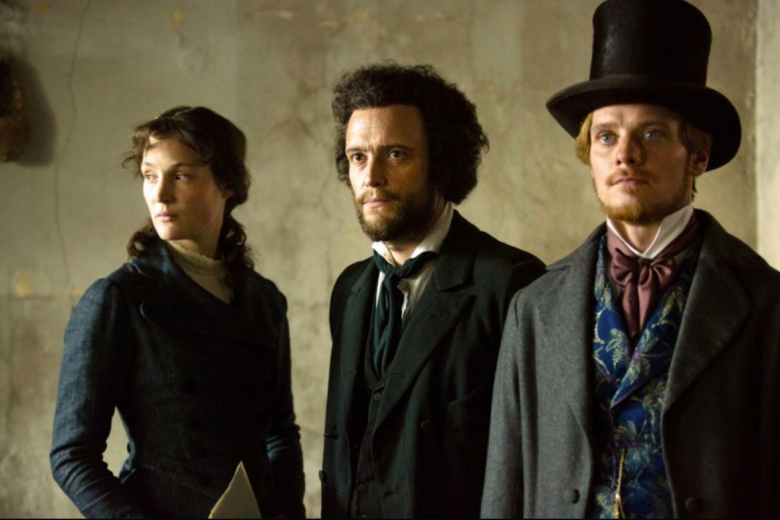
Peck spent a long time being preoccupied with Marx. He also spent ten years finishing The Young Karl Marx (Der junge Karl Marx). Both films depict intellectually political work. The way in which Peck created both a documentary (1992) and a feature (2000) about the murder of Patrice Lumumba, Kongo’s liberation hero and first prime minister, interchanging between genres. However, to the Haitian director, content always comes first – followed by the form. Likewise, the story about Marx and Engels in the British working class environment at the start of the 1800s is about the political content of the struggle leading up to the publishing of the Communist Manifesto. The narrative is built up around the two political thinkers and their political women – and the films are visually appealing. The black and white documentary about Baldwin features a completely different expression – but we are also here trailing Peck’s role models, similarly to how Baldwin followed his in the book about Evers, King and Malcolm X.
We all have role models, and Raoul Peck is one of mine. In the aforementioned film about the director – which you can watch on the Modern Times Review site – you will hear Peck explain about the political student environment he once was part of and their involvement in the ANC, Nicaragua and communist movement in Iran. He also speaks about today’s bombardments of pseudo-news and argues that I Am Not Your Negro is a film about the future. He asks: How are we able to find space, how will the confused among us be able to concentrate – without ending up as perfect consumers?