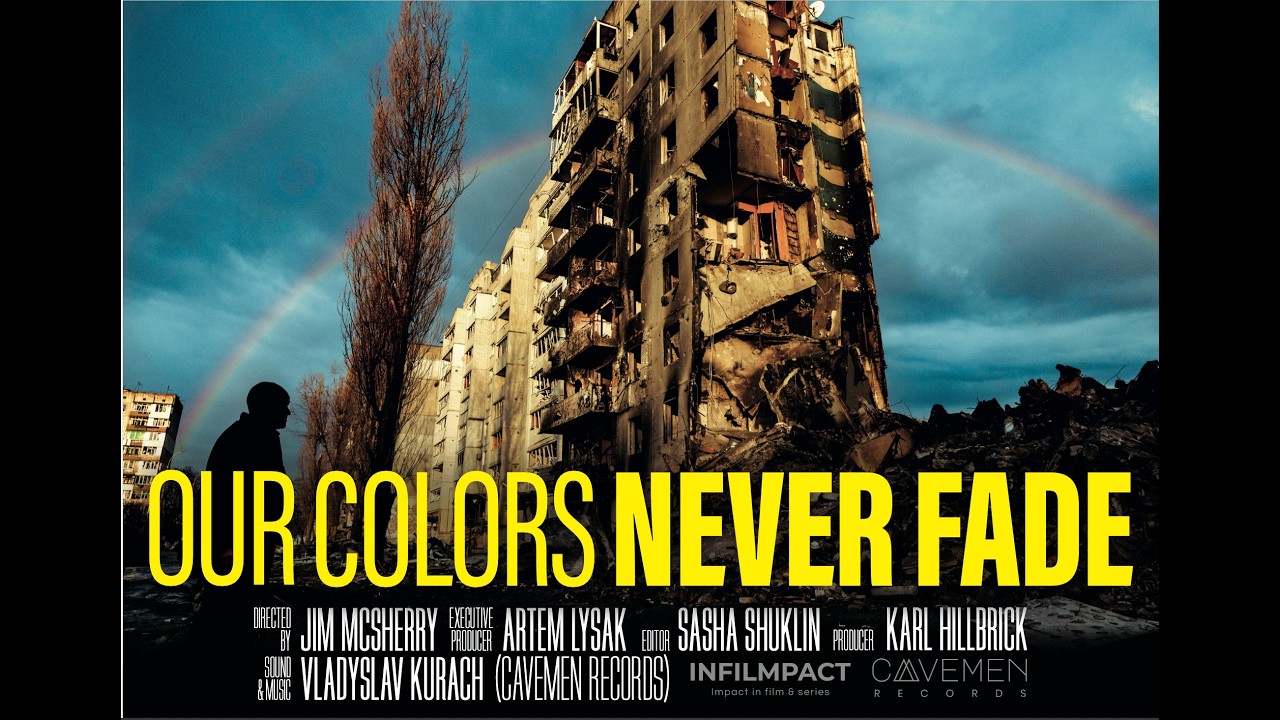
Berlin-based American entrepreneur and gay man, Jim McSherry, wanted to show how people from widely differing Ukrainian walks of life – who happened to be LGBTQIA+ — had taken up arms, or become medics, to defend their country after the Russian invasion of February 2022 was launched.
Pulling together a team that included top Ukrainian talent, a fellow Berlin-based Australian producer, and a single-minded determination, McSherry has succeeded in this privately funded documentary in telling a visually compelling, character-driven story that captures the visceral reality of a war that cares not about your sexual orientation.

Beekpeers to biologists
A serial entrepreneur who has also worked for major US charities, McSherry moved to Berlin five years ago. Learning about the LGBTQIA+ soldiers and medics in Ukraine – who now number an estimated 26,000 servicemen and women – he used his business acumen to make a film under wartime conditions that reflects his and his team’s passion for the subject.
His cast of characters—men and women—ranges from a beekeeper and bat biologist to a theatre director and a 2D-animation creator-turned-drone builder.
McSherry pulls viewers in with images and sounds of the shocking brutality of war from the first frame, as a writhing, shrapnel-peppered Ukrainian soldier is treated by a female medic who gave up an Erasmus University course in Ghent, Belgium, to return home and sign up. The ambulance lurches this way and that as needles and catheters are inserted in a patient who has a piece of shell fragment lodged in his neck.
«We tried to use a magnet to pull it out,» says Anna, the bat biologist, «but in the end decided to simply stabilise him and get him back for more suitable treatment away from the field hospital.»
Theatre director Oleksandr, who served alongside his boyfriend, Antonina, for months before deciding that it was best to end the relationship in case they had to deal with the other’s death or injury on the battlefield, weeps as he recalls the words of a battalion commander when he and other LGBTQIA+ members arrived.
«I know that there are gay guys in my unit. I have no problems with them if they are good fighters,» he told his men.
«I hope that there won’t be tension between you.»
Oleksandr’s emotion wells up, and he sobs as he adds, «It is difficult to remember because he got killed by the Russians on my birthday this year. He was one of the best fighters. He never left his people… he would take everyone with him – the wounded, the dead… everyone. He seemed immortal.»
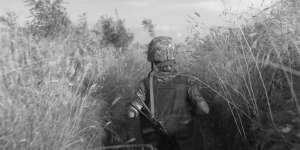
McSherry used the device of a television precariously balanced in bombed-out ruins, or an old military training range, to punctuate the key moments of the war – the invasion and battle for the airport at Hostomel, near Kyiv, that the Russians hoped to use for an airborne landing; the siege of Mariupol; the butchery at Bucha… With a haunting score, grainy colour grading for emphasis, and high production values, including striking cinematography, McSherry creates a powerful sense of what this existential war means for Ukraine.
He also uses raw smartphone footage shot as a Ukrainian unit escaped Russian capture after being surrounded in Mariupol – although a firefight with the enemy at one point leaves several wounded. «We were lucky, our guys had rifle-grenades already fitted, and blew the Russians away,» military medic Maria drily remarks.
McSherry creates a powerful sense of what this existential war means for Ukraine.
Homegrown prejudice
Russia’s homophobia – the detention and execution lists that it prepared for named victims before the invasion, its long Orthodox and Kremlin-sponsored history of encouraging queer-bashing (and worse) – is explored before the director segues into the home-grown prejudice these warriors face.
Oleh, who enlisted on the day of the invasion, 24 February 2022, first talks about how he and his father grew closer through initially serving together. Gradually, his father stopped suggesting girls he might date and dropped hints that he could organise visits to prostitutes. He finally accepted his son for who he was, dropping his own prejudices as he saw his son for who he was, rather than who he wanted him to be.
For others, it is still not so easy: Olya, a self-taught sniper jokes that she and her girlfriend look so much like two big guys in military fatigues, that most people do not look twice at them. But as she recovers from a battlefield injury, she finds her girlfriend is sometimes not permitted to visit her.
«She is the only one who can calm and comfort me, not my parents or anyone else. Only she,» Olya says.
Raw footage of homophobic demonstrations in Kyiv, the anger and spite some direct at the LGBTQIA+ community, reflects the uphill struggle these warriors face to achieve rights to civil partnerships, the right to have their spouses receive military pensions if they die under fire, and other challenges to equality.
Some wear arm patches bearing a unicorn that identifies them as LGBTQIA+ soldiers; others prefer not to advertise that fact; they just get on with the job of fighting the Russians.
President Volodymyr Zelenskyy has promised to back a shift to equal rights and a law on civil partnerships, but nothing has happened yet. Some hope that if Ukraine moves towards EU accession, it will happen anyway, as part of the country’s accession to the 27-member bloc’s legal acquis communautaire.
The film closes with the gut-wrenching screams of a mother whose gay son, Artur – a former musician and cabaret performer – is buried with full military honours.
As one of the characters remarks elsewhere, LGBQTIA+ soldiers bleed red the same as anyone else.
Attention demanded
Our Colors Never Fade had its North American premiere Saturday (13 June) at the Lighthouse International Film Festival, Long Beach Island, New Jersey, before moving on to screen at London’s Raindance Festival 2026 this week (June 21-22), where it is among the nominees for Best Documentary Feature. Its next festival slot is 10 July at the Wyoming IFF, in the USA.
With such a powerful message and strong cinematography, this film demands international attention and success.