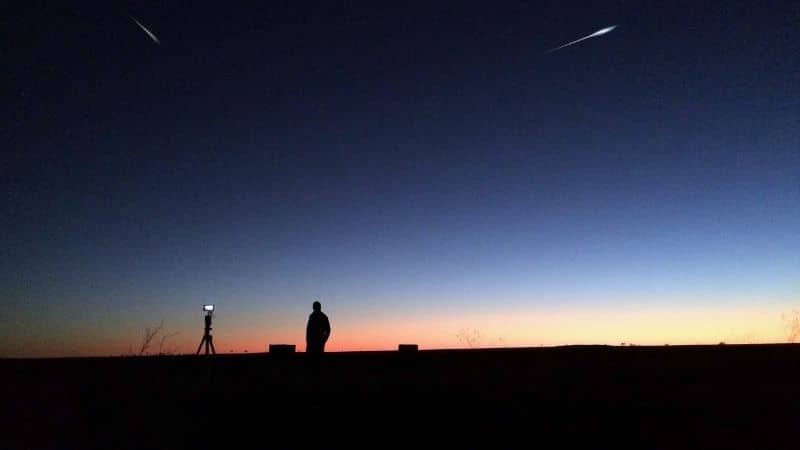
I once had the rare and remarkable experience of seeing a meteorite with my own eyes, swooshing across the sky with a trail of smoke behind it, up in a remote valley in #Norway. Even if it was a random event, I couldn’t shake off the feeling that the sight was something profoundly meaningful: what is extremely rare not only attracts our attention, but it is also charged, like an encounter that can transform us. It is this transformative power of the encounter Werner Herzog is after in many, if not all, of his documentaries.
Herzog’s latest film in collaboration with the British volcanologist Clive Oppenheimer has the suggestive title Fireball – and as their former documentary about volcanoes, it is a series of encounters with fascinating places and people around the world. One of the most subtle and intriguing stories is that of Norwegian Jazz musician Jon Larsen, who besides being a guitar virtuoso is a pioneering citizen scientist. Aware that there is a constant drizzle of microscopic meteorites from space onto Earth, amounting to a couple of truckloads a day, Larsen has figured out an astounding method to actually collect these minuscule particles. On the big white roof of the Vallhall Arena in Oslo, the drizzle of cosmic dust accumulates in puddles of rainwater and can be fished out with a simple magnet. When magnified millions and millions of times and photographed they reveal their alien origin; these fragments, which Herzog poetically calls «visitors from dark worlds» reveal beautiful, alien shapes under the microscope.
Wonder and terror
Granted, they can be beautiful to look at, but the really sublime aspect of meteors obviously comes from the threat they pose as a concrete form of cosmic terror or a kind of astral assault. The film touches briefly on the only person in modern times hit by a meteorite, an American woman, Ann Hodges, who was taking a nap in her home when a space rock plummeted down through her roof and burned her side in 1956. Who wouldn’t feel someone was giving a warning or message if they had such an experience? But what would be the message? What would random space rocks care for human affairs? Herzog’s harsh vision of nature tends to highlight meaninglessness in its raw form. But even seen from the perspective of an indifferent cosmos, these fatal and conspicuous events retain a fascinating, mythical quality.
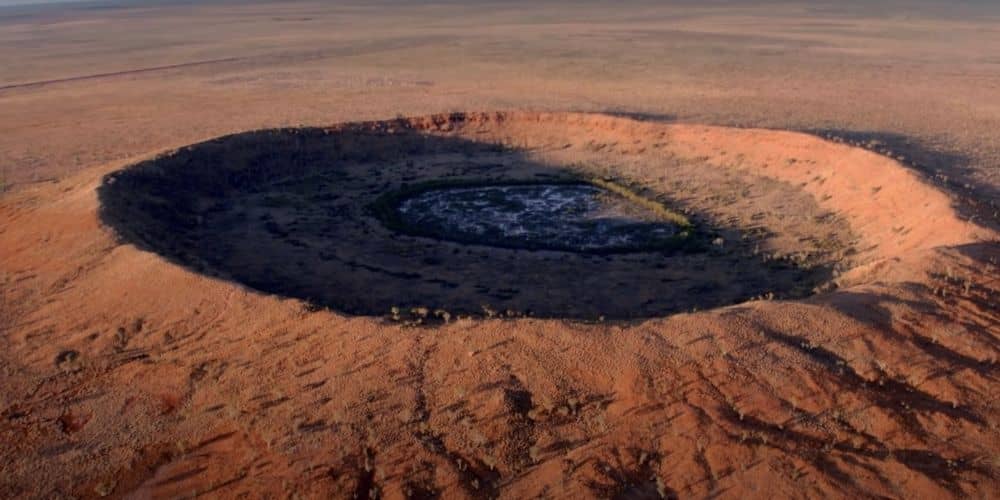
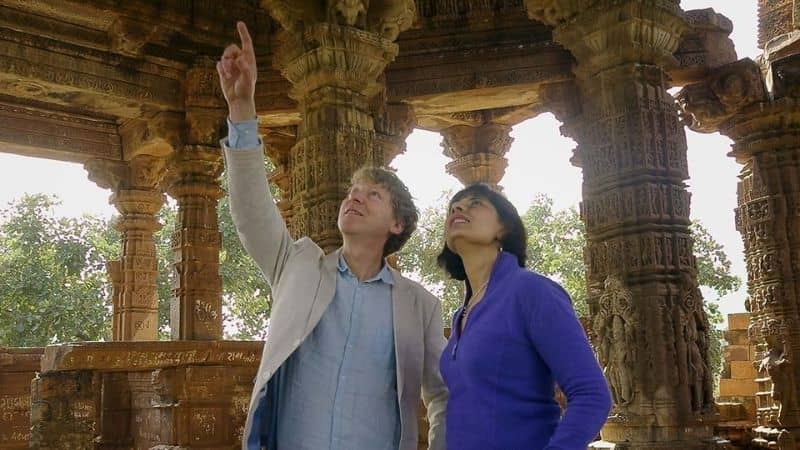
As Herzog and Oppenheimer visit impact craters in different regions of the world, they seek out local and religious myths, tales of Aboriginal forefathers and craters in #Australia or falling stars as vehicles for ancestors of Pacific islanders. In the Ramgarh crater in Rajastan, #India, next to a tantric #Shiva temple, they talk to geochemist Nita Sahai, discussing the astrobiological panspermia theory: Elements of life, such as proteins, or even life itself, might come from space. Like Shiva, the meteorite is a destroyer and creator of worlds. A local sadhu, living by the Shiva temple in the ancient crater, assures us that if all of life was wiped out, it would re-emerge here. In a billion years, perhaps. The Hindus are not strangers to deep time perspectives – and deep disruptions.
Disaster entertainment and science
The prospect of a fireball from above hurling onto earth and wiping out everything is very real, and the scenario is so totally dramatic that it is also perversely entertaining. Impacts such as the one that obliterated the world of the dinosaurs 65 million years ago, has been dramatized many times in documentaries, and Herzog gleefully admits that he loves these scenes, where the slow gigantic dinosaurs have their eyes burnt out by the flash of the impact while staggering toward the deadly shockwave that will soon follow. While visiting a «godforsaken town» Chicxulub in #Yucatan where this meteor once struck, Herzog idiosyncratically remarks, with amusingly unmotivated contempt, that the dogs in the streets are «too dim-witted» to understand what once happened here.
the really sublime aspect of meteors obviously comes from the threat they pose as a concrete form of cosmic terror or a kind of astral assault.
He seems to insinuate that even we humans are only now coming out of the darkness of ignorance, able to look out at the cosmos and contemplate our larger circumstances. And any day we could be wiped out ourselves, leaving the world to the unknowing eyes of random rats or cockroach-survivors, if not to complete oblivion. Herzog excitedly comments on the scenes of the end of the world from the disaster film Deep Impact, with giant skyscraper-high tsunamis rolling over Manhattan. We all know about the Tunguska event in 1918. A bigger rock will come sooner or later, and if humans are still around to see it, we might be oddly familiarized with the experience by a whole sub-genre of meteorite disaster films, such as the upcoming special-effect orgy Greeland.
Oppenheimer and Herzog’s visit at the Planetary Defense Coordination Office at the Mana Lua observatory in #Hawaii proves that there is more to these concerns than science fiction speculations. This office actually monitors meteors headed for Earth. The schemes to divert possible hazards with nuclear bombs, as they do in Armageddon, is discussed as a serious option, and there is some undefinable comic relief in Herzog and thanking the scientist-defenders: he ensures them that he’ll sleep better at night knowing they are on the case – as if they were policemen patrolling his neighbourhood.
Fascinating fascinations
In the film, the fascinated hunters of objects from space are themselves objects of Herzog’s fascination. More than anywhere else in the film, a sympathetic involvement is evident in the portrait of a Chinese meteorite researcher in the icy plains of #Antarctica, where Clive Oppenheimer also gets to experience the thrill of finding a rock from outer space. On one hand, this is the mythical story of an obsessed searcher, an archetype in Herzog’s oeuvre. On the other hand, there is an obdurate #realism in Herzog’s storytelling, which challenges the spectator to take in this lofty narrative while remaining firmly grounded. Thus, the film demonstrates how what is rare and extraordinary is nestled within what seems ordinary and gives a glimpse of grand and dizzying strangeness that envelops our world, which we feel to be so snugly familiar. With some of the unpredictability of life itself, Fireball discloses our cosmic circumstances with a quiet, invocative insistence.