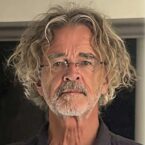
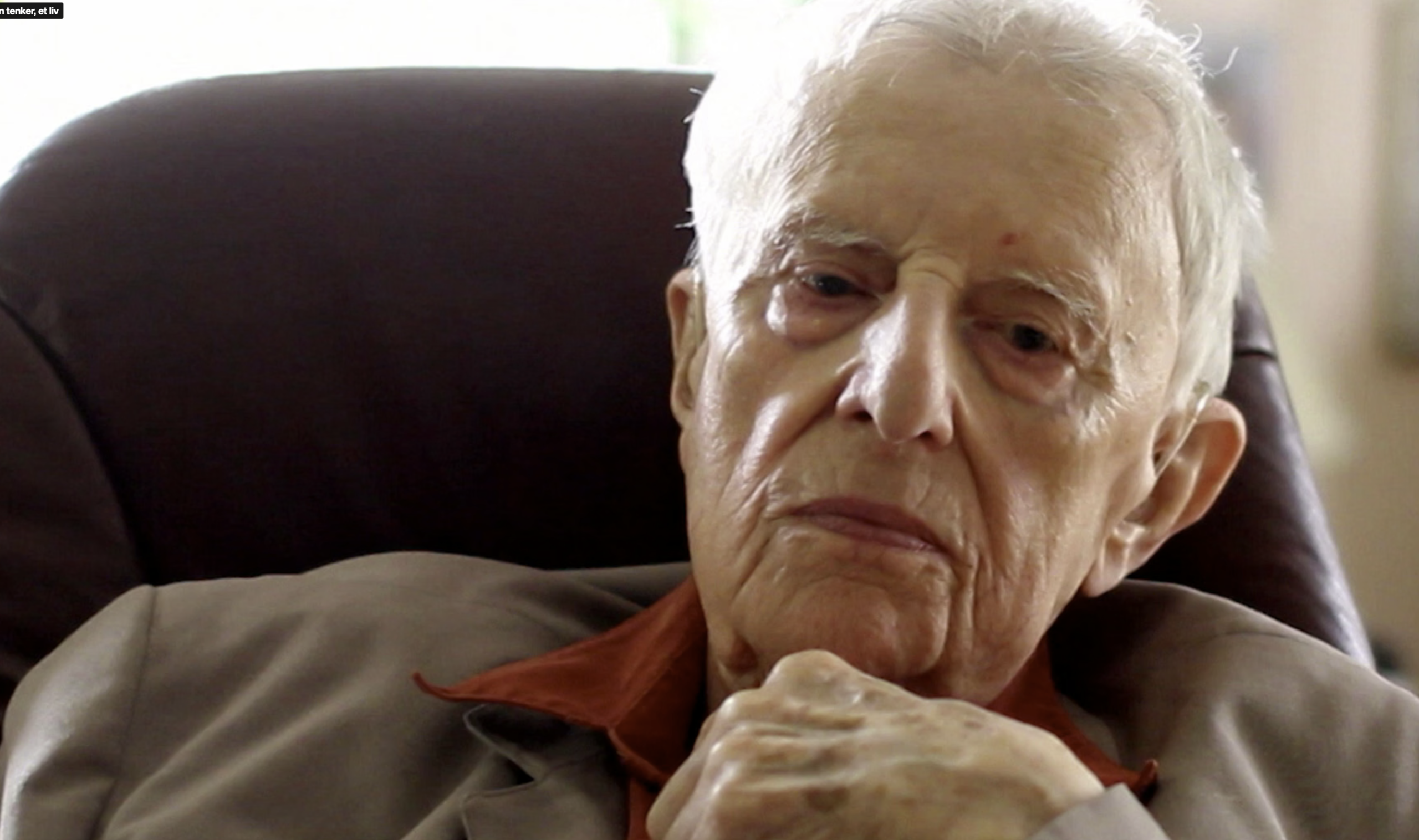
Asbjørn Aarnes is now 87 years old, ten years older than when I conducted what I thought would be my last interview with him, in Morgenbladet. My motivation for meeting him back then was the tension between modernity and postmodernity. He represented something different from my interpretation of French philosophical currents such as those of Foucault, Baudrillard and Deleuze, in which God had long since died. For does humankind still need a core, a foundation, a tradition, a God? Does the intellectual Aarnes – with all due respect – represent a dying generation? Or is his position a rewarding corrective in our time?
Has he changed his views every ten years? I have often turned to older people, people who have lived their lives to the full, to talk about what it gave them, to understand the choices they made, what was most meaningful, and not least the thought of soon having to leave it all behind.
IN MORGENBLADET TEN YEARS AGO we discussed the ineffable in aesthetics and the inviolable in ethics. 1Whilst for Aarnes the poetic ‘inexpressibility’ of aesthetics meant, in essence, keeping one’s hands off, letting go, listening, being open and attentive, the ‘inviolability’ of ethics demanded that one not be touched, but rather shake off any hold and step forward in one’s own dignity. Aarnes’ turn towards ethics came after his mother’s death in 1991:
‘After her death, I discovered this idea that the good, the best, is gone, that the best is not present. This idea really took shape through my reading of ethicists, but especially the French philosopher Emmanuel Levinas. His thinking was enough to fill a lifetime. Being part of a community was no longer enough – after my mother’s death, there was a ‘guest’ who was no longer present. This guest became more and more important, and out of this ethical reflection my religious conviction grew.’
Aarnes grew up in a Christian prayer-house culture in Møre, in Western Norway, during the interwar period. His mother was not a prayer-house Christian, but an enlightened believer. He recalled a winter’s day in his childhood when there had been a revival meeting, where they could see the tracks in the snow left by those who had rolled on the ground and confessed their sins in order to become new people. In this environment, God’s existence became a matter of course for him. Yet he did not see himself as a bold Christian.
Aarnes kept mentioning that ‘powerlessness’ during our conversation that spring. Was this a sense of a divine gaze, or simply longings arising from the frailty of old age? He believed at the time that few of life’s experiences could be attributed to his age. His faith in God was there, even though at times he saw shadows cast over the sun.
The old professor’s education had, then as now, a touch of a bygone era.
The old professor’s education had, then as now, a touch of a bygone era. In response to a critical question about cultivating powerlessness, Aarnes confirmed in 2001 that there might be a danger in Levinas’s impulses: that they invited a kind of quietism, where one lets go of the grip and says yes to powerlessness. Levinas preferred ‘peace’, a peace that arises when the battle – the clamour of the war of being – subsides. I know a few Dionysians, but I get the impression that they are simply getting high on their own; I have seen no sense of community.
Religion can be the opium of the people, as Marx once said. Something that typically arises in times of need. But in Norway, today’s young people have four times the purchasing power of their grandparents – that is, when Aarnes was young – so do they need his ideas at all?
‘It’s possible that people are too well off to be concerned with what I stand for,’ said Aarnes ten years ago.
HAS GOD BECOME MORE IMPORTANT for Aarnes, ten years on?
– Yes, it has become more essential for me to believe in a God. That faith was there in my childhood; it disappeared in adulthood, but has now returned. I developed a rather distinctive relationship with God through Levinas. It is not a God who is in heaven; he does not dwell anywhere, but is at work here amongst us humans. In the face of the Other, I see the traces of God. This conception of God is foreign to theology and conventional doctrine – I have met theologians, priests and bishops who are strong in their faith and proud of it; they seem to take on a certain radiance. But for me, God acts upon us without having an existence of His own; that is what is new about Levinas’s philosophy. It is a searching faith that tries to draw near to Him. The older I get, the more prominent and vital this becomes.
– But why is God a ‘he’ and not a ‘she’, or something greater?
– To me, He appears as a ‘he’; that is clearer to me than the idea that He is a ‘she’ or an ‘it’. Unlike theology and the clergy, who find their way to God via the sign, I am more concerned with the fact that He has left a trace behind. I cannot say with certainty who has been there, or where He has gone, but I am convinced that He has, in some way, been present amongst us, and is present amongst us.
And has he not had doubts about his faith?
– Doubts have often come to me along the way, as have the questions. But in a way, the doubt is no longer there.
Does he really believe today that the soul will live on, in a transcendence, something else beyond life itself, a kingdom of heaven?
– It is difficult to answer what it is that lives on, or whether we live on. Sometimes I have this belief, but I’m not certain that we have eternal life. I’m no more certain of it now than I was ten years ago. Every now and then it washes over me like a wave, the thought that we shall lead a life after death. Then this wave recedes, and I am left in doubt. But if there is a God at work amongst us, then it is perfectly legitimate to ask him, to be uncertain, and to move towards certainty in his presence.
Does faith help an old man like him to overcome the fear of what might happen?
– It’s like a gentle breeze, or a wave that washes over me and makes me feel safe. But then it recedes, and with it comes the insecurity and the fear of losing my life. The fear is real enough; it takes me by surprise. One cannot, of course, live a life without the presence of fear, but it does fade away from time to time. I have been thinking about why the Other is so important. It is because it is he who sustains me, even when fear and uncertainty take hold. But my life’s work lies in writing and thinking, and then the anxiety recedes. Then I have a presence that works within me – that works.
HERE IN LE MONDE DIPLOMATIQUE we often ask about the significance of French culture in Norway:
– French culture has been influential all along, ever since Norway gained independence. Apart from Levinas, Pascal, Camus, Valéry and others have influenced me. Interestingly enough, French culture doesn’t make a splash anywhere, but it works quietly – and more powerfully.
But Aarnes quickly steers the conversation and insists on talking about Norse and Norwegian culture instead:
– This is another culture that has preoccupied me a great deal of late. Both Jewish and Greco-Roman culture have had an impact in Europe. But during the Romantic period, with Snorri Sturluson and his Edda,2, a Norse impulse emerged that spread throughout Europe, in German, English and French translations.
The Norse gods are, of course, great and strong, but they are weak as well.
– Although I have been a writer in Riksmål, since we met in 2001 I have discovered the significance of Nynorsk and its connection to our Norse cultural heritage. Over the last decade, I have been writing in Dag og Tid3 in Nynorsk. This is a remnant of our past that should not be lost. Even if the trend towards joining the EU cannot be overcome – one fine day Norway will probably give in – we can still hold on to the Norse cultural sources.
I do not quite understand where he is going with this and ask what is so important about it.
– When one thinks of Europe, one thinks of strength, power and pride. In Norse mythology, on the other hand, there are many signs of powerlessness and a lack of power. The Norse gods are, of course, great and strong, but they are weak as well. When the Aesir were to bind the Fenrir wolf because fate decreed that he would do much harm, he tore thick iron chains to pieces. They then went to the dwarves and were given a thin silk cord. Fenrir was unable to break free from the fine silk threads. The great, strong Åsa-Tor performed the most marvellous feats, but was also tricked into testing his strength by lifting a cat and was unable to lift it. It later transpired that the World Serpent was hiding inside the cat. Åsa-Tor then tried to lift an old lady onto his back, but he failed at that too and was himself forced to his knees. Afterwards, it turned out that it was old age itself that he had grasped. No one can overcome old age.
Aarnes sees powerlessness as a remedy against a one-sided political or individual focus on strength.
– Powerlessness comes and interrupts our own movement. It stops me in a way that allows me to discover the Other, and God’s presence. It enables us to grasp what is most important of all. In Norse mythology, one does not find an ideal of how our country should be, but rather the value in surrendering one’s own power. The moment you do that, the Other comes to you – that which you cannot grasp yourself.
What about more volatile political situations? Afghanistan, Iraq and the wars in Muslim regions? Sharia law? Does he, following Levinas, see any solution to avoid all this violence; can he look beyond the philosophical and call for action?
– I do not believe Levinas is applicable to all cultural contexts. I have thought a great deal about the Muslim world. It seems as though it is strength that dominates there – a desire to conquer the world. I am not speaking of all Muslims; I know that some scholars lean towards powerlessness. But amongst Muslims, domination prevails – the strength intended to bring the world under their rule. I do not know whether Levinas’s philosophy is applicable there. He rather embodies Jewish caution, the Jewish act of listening.
– As for the action you are asking about: the Face of the Other tells you not to kill. So God reveals through his face not only what he is, but also what we ought and ought not to do.
And dialogue, the importance of which Foreign Minister Støre particularly emphasises?
– When two forces, two proud interlocutors, meet, one might sometimes think they will pounce on one another and strike one another. But then the conversation gets underway, and a subtle path to the Other emerges. We have no better tool than conversation.
I wonder whether it is really possible for free political dialogue to temper power, strength and pride. Can Aarnes explain this by saying that something divine arises from listening – a way of being in the presence of the Other where respect and humility arise?
– I think it is the words. They are not God, in the sense that the Gospel of John says ‘the Word was God’. But I believe that words and language are God’s breath. Language is not God, but it is God’s way of breathing into us.
– Levinas also says, of course, that the Other’s face is not visible, and that one cannot draw the face – rather, the face is something one hears. He refers to the Bible, where the prophet asked whether the thunder, the wind and the storm were God – but was told ‘no’. Then came the still small voice, as the Bible says – that was God. Levinas calls this rather ‘the gentle voice of silence’, that which speaks in the face of the Other.
Ten years ago, Aarnes spoke a great deal about community. What about considering this in relation to political responsibility, in the sense that, as Levinas says, one must ‘respond’? Can the Other also be conceived of as Europe?
– I have drawn strong inspiration from Europe, both from France and Germany, but I am sceptical of the EU, of a Europe of trade and technology, dominated by French and German politics and business.
The film made (in Norwegian)
I CANNOT HELP BUT notice that there is a male-centred community at the heart of Aarnes’s sources. All his references are to men, whether it be God, poets, mythological heroes or philosophers. What about love? Beyond his important relationship with his own mother, what about the significance of women in a relationship between a man and a woman, and the caress?
– I’m not sure about this. It can be decisive; I myself have met a woman who shaped and changed my life. But I’m not entirely sure, because a woman attracts us, draws us along and towards her, so that we ourselves may bring something to fulfilment. There is no powerlessness in the relationship. It is my own desire that drives me towards the woman. It is different from the relationship with the Other.
– Let me rather mention kinship, which is so important: the bond of blood. Because I come from a small family, I did not experience the bond of blood. Stronger still is the ‘kinship by choice’, as Goethe called it. I have gained so many good friends who came to me, who became a presence like the very light of life.
Another interpreter of Levinas, the Danish scholar Peter Kemp,4 mentions the discreet gentleness of the woman’s face and Levinas’s statement about the woman’s face as ‘a first revelation of the Other’ – but a ‘you’ of love, and not a ‘they’ of demand:
– The woman one lives with is important; it is difficult to imagine life without her. But there is a kind of external influence that affects me, and which enables me to master this or that by virtue of this relationship.
I wonder whether what is typically masculine tends towards a pragmatism of strength and power that often underlies war as a means. Is it possible that in women’s experiences one more often finds a wisdom that does not immediately turn to the violence of strength? Where is the presence of women in Aarnes’s life, or in his thinking about powerlessness?
– I don’t know what to say to that. Sons and daughters also mean a great deal; they mean almost life itself to me. It’s not that they should resemble me, but rather the unfamiliar – that they come to me as something overwhelmingly new. But if one is too bound by blood ties, one misses out on the greatness, on the splendour of the stranger, the Other.
Aarnes has lived alone for ten years here in his house in Røa. What does a woman, apart from his mother, mean to him in terms of meaning or as a source of inspiration?
– I have a strong relationship with the woman who was my wife. Many of our encounters were absolutely crucial. But to go from there to attributing value to her as a spouse – I don’t like the idea of that. It was rather the surprise, what she suddenly showed me. She took me under her wing, helped me.
I ASK MY OLD FRIEND AARNES to look back on his 87 years and summarise what was most meaningful in his life:
– It is my mother who stands out most in my memory. She was so forgiving and helpful. She didn’t have much to give, yet she gave of herself, so that I felt I had her support. Even though she was poor, she was still rich in what she gave me in those moments when I needed it.
– It is my mother who stands out most in my memory.
– When Mum died, it made a deep impression on me. A wave of emotion washed over me – which then subsided again – the realisation that Mum had now passed into eternity. And there she is, present for me. I pictured her face with a warm smile. It wasn’t that I was glad of my mother’s death; on the contrary, I felt sorrow. But at the same time, it was a kind of encouraging greeting from eternity.
So where is Aarnes heading – does he believe that his own impending death will hold something of eternity within it?
– Yes, the realisation has washed over me that there is eternal life. I saw my mother at God’s side. It was suddenly there; it came over me.
Aarnes himself once said that a grave is merely the place where you are laid to rest, a place you pass by on your way to somewhere further on. 5 His friend Egil A. Wyller also comforted him once when he was really ill, saying: ‘The “I” doesn’t die, you see, Asbjørn, because it’s never fully present on earth either; it’s only, as it were, temporarily present.’ When his mother died, he thought that everything she had told him and what lived within her could not disappear when the brain was gone. He would be less surprised if he were to meet us again after death than not.
Aarnes’ closing remark ten years ago was this: ‘I think that where we’ve been just now, during this conversation lasting a couple of hours, hasn’t been entirely on earth either. So perhaps we’ll have the chance to do it all over again.” I ask him today whether he thinks we’ll meet again somewhere else:
– I think that if we do meet, if there is life after this, then I’ll find her first. But there are many others, and my dear children and … We must be careful about saying anything on this subject.
Asbjørn Aarnes (87) worked on Norwegian and French thought and literature at the University of Oslo for almost fifty years. As a researcher, educator, cultural mediator, book editor and critic, he has left a deep mark on Norwegian intellectual life, with 800 publications and articles to his name. He was editor of Thorleif Dahl’s cultural library, and the driving force behind the Humanist Seminar at Granavollen, as well as the Humanist College in Oslo.
Truls Lie made an essay film about Asbjørn Aarnes, based on conversations held in 2001 and 2011.