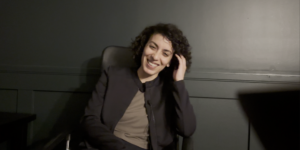
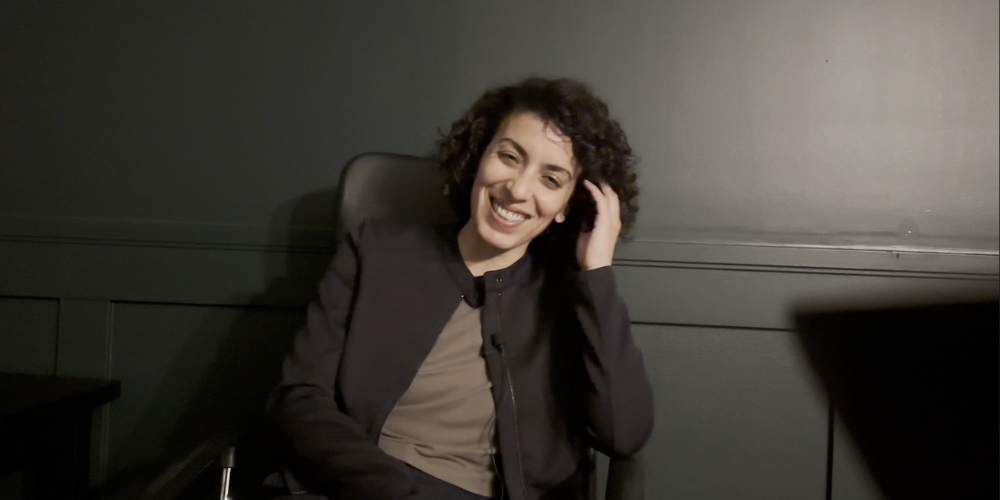
Noor Abed was born in Palestine in 1988 and lives and works between Ramallah and Amsterdam. She is a multidisciplinary artist – her practice unfolds across film, performance, and installation. She has established herself as one of the most compelling and original voices working in contemporary art today.
Abed’s formation has been shaped by an unusually wide range of institutional and intellectual contexts. She attended the Whitney Independent Study Program in New York (2015–16) and the Home Workspace Program at Ashkal Alwan in Beirut (2016–17), two of the most rigorous critical programmes for artists working outside the mainstream art world.
Abed later served as assistant curator for Documenta 15, the landmark edition curated by the artist collective ruangrupa that placed collective and community-based practices at the centre of contemporary art. She was also an artist-in-residence at the Rijksakademie in Amsterdam from 2022 to 2024. Occasional Papers published her book Stars at Midday two years ago.
Her work aligns with what the Palestinian intellectual Edward Said described as the struggle for the «permission to narrate». This is a condition in which the right to tell one’s story must be continually reasserted, often against discursive constraints that determine what Palestine is, how it may be seen, and how it may be experienced. Within this framework, her films cease to function as a medium of representation and instead become a site where narratives are produced.
The viewer confronts multiple cinematic layers that resist reduction to a singular interpretation. Her work can be read in continuity with what Frantz Fanon terms a «literature of combat» – articulating suppressed experiences while also shaping collective consciousness.
Her films’ political force lies in creating a space where what has been erased, suppressed, or marginalised can reappear.
Resistance not in opposition, but in the repetitions.
Palestinian folklore and oral tradition
Central to her practice is an engagement with Palestinian folklore and oral tradition — not as heritage to be preserved or mourned, but as living material to be activated, twisted, and made strange. Her films often draw on folktales: stories of water wells, communal rituals, and women mourning, singing, and moving together across a landscape that is itself a form of memory.
She works with local Palestinians as collaborators rather than subjects, and shoots on Super-8 and 16mm film, whose tactile grain and physical materiality run counter to the clean, distancing surfaces of digital image-making. As she once said: «For me, filmmaking is communal; it has to be connected to the land and the people. It takes a village to make a film.»
To watch one of her films is to encounter something that resists easy categorisation — not quite cinema, not quite documentary with performance, but something stranger and more demanding than either.
Her practice examines the imaginary relationship of individuals, creating situations where social possibilities are both rehearsed and performed.
Abed locates resistance not in opposition, but in repetition. The body’s slow, insistent return to the same gestures, the same songs, the same ground. Movement as resistance. But her films do not document resistance so much as enact it, treating the collective movement of people who come together to perform, rehearse, or remember as a form of political survival.
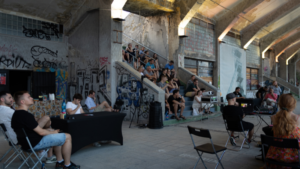
Exhibition with films
The films are not easily explained – with no voiceover or typical context, insisting instead on a sensory encounter that places the burden of attention on the viewer. Let us look at three films she has made, shown at her exhibition Cineography of a Landscape here at the Subversive Film Festival in Zagreb, Croatia.
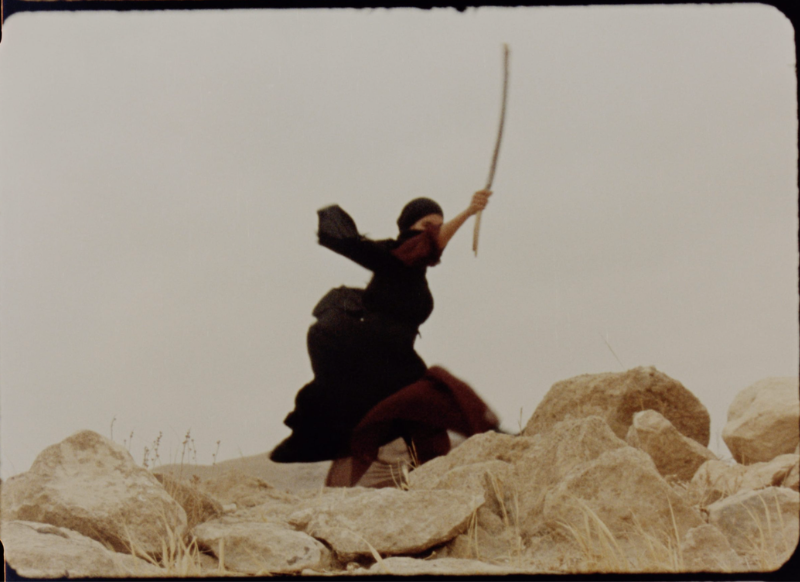
First, and most recently, A Night We Held Between (2024) is a 30-minute 16mm film that won the e-flux Film Award. The film moves through caves, underground passages, and carved rock formations, using sound, movement, and a recording from the Popular Art Centre Palestine’s sonic archive to construct history as a collective, imaginative present.
In the barren landscape, a group of people, donkeys, caves, wells, and light entering darkness do not constitute an exotic image of the ‘Orient’. Instead, as told in the festival, they enter into tension with a long history of Orientalist and colonial gazes that have imagined Palestine – and the Middle East more broadly – as a space of desire, conquest, fertility, and patriarchal possession.
A Night We Held Between centres on «Song for The Fighters», found in the sonic archive of the Popular Art Centre Palestine. Through the layers of the song, in a labyrinth of sounds and sites, the film conjures history as a permanent present tense, a collective and imaginative act. The film was shot in ancient sites in Palestine – caves, carved holes, underground passages, and wild valleys. The land becomes the film’s main character. Scenes intertwine rituals and narratives of community and resistance with everyday representations of social life in Palestine.
Keywords, keywords
Sitting down with Palestinian artist Noor Abed at the festival, I find a woman who has an intense look, steady eyes, and a mission to express her art. She is here in Zagreb at the Subversive festival. But Abed lives most of the time in Palestine – where, as we know but do not experience, people are killed every day.
I decided, as Abed is both a filmmaker and artist, to do an interview or conversation through keywords, words inspired by the three films in the exhibition, and also her role as a Palestinian. I say a keyword, and then she quickly answers what comes to her mind:
Let’s first start with the word «analogue».
– Eight millimetres. Or sixteen millimetres. Limitations, but also limitations that make you grow. Or limitations that make you find solutions. Scarcity and sacred at the same time. And not having enough to work with. You always need to find the moment. «Analogue», maybe it’s about rehearsal for me, rehearsing on the set, forgetting the camera, just clips. Fragments: you need to roll it, and one forms another.
Other words: «landscape» and «community»?
– Owning. Landscape is my main character. It’s the protagonist. The soul of the soil. The invisible and the visible, what’s hidden, what’s under the ground. As much as the beauty that is in the foreground. Layers of blood. Resistance and histories that passed over the landscape that carried so much. It’s an exercise of touching this landscape. This is what cinema is for me.
You have bodies in the foreground, on the ground, or in this cave. What about the «body»?
– The body follows the landscape. So all the movement is responding to certain landscapes. The landscape is the protagonist; it comes first. Then the body responds to it, comes out of it, or touches it again. So it moves with it. All the movement is choreographed within this landscape.
The «holes» in the ground, in the landscape, or a «passage».
– Portals, in other words.
Then: «Myth». It’s all over in your films.
Myth is a public imagination, communal. The magical in daily life. Dreams, all public, all communal, communal beliefs. This is where the strength is, when it is a ritual or a belief.
The collective
With myth and ritual, here you have a contrast to the usual, more explicit way of making films. It is not that explicit, but it triggers emotions, being the bearer of something, a kind of resistance, a kind of «language»?
– But is it my language?
I am looking for your motivation behind the expressions …
– I want to turn daily movements into some kind of ritualistic feeling. Like in documentary films, where the images are meant to be taken at face value. It’s an exercise of representation and formations. For me, it’s all about how we can touch a feeling. And all these rituals are full of collective feelings. Through collective movement and sound, sometimes through rituals. Whether it’s a beat on the ground or a singing voice, when it’s made collectively, it creates a lot of feelings and bonds. In that invisible realm in between, feelings are evoked through the synchronisation of bodies and voices. This is where I’m trying to touch something. And in every film, I try more and more – although I can’t say that I got there yet.
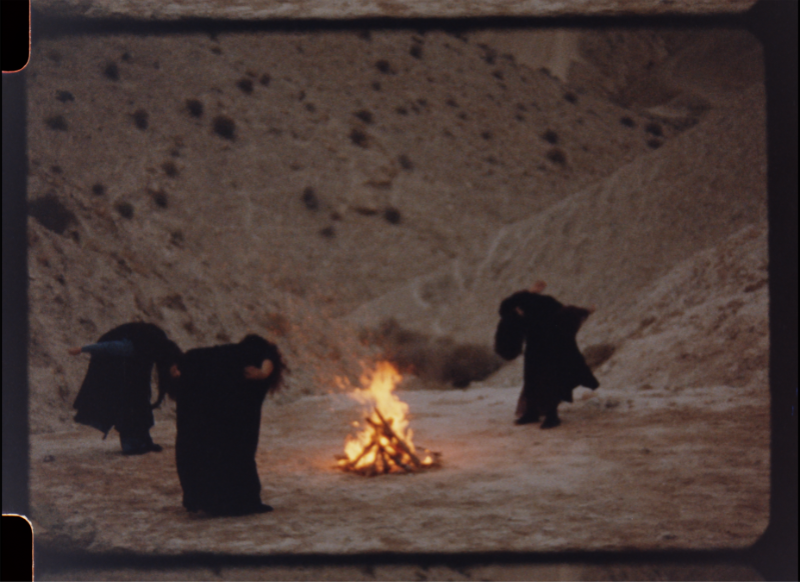
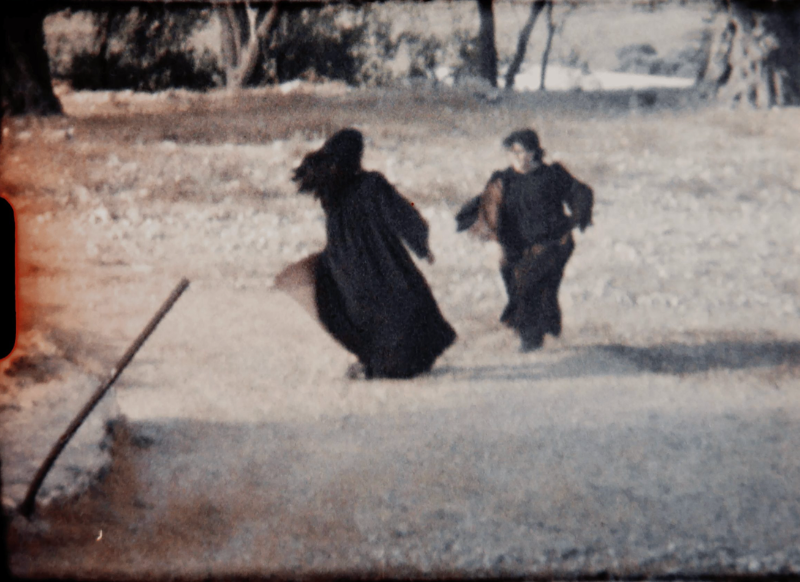
The second to mention, Our songs were ready for all wars to come (2021), is a 20-minute choreographed film that opens with two minutes of darkness and a single woman’s voice – an act of deliberate refusal that sets the conditions for everything that follows. The film weaves together narratives associated with disappearance, mourning, and water, staging women’s bodies in the Palestinian landscape.
Bodies gather, disperse, and reassemble into a shared rhythm, while space is not merely a neutral backdrop but an active element participating in the formation of relations.
As noted in the Subversive catalogue, and as observed in her exhibition, the choreographed scenes are inspired by documented folktales from Palestine. The film tries to reawaken latent stories around water wells and their connection to communal rituals of disappearance, mourning, and death. The film examines the critical stance of ‘folklore’ as a source of knowledge, and its possible connection & to alternative social and representational models in Palestine. And how can ‘folklore’ and popular tradition become a common emancipatory tool for people to overturn dominant discourses, reclaim their history and land, and rewrite reality as they know it?
The female voices and bodies do not appear merely as signs of a wounded community. They constitute community through performance: through song, lament, sound, repetition, touch, circular movement, and the transmission of motifs and rhythms.
So, another concept is «Soundscape», the background of a film.
– It’s the belly of the landscape.
In this film, I can use the keyword «song» – as deep in the cave, a woman is singing.
– This song was a song we made together, me and musician Maya Khaldi, the singer. It came from extensive research on folk tales and oral histories in Palestine. The communal, site-specific knowledge inspired me in the folk tales themselves. We call things by their names in the folk tales. Even if it’s a stone, even if it’s a mountain. There’s always a name for everything. So, people know their lands. In the context of this film, we wanted to write a song for this particular site. We gathered sentences/ words from different folktales, and wrote the song. Maya sang the song as a lamentation – a traditional way of mourning and singing for our loved ones who passed.
Gender-conscious perspective
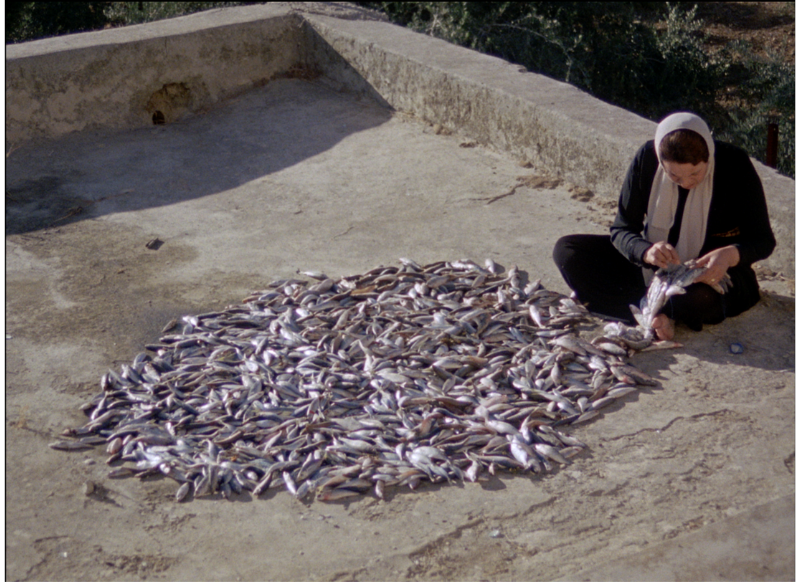
Inspired by Homer’s Odyssey, her third film, Penelope, examines the role and relevance of mythology to the present and the collective imaginary. Filmed in Palestine in 2014, the piece reimagines Penelope as a solitary female figure, weaving a quilt made of dead fish. Through a continuous act of sewing, she returns to a memory, evoking a poignant meditation on displacement and dispossession. The work attempts to reflect a reality other than the one history offers. Here, myth could be seen as a collective dream and public imagination.
The introduction of a gender-conscious perspective, like postcolonial feminism, articulates experiences that remain outside dominant colonial or patriarchal structures. In Abed’s films, this becomes evident in the way female bodies enter the frame, like how they are dressed and act.
As is written in the festival catalogue: «A postcolonial feminist reading of Palestinian culture suggests that the nation is often imagined as a community of birth, belonging, and origin. The very etymology of the word ‘nation’, derived from the Latin natio, meaning birth, people, tribe, or origin – stemming from the verb nasci, ‘to be born’ – points to a conception grounded in shared origin. The nation is inscribed within a symbolic order of family, maternity, and fertility. In the Arabic expression al-watan al-umm, the homeland as mother, this association becomes even more pronounced: the land is imagined as source, body, origin, protection, and return.»
There is this «longing», but also «waiting». In your film Penelope, about sewing fish together, waiting and waiting.
– But it’s an active waiting. She is sewing. She is doing a continuous act non-stop for the whole duration of the film – a kind of active waiting.
She has all the fish on her body – moving around on the edge there?
– That film was made 12 years ago – just to acknowledge that I was a different person then. But back then that movement wanted to capture this feeling, before the death of – especially fish – but also the death of a spirit or a body creature. There is a subtle space or duration when the soul leaves the body. With fish, they flicker and shake so intensely, as if announcing their departure. I think I was aiming for that.
«They need to go beyond the binary of the victim and not.»
Loss and death
What about «loss»? In Palestine, people are losing their dear ones.
– Yes, this leads me to ‘death’. And daily death. Death that is around us. You feel it in the air. And all the souls that have died unjustly. I always ask myself, where do they go? They are all around us. So it’s a way to work with them, listen to them, and continue what they started. These souls are our comrades. The loss of these souls is still telling us what to do.
What about the word «impact»? The consequences of seeing your films: what can you achieve with that resistance you are doing? Does it reach out to a wider circle of people?
– We need to think about what kind of images we are making and why. Especially in Palestine, as it’s one of the most documented places and people. We are heavily documented, so before every record, I check in with myself. Do I need to take this photo? So, this is an exercise. What goes to the final cut and what doesn’t. I believe that we need films and images that go beyond mere representation.
– And they need to go beyond the binary of the victim and not. Yeah, the images need to resist the history of colonial representation imposed on us. And they need to breathe a new imagination, a new political imagination, to open up. This is how they can impact anyone who receives them. How can we open imagination for new possibilities? This Zionist occupation makes possibilities impossible on a daily basis. This occupation keeps telling you that there is no future; there are no possibilities. They do it in the daily life of Palestine, even in billboards.
– It’s also in the direct military actions. If there is anything we can do, or the minimum we can do, it is to open up what imagination is possible. It’s not only about documenting; it has to elevate to another dimension as well.
«7th of October, the beginning of our liberation»
I want to shift the focus somehow to Palestine outside her films, as she is living there and knows what happens from the inside. So, three more concepts about the contemporary situation in Palestine.
What about «impunity» and «genocide»?
– The fascist attitude today is brooding in the world. I think we need to recognise that genocide is just a peak in a long history of direct military occupation and colonial history.
–And genocide becomes a very clear peak in that line. We are exceeding all limits of history. But it is a model that was born on ground already prepared for a genocide to start. And we are all complicit in that – Europe, the US, Arab countries made the ground for such a moment to happen. We need to think about that. How can we shake the ground before they are ready for things to happen?
– Yes, how can we make a rupture? This is what resistance is, if we talk about being anti-colonial as a daily practice – liberating ourselves from such complicities around us. And it can be from the tiniest things in your daily life.
What about «7th of October»?
– You’re going to publish all this about me?
Yes, I find your opinions extremely interesting.
– You know what I mean. If it were written, I would think more about every word I’m saying.
Yes, but try to answer.
– A new imagination for Palestine, 7th of October. Possibility.
If we talk about the next 10 years, what do you see?
– 7th of October is the beginning of our liberation. It’s the beginning of the end of the Zionist entity. This might take years, but nothing will be as it was before the 7th of October. And I want to believe that.
School of Intrusions
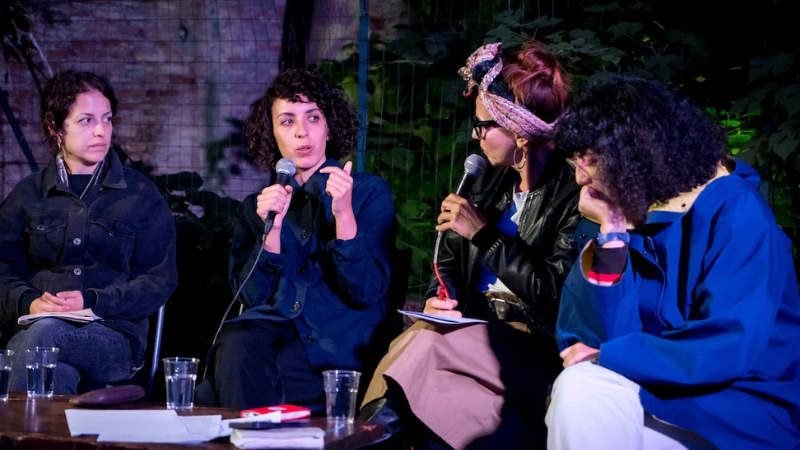
Noor Abed initiated School of Intrusions with Lara Khaldi in 2019. This collective in Ramallah is a platform for artistic and pedagogical experimentation rooted in Palestinian conditions of living and making. It aims to develop a space for collaboration by bringing together independent practices of mutual learning. Seeing education as a form of intervening in the world, not separate from daily life, the platform looks for possibilities for experiential, site-based knowledge; community formation; collectivism; and alternative economies. Through discussion, thought, and action, they attempt to actively intrude into private and public spaces.