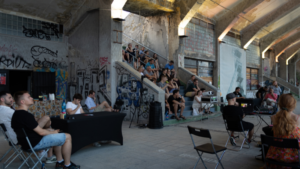

Based at the University College London Centre for Public Anthropology, Open City Documentary Festival creates an open space in the city to nurture and champion the art of non-fiction cinema. In doing so, it delivers training programmes, the annual documentary festival, a bi-annual Non-Fiction journal, and events throughout the year that aim to challenge and expand the idea of documentary in all its forms. In 2022, Open City Docukentary Festival presents its 12th edition. Running from 7 to 13 September at venues across London, including Bertha DocHouse, Birkbeck Institute for the Moving Image, Close-Up Cinema, Curzon Soho, Genesis Cinema, Institute of Contemporary Arts, LUX, and Tate Modern. Overall, 93 new and retrospective non-fiction films and 7 cross-media projects will represent the celebration of the Art of Non-fiction.
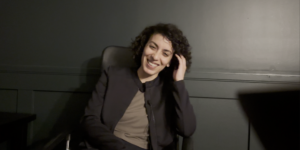
Ahead of the festival, Modern Times Review spoke with its Director María Palacios Cruz on the first post-pandemic edition, as well as her own introductions to creative documentary, and more.
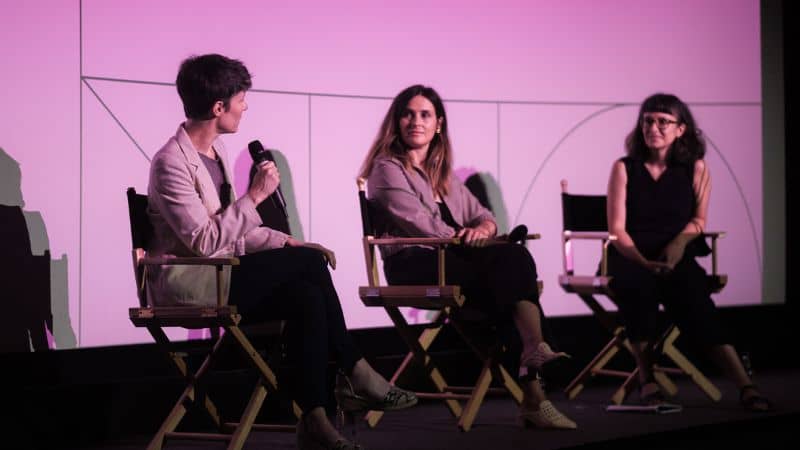
As with all festivals, this edition of Open City Documentary Festival will be the first following two years of pandemic-related adjustments (in Europe, at least). What were some of the lessons you learned from the pandemic-era festivals, and how do you see some of these transferring over to the staples of festival planning moving forward?
Our 2021 edition was largely in person – so the festival itself was not so different from this year’s (we were even able to invite some international filmmakers when the travel restrictions were eased last summer for those who’d been vaccinated), but the planning was dominated by uncertainty. We were working towards a festival without knowing if cinemas would be open in September, what limits there would be on audience numbers, what health and safety rules and protocols would still be in place… We were aware that for many of those attending the festival, it might be the very first time they had been back in a cinema after a year-and-a-half, and we wanted to ensure that everyone felt safe and comfortable. It’s been very different to plan for this year’s festival without having to worry about quarantine-related restrictions. Running a hybrid festival ultimately meant having to organise two separate festivals (one online, one in-person), which, as a small festival team, we don’t really have the capacity to do. This is a shame as the hybrid model made our programme more accessible, reaching audiences across the #UK. The online platform meant that we were able to offer films and q&a’s with closed captions, so this year we have continued to work with Matchbox Cine in order to offer a significant number of our festival screenings with descriptive subtitles.
It has been liberating not to have to organise covid tests for all guests etc., but the lessons, and the experience, from the past couple of years remain… We will never take for granted how wonderful it is to be able to be together, in person, in a cinema. It continues to feel precious, even after a year. But also, the pandemic has had a decimating impact on cinemagoing and film culture here in London, so there is a lot to rebuild or to build from scratch in terms of audiences.
What place does Open City Documentary Festival hold within the broader European non-fiction festival landscape?
We are based in a university (the festival is organised and funded by University College London), so we are more concerned with research and education than the documentary industry. This is not a unique situation because other festivals, such as #FICUNAM in Mexico and #Courtisane in Ghent, also share strong ties with higher #education. Our #academic context means that we are free from market considerations. Open City is quite unique within the UK non-fiction festival landscape, but I think the programming is comparable to other European festivals like Cinéma du Réel, #FID Marseille#, #DocLisboa or Punto de Vista, where I used to be part of the selection committee.
Unlike some of our European counterparts, we are very much a festival that addresses and serves the local community here in London. The large majority of our audience is London-based, and of course, it can be a challenge to run a small festival in a big city like London, where there is so much going on.
Our academic context means that we are free from market considerations.
What do you see as the primary responsibilities of the Festival Director role?
My background is as a programmer, so I am most comfortable with that aspect of the job, but having worked for several small arts organisations, I have a holistic approach and understand that artistic decisions cannot be separated from practical considerations such as finances, production, marketing, and so on. My role as Festival Director extends beyond working on the festival programme into areas like fundraising, overseeing finances, managing the team, maintaining relationships with stakeholders, etc. I need to be involved in all aspects of organising the festival, but I am very lucky to work with a really fantastic team, which means I can delegate a lot of responsibility. I believe in horizontal work structures, so I am not entirely comfortable with the idea of being «the» festival director. I want the decision-making process to be as inclusive as possible, even though, ultimately, the responsibility – for anything that might go wrong – lies with me.
What aspects of the festival in 2022 are you particularly looking forward to as a fan of non-fiction cinema?
I get very overwhelmed when I think of all the amazing filmmakers that will gather here in London in just a few days: #Ruth Beckermann#, #Jumana Manna#, #Elisabeth Subrin#, #Betzy Bromberg#, #Moyra Davey#, #Robert Beavers#, #Ben Rivers#, James N. Kienitz Wilkins, #Jonathan Perel#, #Tiffany Sia# … the list goes on and on. #Alexandra Cuesta# is a filmmaker whose work I have shown and admired for over a decade so I am particularly happy to be able to present her first UK retrospective, moreso that Alexandra will be able to join us from #Ecuador. I am also looking forward to the #Tsuchimoto Noriaki# retrospective, which continues until the end of September. It’s such a rare opportunity to see his films in the UK – with a number of films being translated to English for the first time.
What is the curation approach to Open City Documentary Festival in terms of the films selected and the ultimate programme constructed? What makes a «Open City» film?
We have tried to remove distinctions and hierarchies in the programme. All films are treated equally, regardless of length (and consequently we have invited all the filmmakers of «shorts» as well as of «features» to attend the festival). I felt uncomfortable with the competition when I joined in 2021, but the call for entries had already been open for several months, so it wasn’t possible to do anything about it then. We have removed all competitive programmes this year, which opens up the programme and makes it more cohesive. It has also allowed us to show more historical works and to present more monographic programmes (with Onyeka Igwe, Maryam Tafakory and Robert Beavers) that have been curated in dialogue with the filmmakers. For instance, Elisabeth Subrin’s Maria Schneider, 1983 has been paired with a 2003 film that Manon de Boer made with Sylvia Kristel, or Tom Chick’s portrait of Judith Noble will be shown with a couple of Judith’s wonderful films from the 1980s.
In terms of what makes an «Open City» film, I’d say that we are interested in works that reflect on their relationship to reality and truth but also think about their form, expand cinematic language, and challenge established conventions. Works that invite us to look and think anew, to be in the world and with the world. I conceive of the festival as a discursive space where we come together to think about cinema and think through cinema.
I conceive of the festival as a discursive space where we come together to think about cinema and think through cinema.
Is there a specific film, filmmaker, or filmography that kick-started your own interest in documentary film?
I believe that non-fiction cinema is at the vanguard of contemporary filmmaking. My journey from narrative cinema to documentary took place via #experimental film#. As I was finishing my Film Studies MA in Brussels, I encountered works like Man with Mirror (Guy Sherwin), Light Music (Lis Rhodes), Line Describing a Cone (Anthony McCall). It was the mid-2000s, and there was a resurgence in interest in expanded cinema and the #avant-garde filmic experiments of the 1970s. As someone who loved cinema, I completely fell for works that dissected cinema’s essential elements and conditions: light, time, projection. There was no going back. At the same time, filmmakers of my generation (like Alexandra Cuesta, but also others Laida Lertxundi, Beatrice Gibson, Ana Vaz, Ben Rivers, Luke Fowler, Mary Helena Clark, Basma Alsharif…) were making work – often on 16mm – which drew inspiration from the 1960s and 1970s avant-gardes but was also different, and often had a more direct relationship with #reality and documentary. Their films were very important to me as a young programmer and continue to accompany me and inspire me.