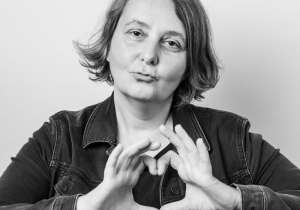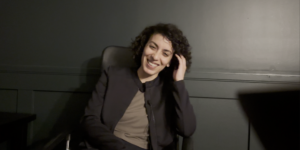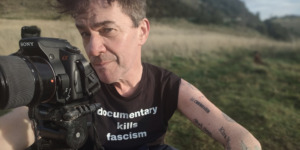
Laila Pakalnina is a Latvian director of both documentary and fictional films. She graduated from the VGIK film school in Moscow. Her observational documentaries are characterised by a minimalist approach, long static shots, and a lyrical atmosphere. Her short documentaries Ferry (1994) and Post (1996) were selected for the Un Certain Regard section at the Cannes Film Festival. She won the Golden Bear at the Berlinale for her short film Udens (2006). With the documentary Three Men and a Fishbone (2008), she received the Best Baltic Film award at POFF. Her latest film, Termini (2024), was presented this year at the Ji.hlava International Documentary Film Festival.
Are you more drawn to capturing fragments of reality, or do you prefer to create your own fictional worlds—and does it even need to be divided this way?
I decided to become a filmmaker during my studies in film school. There was something magical about the films. I also realised I want to make documentary films, not fictional ones. Because life itself—everything that’s going on outside our windows—appeared more interesting to me than anything we could imagine or try to create in a fictional way. The process of looking around and choosing which pieces to «cut out» for other people to see is fascinating. And I´m not talking only about people’s faces or some actions, but about light, sound, and composition.
Then, not so long after my graduation, there was one point when I suddenly understood that I could use the same cinematic language for fiction films as well. So, from that point on, I started to do both. But there lies a strict line for me. I never stage in documentaries. If I should define the method of my work somehow, then I would say that it’s based on observation. We put up a camera and then wait for what will happen. In this way, documentary film is like a mirror in which/where people can see what life looks like and feel its atmosphere.
So is it more important to you to capture the pure reality in front of the camera without any input, or would you say it’s essential to put part of yourself in it as well?
We try not to interact with reality at all. But at the same time, all these decisions about how we frame, how we make composition, where we put the camera, and so on depend on our emotions and are already very subjective. And, of course, as soon as it comes to editing, it is again very personal. So, we can never say that it shows an objective reality.
Are you aiming for a social appeal? Are your films a form of social criticism?
I think none of my films are directly social, even though they all somehow describe current society. Not directly, but it is present there. For example, when the Russian invasion of Ukraine started, we were working on something else, yet still, this war impacted how our images looked. Even though that film was about nature, the atmosphere of war was present there.
Is it necessary for the theme you are working on to be your «inner» one? Or can it become personal during the filmmaking?
In fact, it could be both. Sometimes, I make films about themes that are familiar to me in my everyday life, and other times, they become personal later during the process. However, every film is, in its own way, an exploration.
Why did you choose to explore time?
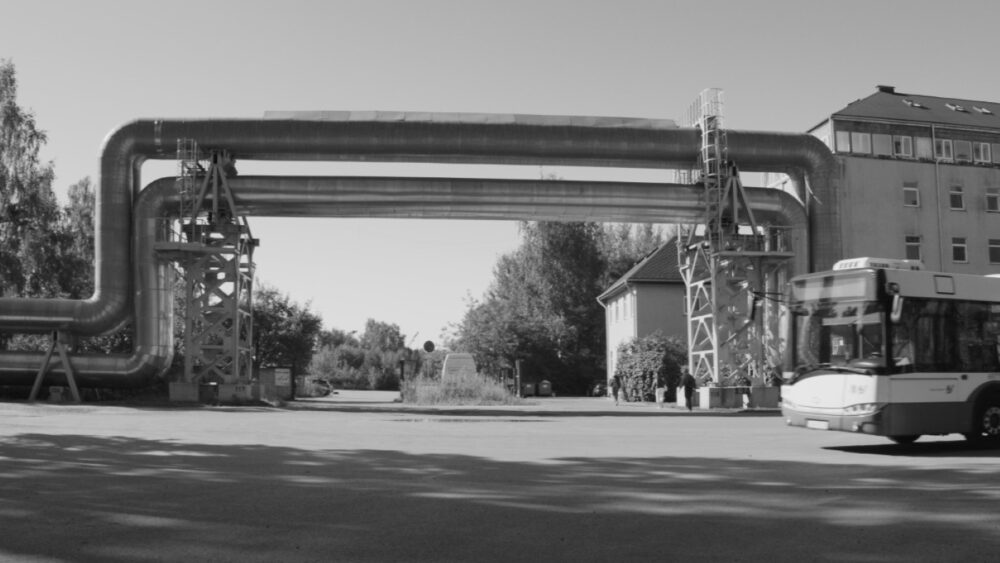
For me, it always starts with the form, not the main theme. First of all, I need to find out how to make it—whatever it will be. That is the most interesting approach. The idea of my newest film, Termini, came to me suddenly during my morning jog when I was passing by the last bus station. I realised that this place is like its turning point. It came to my mind to make a film with an endlessly moving camera turning around. In the end, the camera turns three hundred and sixty degrees around only a few times, but it was enough for the desired result.
Was the shooting an endless waiting for something to happen, or was it also fun?
Of course, it was fun! Just imagine. Four people were on the set: me, the cinematographer, a focus puller (assistant of the camera), and the sound director. But obviously, we couldn’t just stay in place; otherwise, we would destroy the shot. So we were all moving and hiding behind the cameraman, which looked very comical.
The first shoot was a special experience for us because we didn’t follow any specific object with the camera; we were just turning it around. Even if something interesting happened behind the camera, we couldn’t change the course. It became a very interesting method—another way to explore reality. Most of my films only have static shots, making Termini very special.
What criteria did you use to select filming locations?
We had a city map and kept following the public transport schedule. Even though we didn’t manage to shoot in all of those last stations in Riga, now I know there are forty-seven of them, as many as dots on our map.
In your documentaries, the visual component usually predominates with minimal use of music or dialogue. How important is perfection in the visual aspect for you?
I believe that the language of cinema is very rich, so there are enough tools to create what I need to express. I don’t need music in most of my films because I can find it in images. I believe this method allows the audience to be in the film by themselves. In fact, music is very manipulative; it pushes you to feel in a certain way. And I don’t want to manipulate or say what is the right reaction, feeling, or understanding.
How did you reconcile composing perfect photogenic shots and working with unpredictable situations?
I don’t need music in most of my films because I can find it in images.
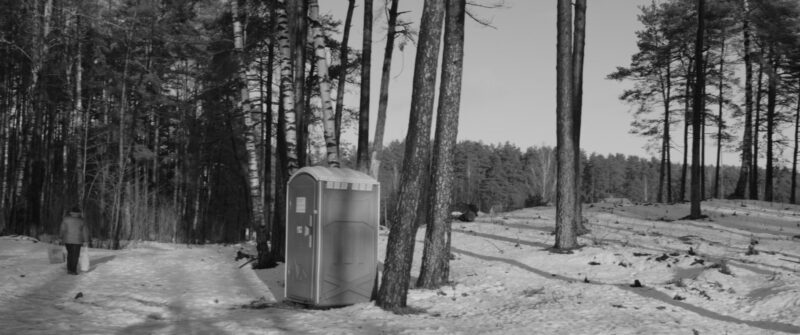
That’s connected with two important things. The first one is my cameraman, Gints Berzins, who I work with in most of my films. Another thing is what happens, that happens. Since our idea was to put the camera in the position of human eyes and evoke their movements, the camera needed to be quite calm without suddenly changing its direction or rhythm in one shot. In this way, it captures literally what life gave us.
How do we capture «life itself?»
There is only one way to achieve it. Somehow, they become invisible. Even if it is not possible literally—we are not magicians—there is still no other way than trying. Luckily for us, a camera is not as huge as it was fifty years ago, yet it is still bigger than a mobile phone. So, in fact, we need to try to be invisible, pretend we are not there, and at the same time, be very open to anything that will happen.
What was the most unexpected thing that happened during the shooting?
Very last shot of the film. The way I decided to finish it. Then, it was also the feeling when we returned to our homes, and yet the city looked so different. Especially these forgotten places. It was a strange feeling.
How did you approach filming people on the street? Did you ask some of them for consent?
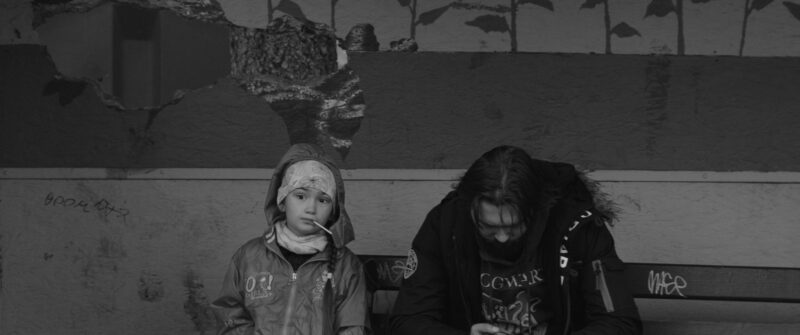
Not at all. We never contacted them initially. Of course, a few cases occurred when people came to us and asked what we were shooting. Older people usually thought we were television, and one woman even wanted to complain about some troubles in her street. We kept saying that we were shooting the city. In a way, it was true.
Are there any ethical questions you engage in your work?
Not with this film. However, my cameraman and I faced this ethically problematic situation when we were shooting a very sad scene with a really small coffin in our film Linen, capturing a children’s hospital. We decided to show it in a wide frame. Afterwards, we were told that we should have gotten closer. But it was such a tragic situation that shooting it in the way we did it was already too much. Why go closer and shoot the faces of suffering people? Wide shots can express the same.
In all those ethical questions, I very much trust my feelings sense. It is not necessary to go where you feel that you shouldn’t. I know some people would go closer because they feel they can. Then, it becomes a different film. For me, the ethical border is where my personal border is.
For me, the ethical border is where my personal border is.
Could watching the film be intentionally a form of waiting?
I would say not so much waiting but watching and observing. It is not much about what is shown to you but what you observe on your own. This is how I would watch the film.
Are you looking forward to your first screening in Jihlava?
Yes, I’m looking forward to the audience´s reactions! Unfortunately, I won’t be able to come by myself but my cameraman will, which is great because his role in this film is really important. Moreover, part of the editing process was made in Czechia, specifically the colour grading, which is an important process even in a black-and-white film.
This article first appeared in DOK. Revue. Interview by Sára Kolomazníková