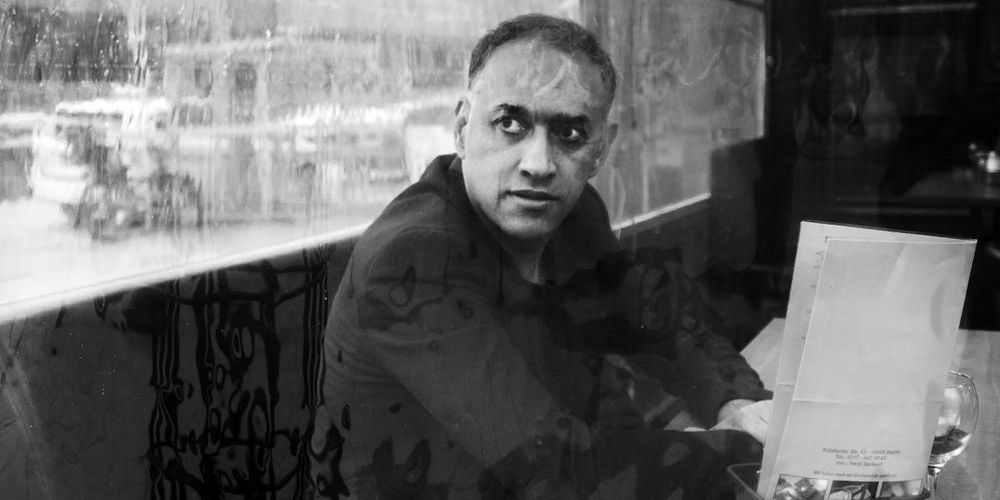
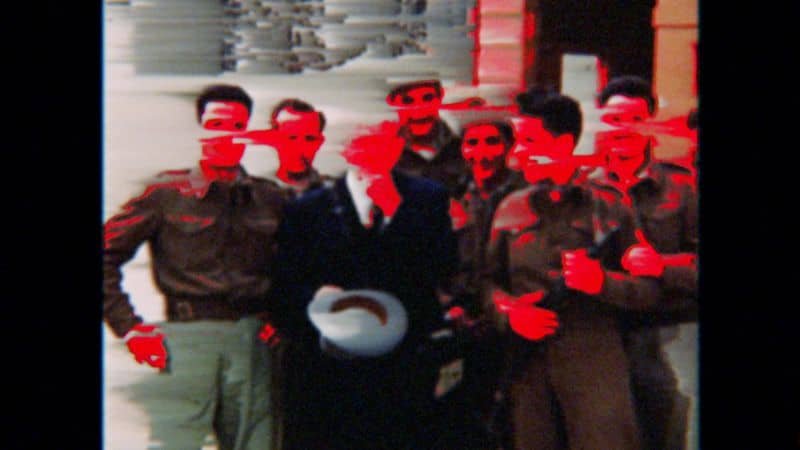
The prologue of Catherine Russell’s book Archiveology (2018), which examines archival practices through the philosophy of #Walter Benjamin#, ends with a reflection on Kamal Aljafari’s Recollection (2015), describing it as a «good opening example» of what archiveology is. After making four short and feature-length documentary films, Recollection marked the first time the Palestinian artist worked with footage he had not shot himself. The film is composed of images from Israeli and Hollywood fiction films shot in #Jaffa between the 1960s and 1990s, from which Aljafari digitally removes the actors, leaving only the extras and the landscape. Through this method, he explores the place of his maternal family, giving it new dimensions for reflection and reinterpretation. A similar, yet maximised, way of archival reappropriation arises in his recent A Fidai Film (2024). Through a complex process of obtaining materials seized from the Palestinian Research Centre during the Israeli invasion of Lebanon, the film reconstructs the content of a nation’s past life, the suffering of which is crystallised in the film copies themselves. By montaging the archives, Aljafari actively disrupts a history recalibrated by Israeli #propaganda, employing artistic interventions by literally redrawing and rewriting falsified meanings. Through this expressive act of incursion, the film becomes an allegory for meanings erased under the oppressive state.
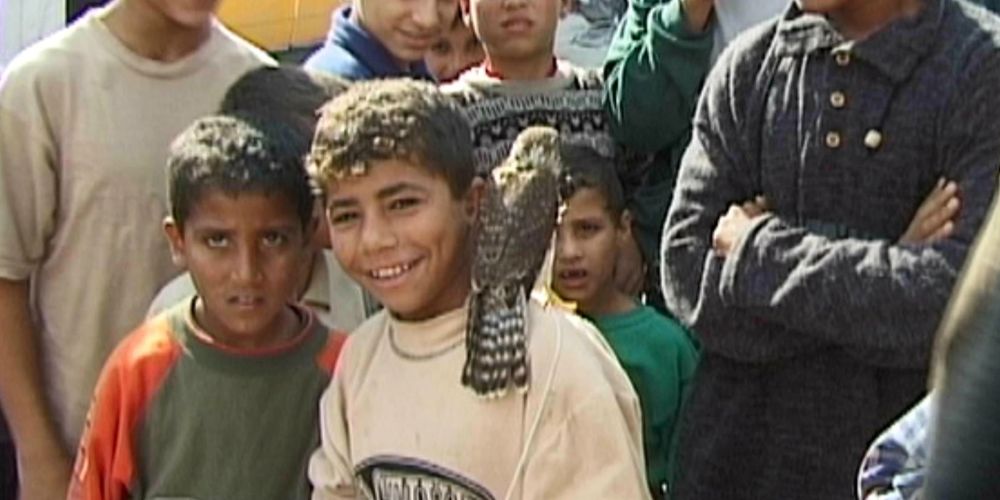
Aljafari’s new film, With Hasan in Gaza (2025), takes an entirely opposite approach to the treatment of archival material. In 2001, before completing Visit Iraq (2003), Aljafari shot material in #Gaza using a MiniDV camera. In this footage, Aljafari, accompanied by a local guide named Hasan, travels through the region in search of Abdel Rahim, with whom he had once served time in Israel’s #Naqab prison. Aljafari could not place the origin of the footage until he recognised himself in one of the scenes, and his first and forgotten film came to him anew at exactly the right moment. Treating the material as a valuable time document, he made almost no interventions, allowing its indexical link to the present to speak for itself. With Hasan in Gaza, it thus becomes both a poetic tribute and an act of mourning, as its grief is rooted in the simple fact that this place no longer exists.
In the epilogue to her book, Russell writes that contemporary archival practice allows the filmmaker to be «both builder and destroyer, constructing new work out of old and making new ways of knowing out of the traces of past experiences.» This is an apt description of Aljafari’s current position as a filmmaker, as his authorship reflects a wide understanding of how to engage with archives at precisely the right, dark moment.
We sat down with Kamal Aljafari immediately after With Hasan in Gaza premiered at the Locarno Film Festival to discuss his delicate approach to the footage and reflect on cinema’s power to create solidarity. This interview has been edited.
The fact that you forgot that you shot this footage made me think about the essence of archival practices, where the effect of forgetting is embedded. Yet this effect came to you in a literal way. How do you situate this experience within your career, presenting with Hasan in Gaza as both your latest film and perhaps the first film you ever shot?
Scientifically speaking, yes, this was the first film I shot. It is quite a mystery how this happened—I shot it, I forgot about it, and I just found it a year ago in this very particular time when these images are needed and they make sense. I have no explanation for why I hadn’t seen them for all these years. I lived in different countries and different places, and I always had these tapes with me, but I never came across them. There’s something very magical in how they [tapes] appeared—in this particular moment, when they were needed. With the destruction of Gaza and life in Gaza, these images, these tapes had value. What is special about this film is that it was making itself all this time, and it was beyond my decisions. For 25 years, it was waiting to be discovered, and I started working on it right away because I just had to. It is truly not the kind of thing that anyone can plan.
I have been interested in found footage, and I have made a couple of films using archival footage, but I did not intentionally decide to do so. I don’t know, maybe tomorrow I will find something else, but right now I want to shoot a film. I have been saying that for a couple of years now, and every time there is something else coming in between, and this was the case with this film too.
There’s something very magical in how they [tapes] appeared—in this particular moment, when they were needed.
There is such a striking formal opposition between your last two films. In A Fidai Film, you use archival footage for reinterpretations through distraction, while in With Hasan in Gaza, there are very few, gentle interventions to the footage. What determined this necessity of intervention?
With Hasan in Gaza is so different from the film I made last year, because it is a found film in almost a literal way. I almost did not intervene in the editing, and everything that you see in the film, the way it appears, is in the order I shot. I had already edited in camera, but unintentionally. In that sense, it is really a document, and it was important to keep it as it is, and there was strength in this material.
The textual interventions were important because subtitles and even the end credits are kind of an act of memory. We carry with us so many memories, so many stories that we don’t have the chance to tell, and we forget them until something triggers us, and we start remembering. I have to say that if I hadn’t discovered this material, most of these memories would have disappeared. In fact, this is where the relationship between the artist or storyteller and the viewer comes in—in mediation through the sharing of images and memories.
Those several interventions helped to bring in an emotional aspect in another, more personal layer to what we see. But also, bridging the past with the present, without showing images of the present and talking about the present in a direct way, because I believe that everybody knows what’s happening, everybody has seen something. Even if you don’t want to see, you know. People know, and it is inside them already.
I felt that the sound shaped the film’s bitterly contradictory tone—serving as a poetic homage to the people of Gaza, while also functioning as a harrowing ghost story. How did you approach creating such a haunting soundscape?
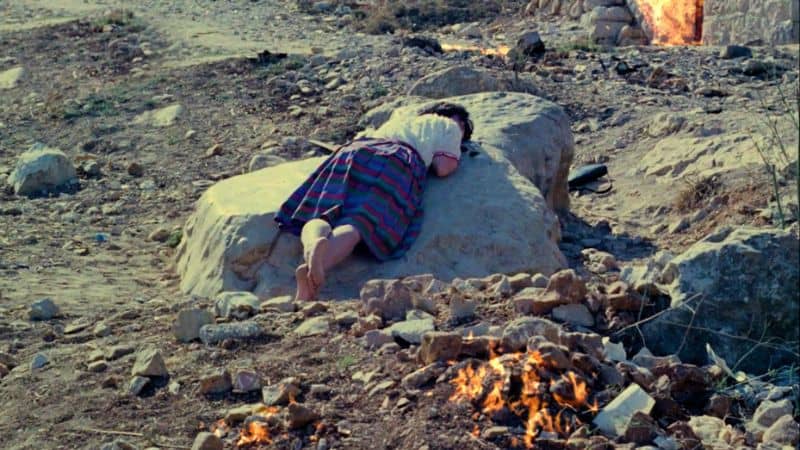
Almost the entire year of the film’s post-production, I was mostly focused on sound, and I am very lucky to work with Simon Fisher-Turner. When I started the conversation with him, I shared the materials, and he would send me compositions, so the work went in a very organic way. The sounds that we decided to use were very serene, kind of sounds that can put you in this state of mind where something really terrible has happened or is happening. They worked very well with the travelling shots. Simon also did distortion for some of the Palestinian musical elements that I added to the film. Attila Faravelli, who also worked with us on A Fidai Film, created mechanical sounds that were very helpful in composing the general feeling of the film. We needed these kinds of sonic elements, as they brought a layer of emotions that was quite essential for the film. But still, everything is done in a very minimal way—very gentle—not to push too much sentimentality because the images are already full of feelings.
everything is done in a very minimal way—very gentle—not to push too much sentimentality because the images are already full of feelings.
Your archival films correspond strongly to the present. And I think that With Hasan in Gaza is the most pronounced in that way, yet it also feels like a closed time capsule because those places do not exist anymore. Could you talk about both the philosophical and emotional aspects of working with archival material and memory?
This goes back to the origin of photography, where one had the ability, for the first time, to freeze and capture moments that will stay with you, even though you have forgotten them. But photography or films make us remember, and in many ways, this is the case with this film. In this sense, cinema has a strong relationship with memory. For me, memory also has a very direct relationship to poetry, and this film is a perfect example of how memory resists erasure and disappearance. Remembering is so necessary for our existence, and it also becomes an act of resistance, as well as a means of coping with the erasure, in a war where you are busy escaping death or trying to survive.
Until today, I cannot believe that I found this footage, because I was asking myself all the time during the last two years, «What can cinema do?”. We see the destruction, we see the killings, we see evidence. And then this material appeared as an answer. This is the role of cinema—to act as a revival of life and preservation of life.
In the film, there’s much discussion about using the camera’s potential as a weapon. After 25 years, do you think the immediate distribution of footage shot on-site of a conflict loses its impact? Can images stop the war and genocide?
I don’t think that images can stop the #war. Cinema can play a role in defeating war and destruction, but only poetically speaking, because none of us can stop a war. But images generate solidarity, and cinema can create hope in the sense that, even amidst this destruction, we found this life. There is a sense of grief and sadness that we all carry with us, having witnessed all of that. One feels totally paralysed, and it’s difficult to respond to that. In that case, the making of With Hasan in Gaza is a contribution to respond with signs of life.
And this is one of the reasons why the Israeli government has been killing so many journalists in Gaza, because they acknowledge the importance of the filmed. They killed about 300 people, a number of journalists who have never been killed in any war before. They do it because they don’t want these images to come out, even though Western governments didn’t change their positions radically after all these images came out of Gaza. But what it did do was generate a lot of solidarity as it changed public opinion. And this is something that, of course, annoys me. They wish they could kill everybody without having any documentation. Israeli policy wants to do a kind of destruction and #genocide like it was done in the 16th century, but they want to do it today, where everything is documented. But this is not possible. As much as they kill people, they are being filmed.
With all these ideas, why do you still credit yourself as a conceiver rather than a director?
I think conceiving is a more gentle way of saying what one does with archival images – collecting and putting things together. Conceived is a nicer, more poetic way to say what directing is. The verb ‘directing’ is very American to me.
Despite the fact that it’s a personal film, it is also a collective work. In that sense, it is a contribution to Hasan and all the people who made this film by just being in a frame.
_
Featured Image: © Giampiero Assumma