The current exhibition on the filmmaker Chris Marker (1921–2012) at Kunstnernes hus in Oslo offers a unique historical and political account of the left-wing revolutionaries. The exhibition centres primarily on the themes of time and memory, with travel and the museum as its motifs. Nevertheless, it is named after his most politically oriented film, Le Fond de l’Air est Rouge, known in English as A Grin Without a Cat, from 1977. Most of Marker’s films depict a thinker preoccupied with the human condition and the foundations of values. His broad knowledge is expressed through the images and reinforced by his running commentary. He travelled the world for over 60 years and produced roughly the same number of films. Many of the films explore revolutionary movements, and particularly in the exhibition’s title film, the revolutionary dreams of a better society are brought to the fore. His narrative style has a prophetic-philosophical undertone, particularly in the photo-films La Jetée (1962) and Le Souvenir d’un Avenir (2003), in which he shifts between the past and the future.
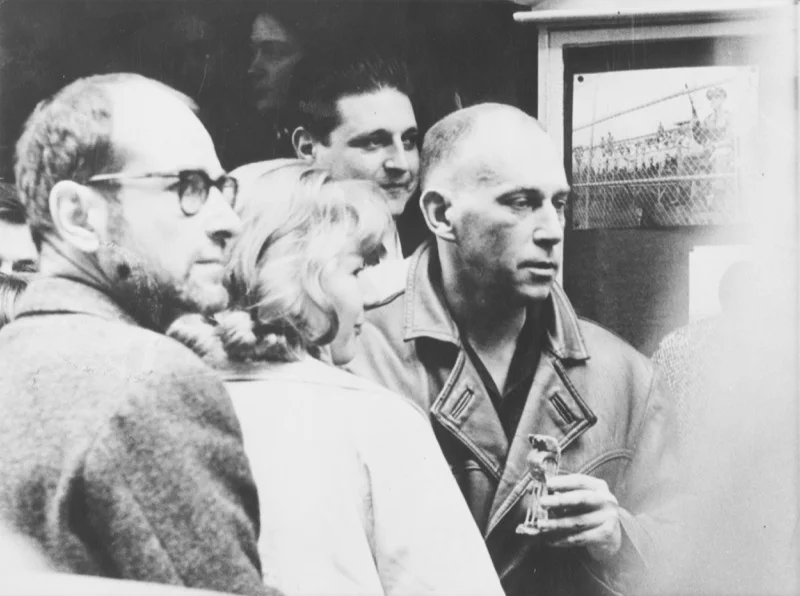
The film essay La sixième face du Pentagone (1968) depicts the Vietnam protests of 1967. Peaceful demonstrations erupt into a storming of the Pentagon in Washington. The placards read ‘Hell no, we won’t go!’, ‘No taxes for the war machine!’ and ‘How many kids, Lyndon?’. The demonstrators shout ‘direct action!’ on the steps of the Pentagon in front of a line of nervous soldiers. Here they burn their military conscription papers and several climb up the building’s façade. Several left-wing leaders are arrested, but this only makes the protest more popular and creates prison celebrities such as Norman Mailer. The incident marked a breakthrough for the Vietnam protests, where, in Marker’s own words, ‘the protesters’ political stance turned into political action’.
Le Fond de l’Air est Rouge is Marker’s magnum opus. It is a unique historical montage of the revolutionary 1960s and 1970s, jumping between Berlin, Bolivia, San Francisco, Beijing and Paris. Marker cross-cuts protest scenes from Eisenstein’s Battleship Potemkin (1925) with street scenes from Paris before peace-loving demonstrators are drowned out by men bearing Nazi symbols in Washington. ‘Bomb Hanoi; Gas the Vietcong!’, they shout. Then, in Vietnam, a smiling American pilot boasts about how wonderfully bombs and napalm work on the battlefield.
Through his distinctive editing, Marker prompts the viewer to reflect on who the world’s real criminals actually are. He shows the Iranian Shah’s visit to Berlin in June 1967, where the Shah’s secret police attack demonstrators and a student is killed. The voice-over narrates the story of the 2,500-year-old monarchy where dissidents are tortured, money is squandered and lavish parties are held for world leaders. The leaders of the ruling powers avoid being labelled criminals, whilst the revolutionaries – to whom Marker then cuts directly – are arrested time and again or killed. We see police officers dragging Ulrike Meinhof by her hair as if she were a wild animal. This is followed by images of a number of revolutionaries – Tania, Ben, Miguel, Malcolm, Camille, Dixie, Julien, George, Carlos and Pierre – all of whom died for what they believed in. In another clip, Fidel Castro reads out a quote from Che Guevara shortly after his death: ‘If I look back on my life, I have worked faithfully to build the revolution. In a revolution, you either win or die.’ Throughout this lengthy historical overview, we encounter a host of political figures and are confronted with optimism, hindsight, naivety, despair and daydreams.
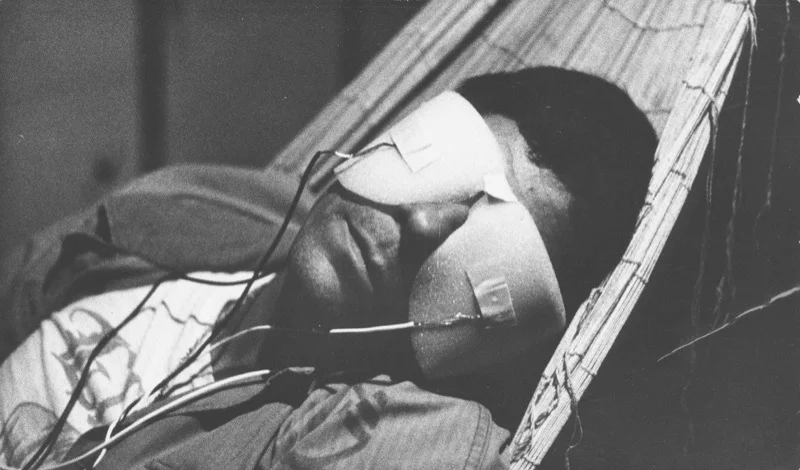
Through Cuba, Marker also shows how communism is not necessarily unambiguous. In one clip, Castro distances himself from Soviet communism by criticising Marxist-Leninist manuals for being full of clichés, stereotypical descriptions and outright lies. Marker no longer has the same faith in Castro as he did in the 1961 film Si Cuba. In that film, he had praised Castro and criticised the USA. Disappointed by Castro’s utopia, Marker cannot resist poking fun at him in Le Fond de l’Air est Rouge. Castro has a tendency to adjust the microphones whilst he is speaking. On one occasion in Moscow, we see Castro struggling with microphones that, comically enough, are firmly stuck in place, no matter how much he tries to twist them.
Marker points out that a number of revolutionary leaders have said that the greatest challenges only arose once they had taken power. Unlike Mao and Castro, his admiration for Salvador Allende is clear. The way Marker edits and portrays him in the film On vous parle du Chili: Ce que disait Allende (1973) speaks volumes about the confidence he had in the Chilean president’s political programme. Here, Allende is interviewed by the philosopher Régis Debray about the economy and nationalisation, his thoughts on being assassinated, and the anti-capitalist project.
In Le Fond de l’Air est Rouge, ‘red’ Allende is portrayed as an example of a leader who knows how to govern a country. In a panel discussion at a workers’ conference in Santiago in the early 1970s, Marker presents Allende as the voice of reason. The President welcomes the presence of the foreign press, saying, ‘Let them stay and bear witness to a true democracy, something others merely pretend to be.’ Allende calls for direct political engagement from the workers, for them to be familiar with the fundamental political principles and to take part in the discussions. Since the factories are now to belong to the people and the workers, he also states that a lazy worker cannot expect a normal wage. You do not get a bonus for laziness. And he adds: ‘The incompetent cannot expect protection from a party badge! A party membership card does not confer titles or honours. Everyone must earn the right to be respected!’ He warns against wage increases, and when some people boo at this, he replies: ‘I have not come here to be booed or cheered, but to talk some sense into you.’ He believes that wage increases will lead to galloping inflation. But Allende makes it clear that he will never coerce or use violence against the workers if they go on strike. He will not use the police to prevent the free exchange of views. No, his only means is reason. If this does not work, ‘then I have no choice but to resign, for what else can I do?’ We know, with the benefit of hindsight, what Pinochet did to seize power in 1973.
But most people aren’t revolutionaries. Everyday life is all about compromises, about making ends meet and being left in peace. Towards the end of the film, Marker sounds at his most sombre. Disappointed by failed revolutions and election defeats for the Communists, he laments ‘what might have been’. The film ends allegorically with wolves being shot from helicopters: the population must be kept in check. Marker comments: ‘Some wolves will always survive’.
In a 2008 essay, Marker writes that Le Fond de l’Air est Rouge was about what happened when the French Communist Party and the Soviet Union no longer represented revolutionary hope. He writes: ‘The irony is that thirty years later, the question is irrelevant. Both have ceased to exist, and the only chronicle is the repetitive rehearsal of a play that has never had a premiere.’ In Paris and elsewhere, the left-wing revolutionaries were, unfortunately, not allowed to take to the main stage; they did not get the future that was supposed to change the world.
Marker collaborated with filmmakers such as Alain Resnais, Agnès Varda, Jean-Luc Godard and Joris Ivens. In the 1960s, they all contributed to a film credited to 150 individuals (!) called Loin du Vietnam (1967) – a protest against US intervention in Vietnam. The collective blended fiction, documentary, analysis and news bulletins. Out of this collaboration emerged the activist film collective SLON,1 which was active for over ten years. The Norwegian producer Inger Servolin also worked there; she has produced several of Marker’s films and is still responsible today for the archiving and conservation of his films in Paris. Within the collective, Marker directed the fiction film Embassy(1973). The film is made in a documentary style and depicts the escape to an embassy during a military coup. The setting is reminiscent of Chile. Young left-wing artists, writers and activists were afraid of being arrested after their friends had been locked up in a football stadium. With clear references to reality, Marker thus created an early ‘mockumentary’.
The collective also produced Cinetracts, small visual political pamphlets shot on 16mm black-and-white film. The aim was to create counter-information as a counterbalance to the superficial mass media. They were also behind the series ‘On vous parle’, in which they gave a voice to people in vulnerable positions, including tortured prisoners, a persecuted publisher, a revolutionary leader and President Allende.
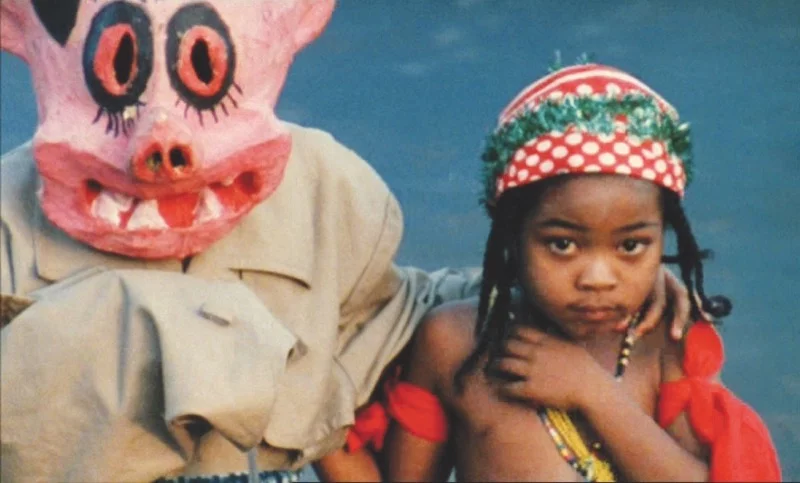
The exhibition also features Sans Soleil (1982). This is arguably Marker’s best-known film alongside La Jetée, and was named the third-best documentary of all time by Sight and Sound magazine this year. Marker seeks to convey that we no longer see the sun. The opening shot shows three happy children in Iceland, before the screen goes black for a moment. It is only towards the end of the film that we see the children’s home has been covered in black lava. The children encountered the dark side of life, here in the harshness of nature. Sans Soleil also shows all of Tokyo’s television screens and comments on how this flickering light replaces reality. Marker’s melancholic theme – the sunless – is a testament to humanity’s inadequacy on earth, yet he is also fascinated by how people find something to fight for.
The film is primarily about memory and its significance. The protagonist, the travelling cameraman Sandor Krasna, is Marker’s alter ego. He travels to Japan, Ireland, Iceland, Guinea-Bissau and Cape Verde. We hear a woman reading from Krasna’s letters and travel diary about his thoughts on the images he is filming. This is precisely the hallmark of the essay film: documenting through personal reflection. At times, the film becomes so intense to listen to that the images fade into the background.
Krasna asks whether all the images we consume actually replace our memories. Marker also employs the technique of giving some images far too strong colour contrasts – to the point where they resemble images from memories and dreams. The film thus questions the significance of memory. But what happens when something in reality disappears completely? On the Japanese island of Okinawa, we see two so-called Noro priestesses. They perform a traditional purification ritual and can speak to the dead through the gods. The Noro tradition will die out with them; they are the last priestesses. Okinawa was also once a matriarchy, but when American soldiers occupied the island at the end of the Second World War, 200 women chose to blow themselves to pieces with grenades rather than be taken prisoner. Today, you can buy tourist lighters shaped like grenades there. All other traces have vanished. ‘The event became a commercial commodity,’ comments Krasna.
Krasna says he is most interested in the small, intimate things he observes – minor events that can make the heart beat a little faster. We encounter a long series of rites of passage and associated sites: cat temples, fertility temples, doll burnings, and girls attending a Japanese ‘confirmation’. Then Marker inserts images from Alfred Hitchcock’s Vertigo (1958). Krasna is said to have watched the film 19 times, and films the locations from Vertigo himself. Marker wishes to say something about the impossibility of memory. The past becomes the future and vice versa, just as when Krasna seeks to recreate the cinematic scenes without the plot.
Marker’s meta-commentary raises questions about whether cultural rites of passage or political struggle can sustain us, or provide us with enough meaning to endure the ever-changing life situations that modern life presents us with. At the same time, with Sans Soleil, Marker attempts to prevent important traces from being lost entirely to our own self-understanding. In fragments, the filmmaker gathers some clues that we can decipher.
One film not featured in the exhibition is Chats perchés from 2004. Here, the filmmaker was over 80 years old and employs more humour and irony. Rather than people, he places his trust in his little four-legged friends, the cats: ‘Have you abandoned us? We need you desperately now.’ Throughout his career, he used cats as symbols. Marker loved the cat’s independence and exclaims: ‘Cats aren’t interested in power!’
The film showcases Marker’s reflective view of our turbulent times and those who protest against abuses of power. The director has retained that old revolutionary spirit. But this time, he shows scenes from a demonstration calling for aid for those with AIDS. The demonstrators have lain down in the streets. Marker allows the images to fade to black and white as the camera zooms out. Gradually, the whole scene comes to resemble the dead on a battlefield. There is still a touch of protest in old Marker, as the following scene shows people gathered in the street in front of a big screen showing a football match. The commentary? “Here they all just stand and watch eleven rich blokes kicking a ball about.”