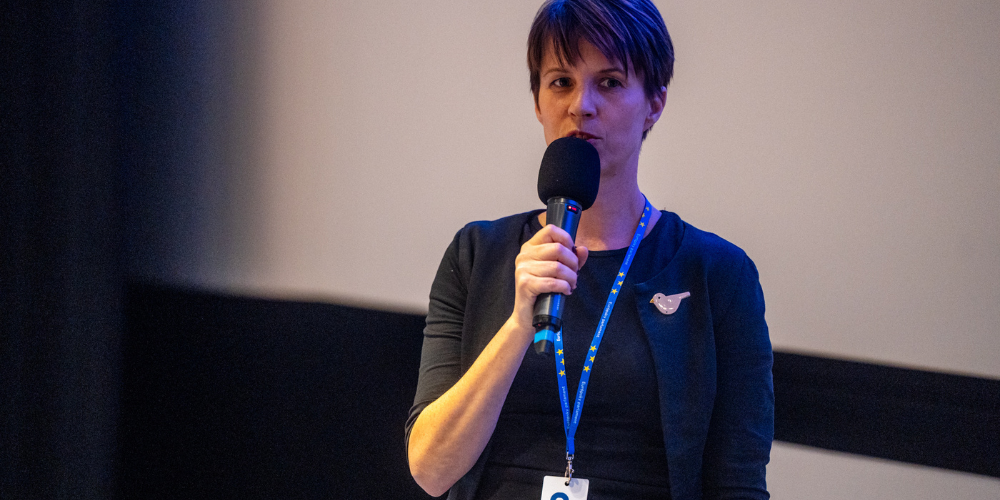
Slovakia’s One World International Documentary Film Festival opens in Bratislava on 20 October with Sára Prokopová’s Retuning, which follows the transformation of the public broadcaster RTVS into STVR. This year’s theme, BONDS, gathers films about the influence of power on people and societies alongside films about solidarity and the strength of communities. It arrives after a difficult year for the Slovak cultural sector. Last year the Audiovisual Fund council refused the festival’s application against the advice of its own expert commission, and the 2025 edition ran on a much smaller budget.
In this conversation, festival director Eva Križková explains how the 2026 edition found its funding and what she makes of the language of human rights in a country whose constitution was amended on 26 September 2025 to state that Slovakia retains sovereignty in matters of national identity.
«Declarations like this one are the Fico government’s way of courting nationalist voters»
Last year the Audiovisual Fund council refused your application against the advice of its own expert commission, and you ran the 2025 edition on a much smaller budget. Did the Fund support the 2026 edition at all? Last October you told Modern Times Review, «This kind of crowdfunding can probably work once.» What supported the 2026 edition in its place?
This year, the Audiovisual Fund provided us with a small amount of support. In addition, we were able to secure a grant from the European Union to explore the theme of the decolonization of cultural narratives, with a focus on Central and Eastern Europe. The City of Bratislava also increased its support for us. So we didn’t do any crowdfunding this time; instead, we left that form of financing to those who have recently been affected by the destruction of the Slovak cultural sector and haven’t yet had time to build up the tools for resilience.
The festival’s account of BONDS asks «What do Ukrainian women who survived wartime violence have in common with Palestinian women who want to have children with their imprisoned husbands?» and answers with a single word, bonds. The theme has to hold very different stories. Was there a lively debate in the selection team about the theme, and what did it change?
At the outset, we had two guiding principles. We knew we wanted to provide our visitors with a safe space where they could experience an atmosphere of mutual support and understanding. We believe it is very important for cultural events to fulfill this role as well, given the current social and political situation. And then we received financial support from the European Union to address the topic of decolonizing cultural narratives, and it all clicked into place. We decided to select films from high-quality domestic and international documentary production—both those that depict the influence of power on people, societies, and relationships, and those that reflect solidarity, mutual support, and the strength of communities. In some films, these two aspects of the theme even overlap. It’s true that while we were agreeing on the theme «BONDS,» we had a fairly intense internal discussion within our team. For example, «Film Wellness» or «Wilderness» were in the running, but each of these themes was also associated with discourses we didn’t want to open up and into which we didn’t want to slip in our communication.
People in Peril Slovakia organises the festival, and last year you announced an afterparty with charity tattooing to raise money for its humanitarian aid in Gaza, the same week the programme screened films about Gaza. How do the festival and the humanitarian work of People in Need inform each other?
The One World Festival and the humanitarian organization People In Peril, which produces it, share common values and a common perspective on human rights. While the organization’s other projects are more conservative in their communication and prioritize practical humanitarian aid, One World is an artistic project and can therefore afford to be bolder in its reflection on global and political issues and to present bold, original perspectives that advance public awareness.
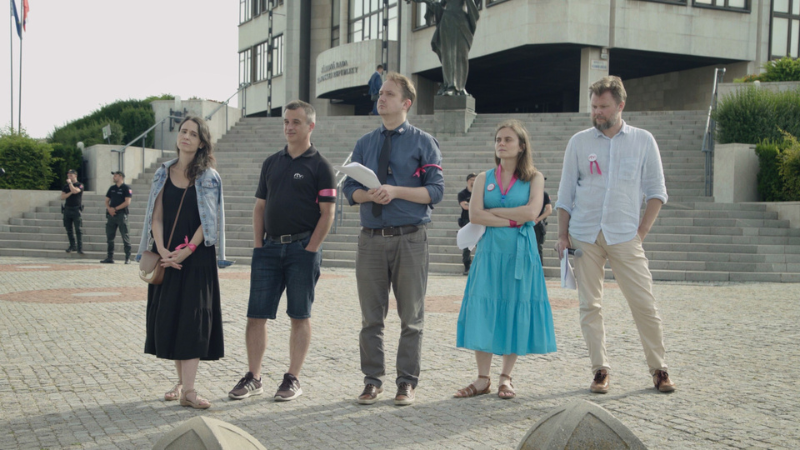
Sára Prokopová’s Retuning opens the festival on 20 October and records the transformation of the public broadcaster RTVS into STVR. You say it embodies BONDS on several levels. What made it the opening film?
As the most significant documentary film event in Slovakia, it is extremely important for us to support young, local documentary filmmaking. We have several strategies for doing so, ranging from the main competition section to screenings of student films and premieres of new Slovak films. It is a great pleasure for us when, once every few years, we are fortunate enough to open the festival with the premiere of a new Slovak film. Moreover, Retuning reflects this year’s BOND/SHACKLES theme of decolonization, as it explores the shackling of public media by repressive political powers and the efforts to manipulate cultural content and narratives for political gain.
It turns out that the letter of the law is not enough to build a high-quality society in which the vulnerable do not suffer.
Your competition is called Slovakia and Czechia for Human Rights, yet when you introduce this year’s theme you speak of freedom and of «trust, solidarity and mutual care». What do you think about the language of rights today, and what does the language of care add to it?
It turns out that the letter of the law is not enough to build a high-quality society in which the vulnerable do not suffer. We need to supplement our efforts to ensure respect for human rights by fostering mutual empathy and spontaneous, immediate care — not only for those around us but also for ourselves. And we also need to bring art to people, for it has the power to enrich their minds and souls.
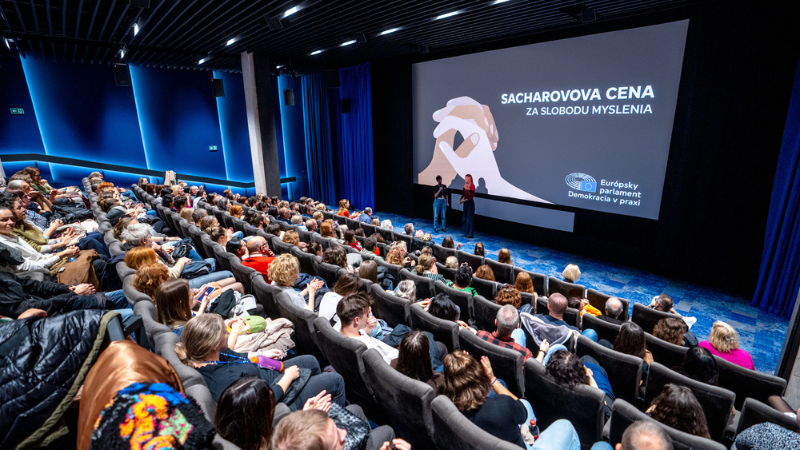
Your 2026 edition highlights one Ukrainian film and one Palestinian film. Debates in many countries ask whether European institutions apply the language of rights equally to Ukraine and Gaza. How does the festival approach that question when it brings both stories into one programme?
As I mentioned earlier, it is essential for us to give a voice to the vulnerable, the oppressed, and those who are not heard. We apply this principle equally to both conflicts.
The Slovak constitution was amended on 26 September 2025 to state that Slovakia retains sovereignty in matters of national identity, including cultural-ethical questions. When Robert Fico introduced the draft, it said international pacts would not take precedence over the constitution on such matters. Rights treaties are international agreements. How does that change what human rights mean in Slovakia today?
Slovakia is going through a difficult period. In my view, declarations like this one are the Fico government’s way of courting nationalist voters, and they poison the atmosphere in which Slovak civil society works. I find that shameful. But that does not change the basic reality: Slovakia remains a member state of the European Union and is bound by its law. Human rights do not become optional because a politician declares them a matter of national identity. What does change is the climate. The people whose rights are being questioned feel it first. That is why it matters that cultural spaces keep telling their stories.
You said last year that the situation in Slovakia «does not bode well for at least the next two years, until the parliamentary elections». If the political climate eased, what would you hope the festival becomes?
I would like to return to the festival’s original mission and strategy: to become a major international documentary event comparable in significance to Ji.hlava IDFF, CPH:DOX, or DOK Leipzig. And, of course, to maintain our unique focus on human rights and accessibility for disadvantaged groups, which already makes us pioneers among film festivals on an international scale.