GO SHORT INTERNATIONAL SHORT FILM FESTIVAL: Why size matters

How can you craft a story that will have some impact? What is the best way to use the limited time available? Three approaches to making a short film are discussed by Willemien Sanders

Written by:

1,536 words

Athough any filmmaking entails making selections and possibly killing a darling or two, the short film format forces filmmakers to be even more to the point. What is possible in a 10, 20, or 30 minute short? How can you craft a story that will have some impact? What is the best way to use the limited time available? Or what kind of narratives benefit from a short time frame? The opportunity to watch a wide array of short documentary films, provided by the Go Short International Short Film Festival, fostered ideas about what actually makes shorts work, and what possibly doesn’t.

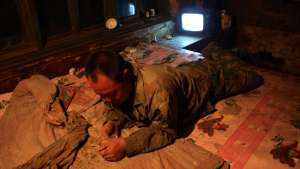
A film like Returns (7’) depicts preparations for the reception of the coffins of the victims of the plane crash near Smolensk in 2010, which killed the Polish president Lech Kaczyński. Polish military exit the plane, but without coffins… What we see is a short black and white choreography in which the soldiers take out the invisible coffins and place them on supports. Such a ceremony apparently needs to be rehearsed. A somber film that allows a rare peek into an otherwise invisible universe but at the same time shows the triviality of such an austere event.1
moon3
The Day We Danced on the Moon (11’) Director: Tristan Daws

In The Day We Danced on the Moon (11’) mental health patients travel to an arts festival in Ireland. They talk about what it is like to have a psychosis, with animation visualizing an alternative reality, and about how society treats them. We see them on their way and we see them perform. Visually the film is a bit messy, with various styles included, but that serves the points it addresses: the possibilities of these individuals despite their ‘impediments’, our own prejudices and short-sightedness, and a broader idea of what normality is and how it is constructed.

Tons of Passion (13’) is completely different, a charming ode to big demolition machines and their drivers. The men, who own their machines, talk about them in various ways but always from the heart. In movement, either in choreography designed for the film or at work at a demolition site, the machines are reminiscent of dinosaurs: Jurassic Park 3.0.
These three films do not investigate their topic but make a proposition or put something on the table – they make an observation the viewer can take and dwell on herself, in specific styles.

That style can be crucial is illustrated by What the Cat Sees (18’). A cat residing near the entrance of a hospital is witness to the comings and goings of patients and their families and friends, and to the breaks they spend outside, mostly smoking. This results in many interesting, funny and wise observations and overheard conversations. Unfortunately the film is not as true to its form as it could have been: there are many scenes in which people clearly speak to the filmmaker and a few in which questions are included. It breaks the unity of the film and with that the whole idea falls apart.
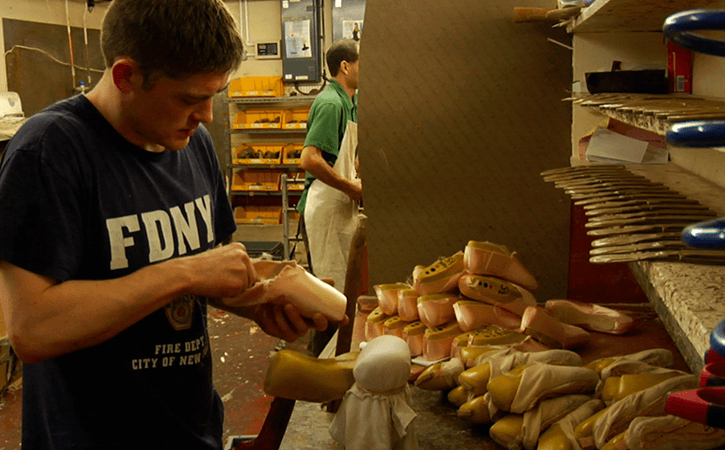
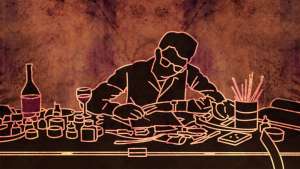
Pointe shoes are typically associated with the female: they are the ballet shoes that make it possible for ballet dancers to stand and turn on her toes. Making them is presented as handicraft in The Perfect Fit (9’). We see a ballet dancer’s movements in the shoes that provide both opportunities and pain and one of the craftsmen working hard to make the perfect shoe. His reward: hands bruised like a ballet dancer’s feet and a pinky thank-you letter.
The Perfect Fit Director: Tali Yankelevich

This kind of juxtaposing two sides the coin appears in more films, and is another way of putting something on the table by aligning it with a counterpart. In Framing the Other (25’) a Mursi woman of Southern Ethiopia and a Dutch tourist who visits her to take pictures are contrasted. The Mursi is a traditional tribe who allow tourists to photograph them for money. As a consequence, an industry has developed in which both play their role: tourists want something for nothing and the Mursi want to get the most out of it. We witness the protagonists before, during and after the ‘shoot’. We listen to their expectations, preparations and the inevitable disappointment: one is too stingy, the other too greedy. Although the topic could easily make for a longer film in terms of the impact of this development on traditional communities and how it feeds people’s desire for possessions, the film is effective in its juxtapositioning – although the inevitable indignation of course concerns the tourist rather than the Mursi woman. The film received a special mention from the Go Short European Competition jury.

In these two films, the contrast is obvious, in others it is less explicit.

An unsettling peek into the lives of two young men, Alex and Peter, who collect cans for a living, is provided by the film Faggots (32’). Alex shares the dreams he once had about his future, including having children; it seems outdated now. We see their daily struggle, eating whatever they can get their hands on and passing out from alcohol at times. The flipside of their harsh life is their love for each other, which still seems to be in the phase of discovery. The images are as raw as their lives, the filmmaker never hiding his presence on the scene, visually questioning their hopes and dreams and his representation of it.

An example of a film in which such a juxtaposition might have worked but doesn’t is Passenger (29’). It starts with a young girl noticing a tattoo on an older man’s arm, upon which he explains where it is from. This promising connection between young and old and the past and the present is broken when in what follows we see the old man telling his story to a film crew of grown-ups, who are included in the film itself in a somewhat artificial way. This happens while the girl is filmed on endless tram rides in Helsinki, contemplating the old man’s story. The dutiful inclusion of archive photos further ruins a promising narrative.

Of course, many films do not fit into these two approaches. One of them is When the War Ends (36’), set in Belfast, Northern Ireland, the war it refers to being the troubles between Catholics and Protestants. The film addresses how this war is still present in the heads and lives of those who lived through it, especially for Robert McClenaghan. The film contains archive material, observation, interviews and a carefully crafted soundtrack that opens to the voices of others. Are they in his head or do they point to others who lived through similar experiences? Other consequences of the war remain somewhat invisible, save monuments and guided tours. But it seems McClenaghan is more relaxed giving such tours than expressing himself in an interview.

Lady cab driver Boury has her own struggle to attend to. She features in Taxi Sister (28’) as one of 15 female cab drivers in Dakar, Senegal (compared to 15,000 male drivers). The filmmaker tried to include many aspects of the main character’s life: her male colleagues/competitors, her best friend/colleague, her absent father and her ex-husband, her family. But because there is relatively little time a lot of information concerning these is told in voice-over rather than presented visually.

147753092
Taxi Sister Director: Theresa Traore Dahlberg

These two films scratch the surface of topics that definitely merit longer films. Both films show complex situations in which individuals try to give meaning to their lives and need to battle some mental and/or physical demons to do so. Quite possibly, production circumstances dictated the limited lengths of these films. In any case, they tickled my taste buds and felt incomplete.

Claes Director Martina Carlstedt
The winner of the European documentary competition was Claes (23’), a well-crafted but hardly original and somewhat pointless film about an over-talkative single man dealing with the setbacks of getting older. While he is contemplating the stumbling blocks (in his mind) between his place and the local cinema, we observe him roaming his two-room apartment. With the humor in the film the sadness of Claes is easily laughed off.
1 This film won a prize in International Competition at ZagrebDox in March, competing against 30 documentaries of different lengths. The film was seen – as the end text says – against the backdrop of the plane crash that killed the Polish president and his staff in Russia.
Returns
Director: Krzysztof Kadlubowski. Production: Studio Filmowe Plus TV. Poland, 2010, 7 min.
Claes 
Director Martina Carlstedt, producer Geir Hansteen Jörgensen, Sweden, 2010, 23 min.
The Day We Danced on the Moon (11’) 
Director: Tristan Daws, Production: Stefan Kloos. Germany, 2011, 11 min.
Faggots
Director: Robin Färdig. Production: Robert Melo. Sweden, 2011, 32 min.
Framing the Other
Director: Ilja Kok. Production: Willem Timmers. The Netherlands, 2011, 25 min.
Passenger
Director: Pia Andell. Production: Pia Andell. Finland, 2011, 29 min.
The Perfect Fit
Director: Tali Yankelevich. Production: Finlay Pretsell. United Kingdom, 2011, 9 min.
Taxi Sister
Director: Theresa Traore Dahlberg. Production: Theresa Traore Dahlberg. Sweden, 2011, 28 min.
Tons of Passion
Director: Corina Schwingruber Ilic. Production: Minerva Film. Switzerland, 2011, 13 min.
What the cat sees
Director: Kim Brand. Production: Janneke Doolaard. The Netherlands, 2011, 18 min.
When the War Ends
Director: Thijs Schreuder. Production: Maarten van der Ven. The Netherlands, 2011, 36 min.
Willemien Sanders avatar

Other interviews:

  • Laura Poitras and Rachel Lauren Mueller: «Hope? I call it resistance»
    INTERVIEW: Short in runtime, yet sprawling in its political scope. With They’re Here, Laura Poitras and Rachel Lauren Mueller assembled an uncanny hybrid of horror film and documentary from crowdsourced footage, OSINT data and material shot on the ground in and around Minneapolis during the ultra-violent ICE occupation.
  • KineDok: «Decentralisation is absolutely crucial»
    INTERVIEW: KineDok's Juliana Moska talks through a season built on decentralisation, and what changed since she and Walter Nagy took over the Czech programme this March.
  • Mark Cousins: «AI would never do that»
    INTERVIEW: Mark Cousins built a sixteen-hour documentary, refusing to separate images from the world that makes them. In conversation, he keeps reaching for objects scattered around him, as if the room itself were mapping cinema's connection to everything else.
  • «Our cameras are weapons, but peaceful weapons»
    Sunny Side of the Doc: Managing Director Aurélie Reman discusses the market’s return, Europe’s documentary funding crisis and the move from La Rochelle to Strasbourg.
  • «We need to reframe innovation»
    SUNNY SIDE OF THE DOC: Donata von Perfall sees the documentary industry under pressure, yet far from exhausted. Ahead of Sunny Side of the Doc 2026, she speaks about physical markets, digital-first work, brand ethics and the need for practical collaboration.

Scroll to Top