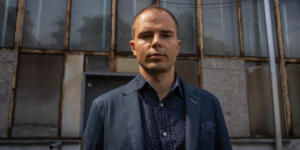
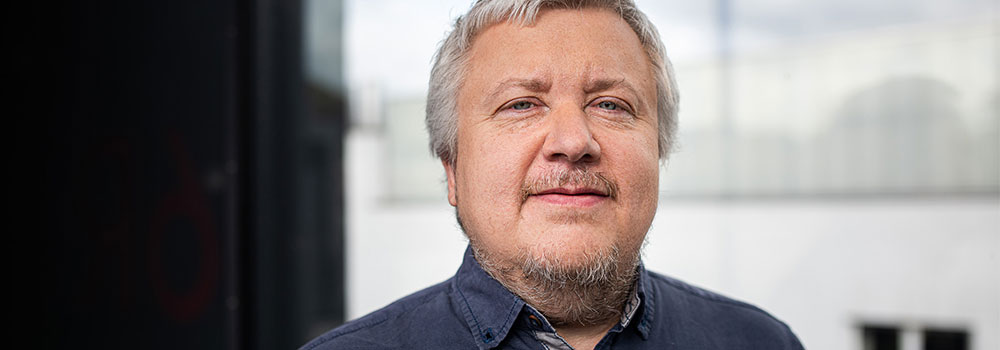
Ji.hlava International Documentary Film Festival, the festival bringing together audiences, directors, producers, film critics, journalists, friends and family of documentary cinema to spend several days «thinking through film». With its 23rd edition occurring 24-29 October 2019, Modern Times Review spoke with the festival’s Programme Director, Petr Kubica.
Can you explain the overall theme of Ji.hlava 2019? Why is this theme relevant now?
This year’s edition of the Ji.hlava International Documentary Film Festival will revolve around the theme of environmental protection. Although surrounded by apocalyptic news, our outlook into the future is slightly optimistic. We believe that if we take a responsible attitude, we will handle the situation. We have always tried to keep the environment in mind. But we realised that our environment-friendly attitude has been rather patchy. We want to be consistent and plan our following steps based on the latest facts. We are trying to find savings within our system and perhaps be an inspiration to others. The topic of environmental protection will resonate through the festival programme, industry activities and Ji.hlava’s Inspiration Forum.
Another important programme theme of this year’s edition will be «Women in Transformation», a topic introduced also in the festival trailer. In recent years, the role of women in society has been becoming more prominent, and not only in society but also in documentary filmmaking. Films created by women draw our attention by evocatively opening painful issues, being formally innovative and lending an empathic ear to the stories of others. This year, many such titles are included in the festival programme.
What do you see as attributing to documentary’s stark increase in popularity?
To put it simply, I see it as the result of technological development and sustained interest in true stories or reality-based stories. But we find it important, and always have, to approach documentary cinema as art. Not only as a report or a simple description or account of facts, we are looking for what is not currently usable and descriptive, but what develops and transforms documentary filmmaking. At the same time, documentary film is a format that allows for a specific issue to be addressed in a broader context. This is especially important during the current decline in the importance of traditional media, news reports that are becoming shorter and shorter and increasingly more superficial.
What would you say is the future of the documentary genre? How does this affect the way film festivals will be curated?
This depends on how fast the standard TV service will come to an end – as the television specifies a predefined slot for documentary production to fill. This affects the dramaturgy of documentary films. The documentary cinema has indeed already started diverging from the TV screen. Short documentary videos are made directly for web portals as well as documentary films to be released in cinemas. Cinema digitisation has brought new distribution possibilities and television will offer new choices, in addition to passive viewing. This will not affect our festival – other than by opening up a greater choice. Not even in the 1990s were we dependent on the dominant television service, which by its nature has always been conservative. We were looking for the potential of documentary cinema elsewhere, at schools, independent productions, and have always been interested in experimental filmmaking, stemming from reality. And we are looking forward to even more diversity in the future!
What are the criteria that determine a festival’s acceptance into Ji.hlava?
The criteria and conditions for film submissions are described on our website. But this mainly concerns formal aspects, such as the fact that submissions are free of charge, or that you can submit a film to specific sections only after their world, international or European premiere. Generally speaking, Ji.hlava closely monitors the current developments on the documentary scene, but we are also aware of the historical background. With this experience and eager for new discoveries, we watch the submitted films. On a personal note, I have graduated in literature and I approach documentary cinema with the knowledge and passion for literature. I expect the best documentaries to have the same impact as great reads.
What was a seminal documentary for you? Was there one that you consider to be integral in your own relationship with the genre?
Films by Alexander Sokurov have been a great influence. That’s where it all started.