When the French political scientist Jean-François Bayart’s book L’Etat en Afrique. La politique du ventre was translated into English in 1993, it quickly became an international bestseller and a part of the curriculum in African studies all over the world. The book shaped an entire generation of Africa scholars, whether they were political scientists, historians, or anthropologists. Bayart argued that African states functioned according to entirely different principles than European states: Personal connections, ethnic loyalties, and traditional forms of authority, often referred to as «neo-patrimonialism», shaped and governed the African state. Formal institutions had no real influence and existed only as empty façades. Patrick Chabal and Jean-Pascal Daloz further reinforced this understanding with their book Africa Works (1999), where they insisted that it was informal institutions – norms, (dis)habits, traditional bonds, ethnicity – that made Africa work. Those of us who studied Africa in the 1990s were fascinated, absorbed, and strongly influenced by these ideas.
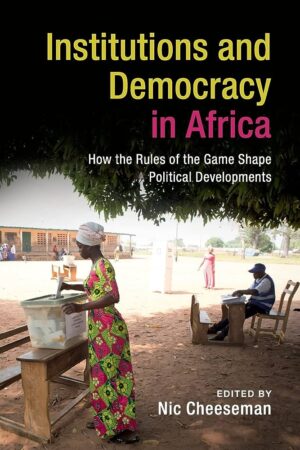
Now, finally, some counterbalance is emerging: Nic Cheeseman has invited 16 Africanists from prestigious universities such as #Cambridge, #Oxford, #LSE, #Cornell, and #UCLA to write the 13 chapters of the book Institutions and Democracy in Africa: How the Rules of the Game Shape Political Developments. The result offers nearly 400 densely written pages of empirically-based criticism of the 1990s understanding of the African state. Cheeseman himself contributes with a highly informative and cohesive introduction and conclusion, describing the need to establish a new theoretical framework to understand the African state based on the recognition that both formal and informal institutions are important in today’s Africa.
The market is flooded with books about democratisation in Africa; this is the best book to have come out in many years.
Democratisation
The anthology consists of excellent chapters, each challenging Bayart, Chabal, and Daloz’s understanding of the African state: bureaucracies (Anne Pitcher and Manuel Teodoro), financial institutions (Leonardo Arriola), the judiciary (Peter VonDoepp); the police (Peace Medie). The chapters on elections (Carolien van Ham and Staffan Lindberg) and presidential term limits (Daniel Posner and Daniel Young) are particularly impressive.
Multiparty elections represent a sine qua non for modern democracies and are simultaneously one of the most visible formal institutions in today’s Africa, write Van Ham and Lindberg. They remind us that approximately half of the countries in Africa became military dictatorships during the 1960s, while most other countries became one-party states. Only three countries – #Botswana, #Gambia, and #Mauritius – remained formal democracies from the end of colonial rule to today. In his earlier work, Lindberg concluded that democratisation only occurs when regular elections are held. Now, he and van Ham claim that the quality of the elections is also crucial. They analysed 277 elections in 45 African states between 1986 and 2012. They found that if the elections were poorly conducted – that is, manipulated, characterised by cheating beforehand, during, or after – they weaken both democratisation in the country and people’s trust in #democracy as a system. In the worst case, the result could be violent uprisings and civil wars.
Conversely, if elections are relatively free and fair, they contribute to increased democratisation in the long run. If the first political election in a country was free and fair, van Ham and Lindberg found a 75 percent chance that the next election would also be free and fair and a 72 percent chance that the third would be. However, if the first election was marked by fraud and manipulation, there was a 77 percent risk that the next election would be as well, and a 73 percent risk that the third election would continue in the same vein. They conclude that free and fair elections can significantly impact political life in Africa in the long run.
400 densely written pages of empirically-based criticism of the 1990s understanding of the African state.
Presidential Successions
Posner and Young have studied how 286 presidential successions in Africa took place from 1960 to 2015. The majority of successions occurred as a result of coups in the 1960s and 1970s. This gradually changed: In the early 1990s, most sitting presidents had won an election.
By the beginning of the 21st century, 36 African presidents had completed their two allotted terms. In most cases – 20 out of 36 – they accepted stepping down calmly. However, in 16 countries, the presidents wanted to remain in power. In five states (Burkina Faso, Malawi, Niger, Nigeria, and Zambia), the parliament and/or the population stopped proposing constitutional amendments allowing more than two presidential terms. In the other 11 countries, the presidents changed the constitution so that they could run for a third (and fourth and fifth) term.
I used to think these were examples of a lack of respect for African institutions. In line with all the chapters in this book, Posner and Young argue that, on the contrary, it indicates that the institutions are respected; if the presidents did not respect the formal institutions, they could just as well have remained in power – without having the parliament adopt the constitutional change that lifted their term limits.
The market is flooded with books about democratisation in Africa; this is the best book to have come out in many years. It links democratisation to societal institutions and clearly demonstrates how these function and positively influence African #politics. After reading this book, I will undoubtedly give lectures on Africa differently.
Our website features Amazon affiliate links, and we may earn a commission from purchases made through those links.