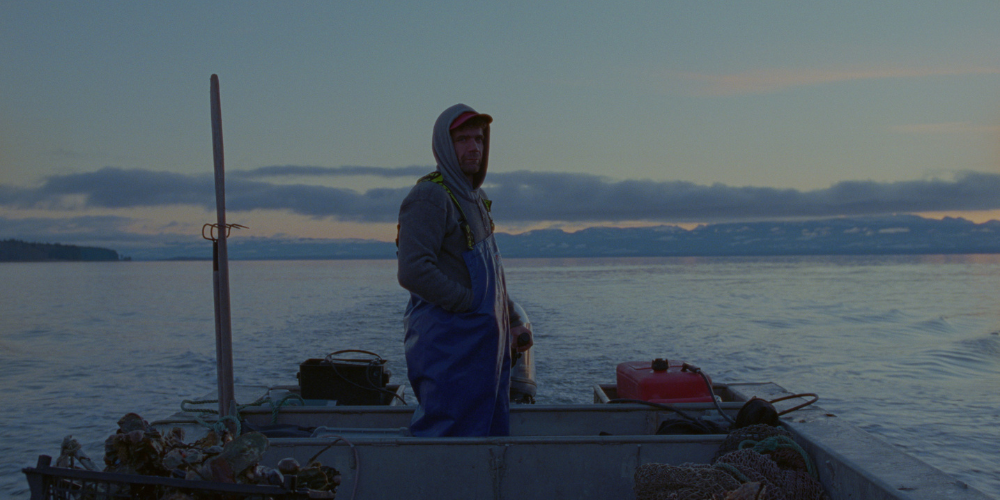
Concrete Turned to Sand took Jessica Johnson and Ryan Ermacora around three years to make, much of it spent on the oyster beds of Cortes Island in British Columbia, where they shot on 35mm, often at night. The 73-minute film played in the Documentary Competition at the BFI London Film Festival on 13 October. In our interview from London, the directors describe how a boxy 1.33:1 frame, the night shoots, and a lagoon filling with the rising tide found their way into a film that, by their own account, belongs in a dark cinema on the largest screen available.
Concrete Turned to Sand names a change of state, from something built to something ground down. Did you title the film before the shoot, or did it emerge from the footage?
The name was percolating early on during the shoot and research/scouting phase of the project. The project took around 3 years to complete, and the title left and returned a number of times through the process. The title comes from a Bill Callahan lyric, from his song ‘Jim Cain’, though his use of the words is quite different from the way they’re being interpreted for our film.
You chose 1.33:1, a boxy frame, for a film about a horizon and the tide line. What did that ratio do for the sea and sky that a wider frame would have taken away?
We shot the film in 4-perf 35mm, using the full camera aperture or «open gate.» This means we didn’t crop into the image and used the full size of negative that our camera was able to capture, which ends up being an aspect ratio of 1.33:1. During the scouting phase, we took a lot of photos on medium format film cameras to build the structure and ideas around the project. These images were all 6×6 negatives, so we have become accustomed to framing in this way. This is a process we also used for our previous film, Anyox. In terms of the sea and the sky, we like how it allows us to simplify the image and condense the landscape into discreet images. We also like how it functions for framing people working in the intertidal zones and on their boats.
«The title left and returned a number of times through the process»
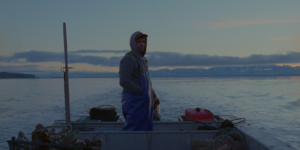
The film stills share a cold blue-teal cast, with pale dusk skies and nearly crushed blacks, and the Le Guin epigraph speaks of a place «illuminated only by starlight». How did you and cinematographer Jeremy Cox judge how much darkness Kodak 35mm could hold? How much of the final look was in the negative, and how much was added in the colour grade?
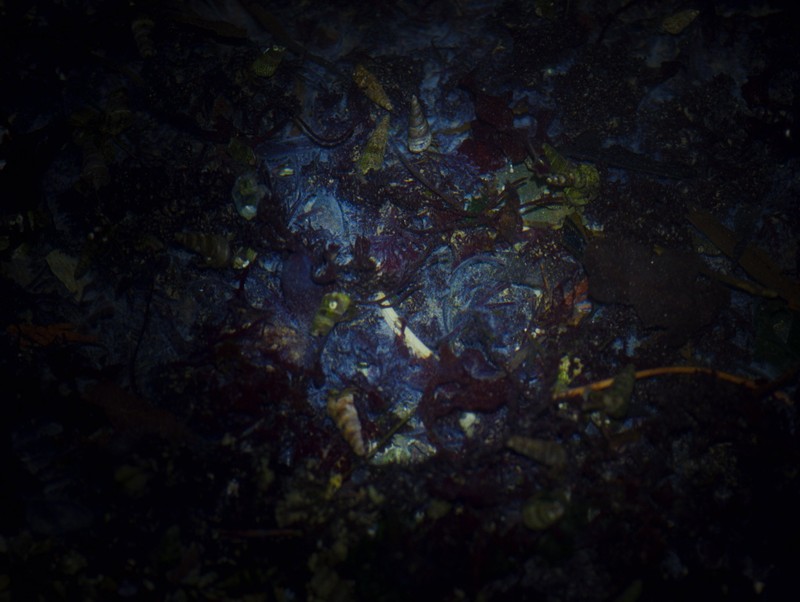
During production, we shot on a number of nights with oyster farmers working on the beach with their headlamps. We shot these often months apart and were able to look at the processed and scanned negatives to get a sense of what was working and what was not working, so we were sort of doing testing in the field. We also did quite a bit of day-for-night photography, as well as dusk-for-night. We occasionally used a blue day-for-night filter but often did a lot of the darkening during the colour grade, to get towards a feeling of night often combined with spectral highlights through reflections.
Jessica, you recorded the location sound yourself while co-directing. What did the intertidal zone sound like at night that you didn’t expect?
Filming and recording audio at night was advantageous because so much of the noise from the day subsides and allows for the quieter sounds to come through. On one of our first scouts of Manson’s Lagoon, I was amazed at how difficult it was to localize any individual shellfish sound at low tide because it was so rich and cacophonic. It really gives you a sense of how much life is around you and just beneath your feet. Even while shooting, it wouldn’t be until most of the crew went inside for dinner that there was enough quiet for sustained recordings. I was lucky to have Marianne Thodas on set, who encouraged long-form recordings. The most unexpected sound happened while everyone else went in after a late-night shoot. The tide was rising, and you could hear the water fill the lagoon.
«It was so rich and cacophonic»
The film resists the impulse to explain, yet you worked closely with scientists on ocean acidification. Which piece of their knowledge was hardest to turn into image or sound?
The core ideas we were hoping to explore through image and sound were considerations of deep geological time. Cinema gives us the ability to work with duration, which helps to convey some of these ideas. The hardest thing to represent visually was the effect ocean acidification has on shellfish. This is a process that happens gradually and often to oysters in early stages of life, so it was quite difficult to present it visually. Additionally, representing trends in warming and acidification within the region was also challenging to depict or convey, as the data can be quite overwhelming and complex, which one of the scientists, Wylie Evans, alludes to in the film.
The film opens with The Dispossessed, a novel about a society built on shared labour. What did you recognise of that cooperative spirit among the Cortes Island farmers?
Yes, the cooperative of oyster farmers is both really independent and self-organised, while also sharing a lot of resources, labor, and knowledge with each other. Through conversations with locals, we could tell that both older generations and seasoned oyster workers were incredibly generous towards newcomers interested in trying it out, as well as amongst themselves. It was also interesting to see the sharing of knowledge that is happening between oyster farmers and scientists such as Tim Green at Vancouver Island University.
The film is shot in 1.33:1 on 35mm and screens in 4K DCP. Eventually, people will watch it on laptops and phones, which is exactly the habit the film pushes against. Do you want it watched there at all? Have you thought about how a film built for slowness should be released?
We’re most interested in showing the film in a cinema. We had hoped to make a 35mm print but had run out of funding after multiple shoots on Cortes, Quadra and Vancouver Island. Because the film often explores images at the edge of exposure, it’s really only meant to be seen in a dark cinema environment, ideally on a large screen. It’s unfortunate that very large screens are often reserved for commercial releases and a very narrow strand of cinema.