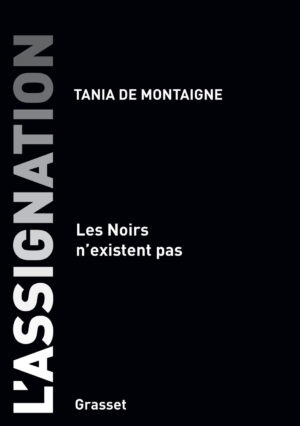
Political scientist Tania de Montaigne (born 1971) is a regular columnist for the French daily newspaper Libération and an essayist. Now, she has released her third book: a 100-page essay about the hidden, everyday racism in France. The book has already become a topic of discussion since its release in April, and de Montaigne is frequently interviewed on TV and radio, as well as in daily and weekly press.
Everyday racism
I must admit that I googled images of her before starting to read. A woman with a noble French name writing about being black in today’s France? I must also confess that I wondered why she had the same last name as Michel de Montaigne, the master of the essay genre. Did she use de Montaigne as a stage name to gain an advantage in the genre of essays? And, shamefully, I also committed everyday racism against Tania de Montaigne. She uses similar examples in her essay, but with references to Frantz Fanon’s Black Skin, White Masks (1952), she is also concerned with the everyday racism of the afrophiles: those who admire everything that is Black (with a capital S); those who say «I love Black music.» Tania usually responds to them with «I love White music», and the afrophiles are left puzzled.
There is no such thing as «White music»; we have classical, pop, rock, or other genres, but not «White music.” But just as «White music» does not exist, neither does «Black music», but there is classical, hip-hop, jazz, or rock performed by musicians from entirely different geographical origins. This is also the basis for de Montaigne’s scepticism about debates on cultural appropriation; she believes it is often wrong to define ownership of a cultural expression to a specific group. Clearly frustrated, she tells about an Indian student at the University of Ottawa who protested against a white Canadian woman teaching a yoga class; yoga belonged to Indian culture, and calling something yoga was cultural appropriation. The student organization renamed the yoga class «stretching.» A student canteen in Ohio had to stop serving tacos after protests from Mexicans who claimed that tacos belonged to their cultural universe. The canteen changed the name of the dish, and the conflict disappeared.
it is often wrong to define ownership of a cultural expression to a specific group.
The Destructive Stereotypes
Other incidents explained by stereotypical cultural understandings and essentializations are more personal. Tania de Montaigne recounts a significant experience she had as an eleven-year-old. She played the flute and was supposed to play Schubert in front of her teacher and the other students. «You played it very well», the teacher said to Tania’s great joy but continued, «Do you hear that the rhythm in Tania’s body comes from her genes, her origin.» Possibly well-intentioned but poorly said. All of Tania’s practice was reduced to having rhythmic family roots. Once again, she was essentialised and generalised to belong to a group, a race, rather than being seen as an individual herself. This is also what those who «love afro» or «Black music» do: they take away the uniqueness, identity, and individuality of those they talk about, thus becoming just as racist as those who think Black people are lazy and corrupt. Once, she was asked by an understanding journalist if it was not difficult to be a Black woman. She replied that both Michelle Obama and a female Eritrean asylum seeker were Black women; therefore, she did not understand the question. I also remember well when Chimamanda Adichie was to be interviewed at the House of Literature in Oslo a few years ago. The first question was something like You, as a Black female African author, how… And the interview stopped there.
There was no room for more questions because Adichie became furious; she was an author, not female, Black, or African. It was her literature that was to be discussed, not her ethnic origin or gender. De Montaigne’s essay starts with almost the same question: You, as a Black woman, what do you think? As if Black women think the same and have something entirely unique. As if all Black women have the same experiences, opinions, and ideological stances. Tania de Montaigne becomes as angry as Adichie did; she refuses to represent Black people or be classified as something she is not. While «Black» as an adjective can be used well, she believes that «Black» as a noun is reprehensible.