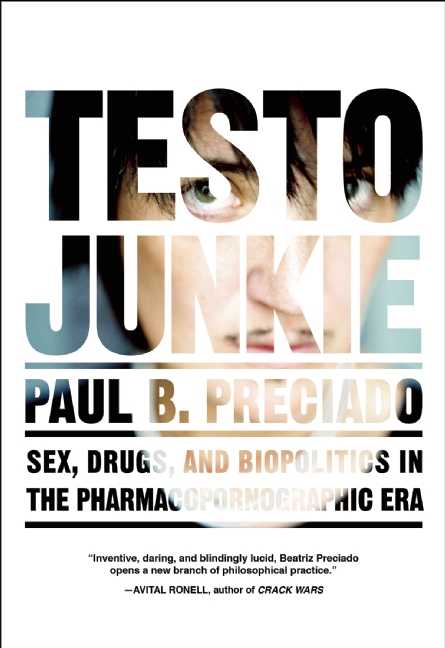
When Testo Junkie was published in 2008 in Spanish and French (in the author’s own translation to French, by the way), it constituted a philosophical breakthrough that had not been experienced since Jean-Jacques Rousseau’s Confessions (published posthumously starting in 1782): In the late 18th century, Rousseau philosophised from the philosopher’s own life, both the social and the private, to find a truth about this life.
With Preciado’s biography of their social and private self, #philosophy was conducted from the entirety of the philosopher’s body in order to incorporate the reality in which this body must operate. Preciado’s body constituted the very effort, that is, both the starting point for criticism and the intimate space for reflection that the philosopher has at their disposal to think as outwardly as possible: To expose the present fully and to do so in the hostile landscape that Preciado has called the #pharmapornographic age, thus providing an historico-philosophical diagnosis based on a «sexopolitical analysis of the world economy.»
And by the world, Preciado understands the world as a whole, that is, the world shaped by the nineteenth-century «scientific and colonial society», whose underlying vectors only became fully visible 75 years ago, after World War II. Resistance to these underlying vectors is made possible by the potentia gaudendi [«In #sexuality studies, ‘potentia gaudendi’ or orgasmic force is the physical and mental potential for pleasure in a body» – Editor’s note.], the reserve of uninhibited «pleasure potential» that constitutes the foundational assumption of desire philosophy from Reich to #Deleuze and #Guattari, among others. But Preciado also knows that the power of pleasure is embedded in a labour force that can be disciplined through various dispositifs: While Rousseau’s dispositifs culminated in the negotiation of a «social contract» of a communal nature, Rousseau’ « «contract social» becomes a pornographic or pornic contract in Preciado’s work.
Life in capitalism
The hypothesis that Preciado aligns with is that of a «general production of surplus value» or, as #Jacques Camatte# formulated it in 1972 in the journal Invariance: Human beings produce surplus value even when they sleep. That is, production includes the reproduction of labour power, which was the main point made by Italian feminists in the 1970s. Such a hypothesis about life in #capitalism as universally productive has been embraced by mainstream Marxists such as #Negri and #Hardt, although they do not cite Invariance or the Italian feminists.
While mainstream Marxists continue to operate with politics as the conquest of state power, Preciado unequivocally focuses on the power, the possibilities of the potential, contained within the potential multiple layers that still need to be explored and mapped out theoretically and practically. Since the publication of Testo Junkie, it has been supplemented with Agamben’s major work Use of Bodies, from the autumn of 2014. This book, which I have translated into Danish for THP Publishers, concludes the grand Homo sacer project, whose nine volumes can easily be read as the philosophical foundation for Preciado’s writing and, not least, way of writing.
Stylistically, Testo Junkie is quite unique, and the book could be described as polemical technical prose: The writing is outward-looking and almost aggressive, and the subjects of criticism are constantly expanded by utilising various pre-existing analyses, whether they are Marxist, feminist, biochemical, neurophysiological, or sociological – and always in unexpected combinations. Naturally, without affiliation: Preciado thus takes Engels’ confrontation with norms in «family, state, and private property», which is cited, for granted, just as the products originating from the pharmaceutical industry are met with scepticism, including the testosterone that Preciado used for a «voluntary poisoning» of Beatriz Preciado’s «body and emotions.» A bureaucratic endpoint for the poisoning is described in the chronicle that Preciado published in the newspaper Libération on September 10, 2016: «First Name: Paul Beatriz, Application 34/2016», which reveals that Paul B. Preciado had to go through a limbo state between having a name and existing in reality when their birth certificate was destroyed but not yet replaced by the new certificate that could attest that they had been provided with a new first name «confirmed by a signature in 2016 but dated to 1970», which is Preciado’s year of birth with a birth date indicated as September 11! This story cannot become more groundbreaking.
the subjects of criticism are constantly expanded by utilizing various pre-existing analyses, whether they are Marxist, feminist, biochemical, neurophysiological, or sociological
Michel Foucault’s biopolitics and from Achille Mbembes necropolitik
It is worth noting that, despite how demanding this course of action may have been and perhaps still is for Preciado’s circulation, there is absolutely no trace of self-pity in Testo Junkie. On the contrary, theoretical aggression maintains a close alliance with the aforementioned #potentia gaudendi#, which never strays from the reasoning and writing style.
Certainly, it is unnecessary to burden theoretical texts with overarching categorisations, although Preciado explicitly places their work in the wake of Michel Foucault’s biopolitics and Achille Mbembe’s necropolitics. But there is a difference in the autobiographical material, especially as the relationship with Preciado’s longtime partner and later colleague #Virginie Despentes# attains the status of an argument in the final chapter, defending dissident #feminism and promoting a departure from Simone de Beauvoir’s classical version of it.
Nevertheless, I propose in my title «political biology», and that is because that is where we have ended up in the discussion of the Homo sacer books and, most importantly, in the debate on the aforementioned Use of Bodies. The book was analyzed by experts in an extensive anthology titled Politique de l’exil. Agamben et l’usage de la métaphysique [Politics of Exile: Agamben and the Use of Metaphysics] in 2019. Jean-Luc Nancy explained that Agamben’s quest not so much provides philosophy with new justifications as it constitutes an «expérience au cœur», an experience for the heart or a heart experience that challenges thinking by putting ontology at stake to such an extent that it risks becoming a ‘bio-logy’. And this is not a critique, Nancy points out:
«There is no criticism in this conclusion as if I had something better to propose. I don’t have anything better; I just mean that it is a way to display our shared difficulty. It does not arise from another or displaced politics; it primarily arises from a being or from a mind that is aware of its own stasis, of its own pulsating and trembling vulnerability.»
Nancy died on August 23, 2021, and Preciado continues their meditations from a slightly different sensibility than those of our generation born in the 1940s: After all, they are only 50 years old, so much else can come, as the uprisings continue and the revolutionary impatience that permeates Preciado’s writing grows.
Our website features Amazon affiliate links, and we may earn a commission from purchases made through those links.