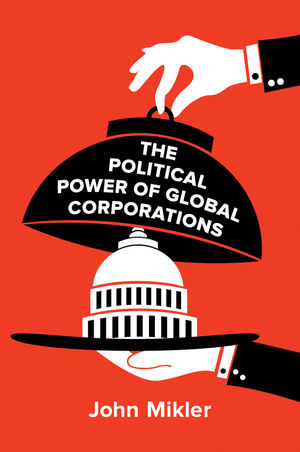
No new actors manage to establish themselves in markets characterised by monopoly-like tendencies. John Mikler argues that instead of competing in free markets, large firms define and control them. This is the starting point for his study of the political power of global corporations in the book The Political Power of Global Corporations.
«Global» vs «big» firms
Mikler first points out that only a small number of what is often referred to as «global companies» are truly so. According to UNCTAD’s definition, companies are considered global if they have more than 60 percent of employees from nationalities other than where their headquarters are located, if more than 60 percent of sales revenues come from other countries than where their headquarters are located. The same applies to their share capital. With this understanding, there are not many global firms today. Therefore, Mikler is concerned with «re-territorialising» our understanding of global companies. #Walmart is an example of a company many refer to as «global,» but according to the above definition, it is unequivocally American.
The political power of large companies is geographically rooted rather than global. Mikler provides several examples of how large companies negotiate favourable deals for themselves in certain countries, thus contributing to the differentiation and exploitation of the global financial landscape.
The political power of large companies is geographically rooted rather than global.
Equally acclaimed despite misconduct
For example, #Apple paid no (0 percent) income tax on the 30 billion dollars the company earned in #Ireland between 2009 and 2012 through so-called «aggressive tax planning.» In 2011, #Google shifted 80 percent of its profits to the tax haven of #Bermuda and paid only 2.4 percent corporate tax on profits earned outside the USA that year. The American sports brand NIKE’s contracts with 600 factories, employing 800,000 workers, give it such political authority and bargaining power in several low-cost production countries that working conditions, including wages, can be pushed far below acceptable levels. Paradoxically, this happens while these companies put a lot of effort into building their own brand as «socially responsible businesses.» They do it so well that they are almost unaffected when #tax avoidance or production scandals become known to the public.
When it became known in 2010 that the Chinese company #Foxconn Technology Group, which produced iPhones for Apple, forced its workers to work 100 hours of overtime per month, housed them in very poor conditions in the factory’s dormitories, and paid them a miserable wage, it did not lead to any consumer boycott of iPhones – quite the opposite. Apple became the world’s top-selling mobile phone manufacturer the following year. Apple switched manufacturers in #China, but in 2015, it turned out that the new factory also produced iPhones under highly criticised conditions – without affecting sales or stock prices. And how many of us have actually stopped using Google after Dagens Næringsliv revealed last year that the company paid a paltry 2.9 million in tax on revenue of 2.5 billion Norwegian kroner in Norway? Aggressive tax planning – where Google Ireland invoices Google Norway for brand rights and other services – resulted in Google Norway reporting a loss in 2016! Still, according to the American economic magazine Forbes, Apple and Google are the «most admired companies» in the world.
He doesn’t write «short and sexy»
Shaping the societal discourse
These large companies maintain a positive image of themselves by determining the prevailing societal discourse. Due to their size, they have enough resources to set the agenda and decide how we talk about things (the world’s 20 largest companies have the same annual revenue as the world’s 138 poorest countries). The large firms have a vested interest in shaping the discussion of #neoliberalism and the power of the market as if «there is no alternative» (cf. Margaret Thatcher’s slogan TINA from the early 1980s). However, according to Mikler, it is not the market that has power. It is the large firms that do, while the free market hardly exists where these large companies operate. How free is the market for #social media# when #Facebook has 2.2 billion users today and has recently acquired both Instagram and WhatsApp?
The neoliberal discourse makes it sound as if economic development cannot be controlled, that it simply follows its natural course. But Mikler reminds us that large companies are vested in depoliticising their role and making people believe that development cannot be politically controlled. As a result, global corporations can continue to influence policymakers to adopt conditions that allow the companies to grow in terms of economic size and political power.
Mikler’s book is heavy material. He doesn’t write «short and sexy»; he loads it with references and takes numerous reservations in his writing. I would be content with reading this review and leaving the book aside. In any case: Don’t buy it on Amazon – as that would contribute to maintaining the market monopoly of the global giants in their controlled neoliberal world.