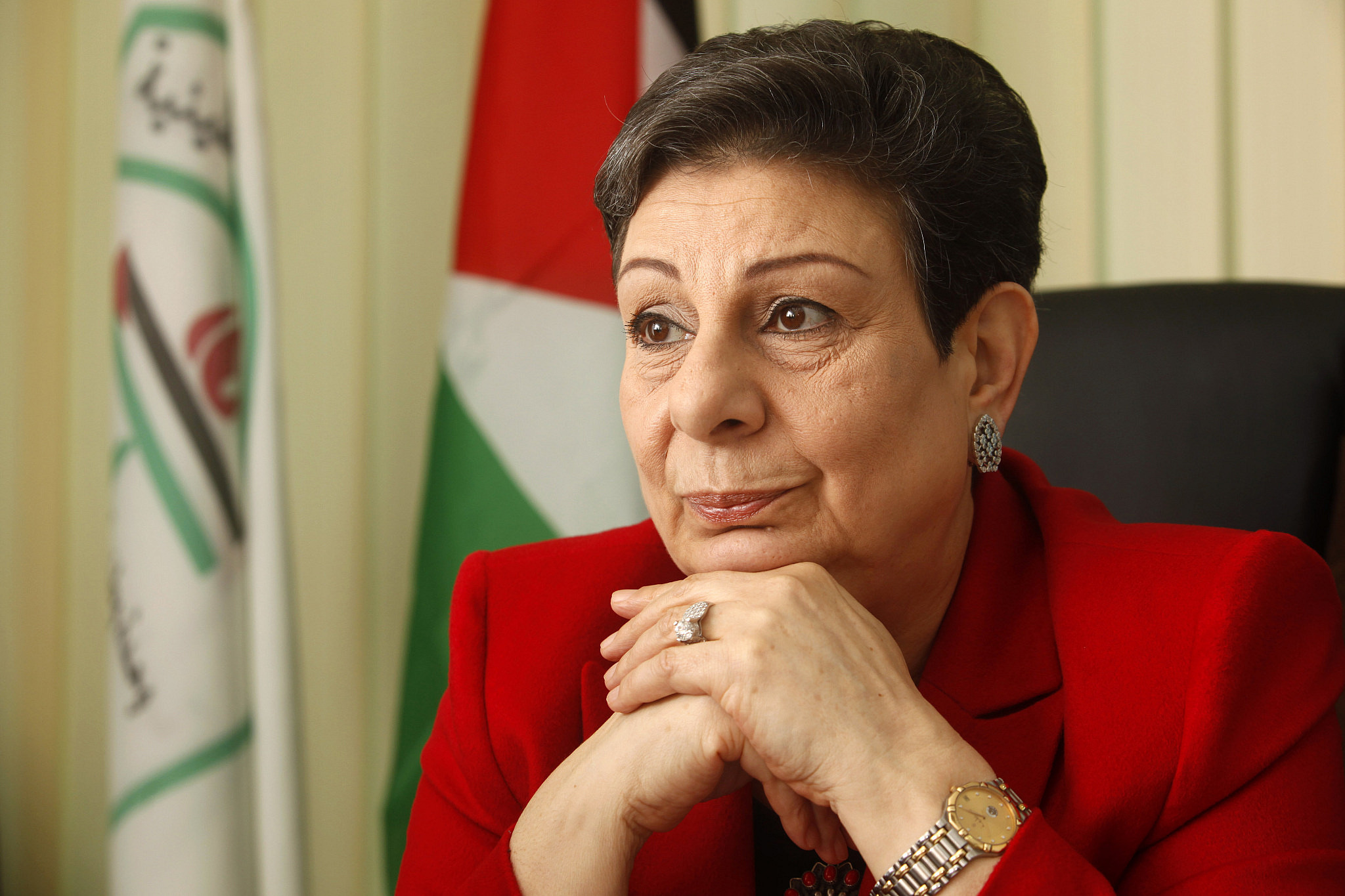
I meet Hanan Ashrawi at the PLO headquarters in Ramallah on the West Bank. As early as 1995, she wrote a book about the Oslo Accords, This Side of Peace: A Personal Account, in which she describes the negotiations as ‘a non-creative event’. She was a leading figure in the negotiations, but eventually withdrew ‘because the balance of power between the Israelis and the Palestinians remained asymmetrical’.
– That is not how one negotiates. Such negotiations perpetuate injustice rather than creating a future. Unfortunately, the Oslo Accords ended up being a deeply flawed agreement. It exploited the vulnerable position of an occupied people and allowed the occupying power to avoid providing guarantees. They bought themselves time. Although the agreement could have led to a Palestinian state, it was more likely to lead to a catastrophe.
She wrote the book in 1995 because she felt that the political process paid little heed to the human aspects, something she believes was reflected in Arafat’s ‘far too political’ speech in Washington in 1993:
– The speech lacked our Palestinian humanity. Arafat was abstract and dry, rather than human, intellectual and committed. When I wrote the speeches and presented our peace initiatives, I wrote from the depths of my heart. I could not be manipulative with themes such as hope, inspiration and suffering. Arafat’s speech was not a Palestinian speech. It did not bear witness to our collective experience, but sold us out.
For most Palestinians, Arafat was the last Palestinian symbol of the struggle for liberation, but according to Ashrawi, he also ran a one-man show:
– Arafat – or Abu Ammar, as we call him by his alias – was a father figure; he was paternalistic; he was a symbol, but also a revolutionary and someone capable of mobilising people. People had great awe for him, but also great devotion. Even within Hamas, they could not help but respect him. I really miss him, but I also know that he made many mistakes. He struggled both with nation-building and with decision-making, and, sadly, he allowed corruption to continue. But today the people miss Arafat’s closeness, his attention and his care. He was there for us; he didn’t care about things for his own sake.
– When Arafat asked me if I would be the PLO’s spokesperson during the peace negotiations, I replied: ‘Only if I’m free to say what I think. I’m nobody’s parrot.’ He replied: ‘All right, what you say will be our policy and we’ll respect that. You’re part of the leadership, and so you make decisions.’ And that’s what I did. I shaped policy as a spokesperson. Although our team consisted of academics and intellectuals, I believe we were professional politicians. We had the people’s trust. It was only much later that I realised a male-dominated system had become established, with its benefits and privileges. The men who wanted power pushed us women to the sidelines.
Concrete action
The Norwegian Ministry of Foreign Affairs transfers nearly 800 million kroner annually to the Palestinian territories and chairs the donor group AHLC (Ad Hoc Liaison Committee), which transfers around six billion kroner annually. Many of the countries in the group have become critical of the transfers because the establishment of a Palestinian state has not materialised. Many believe the Oslo Accords are dead. Even people I meet in Ramallah generally shake their heads at the outcome of the agreement that Ashrawi helped to initiate.
How do you assess Norway’s role in the negotiations?
– Norway contributed a very important approach. Actually, I don’t believe in secret talks, but Norway showed the courage to intervene. Norway’s principles make a difference, even though you are a small country. Foreign Minister Johan Holst was an outstanding man whom I respected and was fond of. The others who took part in the process were too political; Holst, on the other hand, had a vision. He believed he was doing something good by bringing two peoples together. When I established the first back-channel between the Israeli Yair Hirschfeld and the Palestinian Abu Alaa, I too believed I was doing something good. I did not know that this would lead to the Oslo Accords. The serious problem was a lack of understanding of the power imbalances. Moreover, two Palestinian negotiators were brought in who had not lived here under the occupation and experienced our reality – nor did they have a particularly good command of English. An asymmetry of power was built into the Oslo Accords, and in the multi-phased approach, Israel ended up holding the power, says Ashraw, adding:
– But Norway has continued to contribute to nation-building, supported Palestine, voted for us in international forums and wants peace. Norway can make a contribution. Nor do I think Norway should be ashamed of the Oslo Accords. I do not blame a third party that tried its best. I blame the Palestinians; we should never have signed the agreement – we should have known better. The negotiators should have realised it was a mistake.
But at least you managed to establish the Palestinian Authority?
– Yes, we eventually established a civil administration. Israel said: ‘Build your own schools and hospitals, and collect your own rubbish.’ We replied: ‘We want freedom; we want an end to the occupation. We do not want to run the occupation for you; we want to live as free people, and we refuse to cooperate.’ We refused, but were threatened and challenged.
With the Oslo II Accord in 1995, the West Bank was divided into Areas A, B and C. Only Area A, three per cent of the territory, was granted ‘real’ Palestinian self-rule:
– We have lived here all our lives amidst places with significant historical names, places you can read about in the Bible. Now we only have the letters A, B and C. And Israel is carrying out ethnic cleansing in Area C – there are now more Israeli settlers there than Palestinians. In the ‘free’ Area A, there are constant Israeli raids. When my husband and I go for a walk in the evening, we often see Israeli military patrols. They arrest and destroy people just as they please. The State of Israel has no respect for signed agreements, international law, or humanity as such.
The US gives Israel around three billion dollars a year, mainly for the military. Were the Norwegian negotiators too naive about Israel’s intentions?
– They may have been naive, but I wouldn’t blame Norway. You’ve done far more than other countries; at the very least, you didn’t want to cause harm. I keep telling the US that ‘if you can’t do any good, please don’t harm us’, but they keep on harming us. Other European countries do too, because they do what the US asks them to. And the US does what Israel asks them to. Norway tried to break this cycle, says Ashrawi before continuing:
– Israel believes that its history grants it a privilege that elevates it above the laws found in other countries. This cannot go on forever. Today, it is time to talk about concrete measures, to put an end to the occupation. Together with other European countries, we must call for an Arab peace initiative and try to change the realities on the ground. There is no longer any time for talk. We constantly see peace negotiations being used against us; such agreements take on a life of their own, divorced from reality. We really need action, binding timetables, collective commitments that can change reality. If that can happen, I can see Norway playing a role in it. I wouldn’t call it Oslo 3, but I would very much like to see Norway take part, because they have always shown courage and had a vision of making a difference. We need an action plan, rather than signing more agreements – which Israel denies anyway. Better still, arbitration: serious commitments that make it clear to Israel that there is a price to pay if they continue this behaviour. That could make a difference, says Ashrawi.
Historic compromise
Whilst US Secretary of State Kerry is currently trying to bring the parties to the table for new peace talks over a nine-month period, one might wonder what the alternative is if yet another peace process fails to bear fruit. Many have lost faith in a two-state solution. The West Bank is now so fragmented by settlements that a contiguous Palestinian state seems an impossible prospect. Recently, the Israeli government also allocated huge sums to expand the railway network to cities across the country, including the occupied Palestinian territories. They are hardly planning for a two-state solution. And shortly after negotiations resumed this summer, the Knesset went ahead and approved a thousand new settlements. Netanyahu’s coalition government is highly opposed to peace negotiations. Right-wing politicians are also speaking out publicly, saying that Israel should stop playing games and instead annex the entire area between the River Jordan and the Mediterranean Sea.
Will we end up with a state for two nations?
– The one-state solution is the de facto result of current Israeli policy. Israel is destroying the two-state solution, whilst their version of a one-state solution is clear: a country without our people. They want to fill the land with settlers right up to the very borders. They want to get rid of Gaza, preferring to make it an Egyptian problem. This involves gathering the Palestinians into population centres, granting them administrative rights, but leaving them to be Jordan’s responsibility. Or perhaps they want to drive us out, making our lives so difficult that we move away. We are already experiencing a very serious brain drain. Would Israel really grant us citizenship and full rights? According to Israel’s racist laws, we do not even qualify for a passport, says Ashrawi.
But if this is the only solution in the long term, can you envisage shared schools and institutions for Jews and Arabs?
– Many years from now. It’s a utopian vision. Right now, we have a system of power, a state that enslaves an entire nation. Remember that the Palestinian population has been oppressed and excluded for 65 years. Do you really think they will suddenly view Palestinians in the West Bank and Gaza as equals? All we have is a Palestinian travel document and possibly a temporary Jordanian passport, says Ashrawi, adding:
– I cannot envisage the international community supporting a one-state solution. Today they are pushing for a two-state solution, even though they can see that Israel is destroying it. Back in 1968–1969, we advocated the one-state solution. We wanted a democratic, non-sectarian and secular Palestine, where Muslims, Christians, Jews and others could live freely and as equals. But we were immediately rejected.
– Just think what would happen if the refugees were allowed to return and we ended up with two to three million more Palestinians than Jews in the whole of Israel? Do you really think we’d be granted full rights and citizenship? After all, today they refuse to treat the 1.2 million Palestinian citizens of Israel as equal citizens, says Ashrawi.
– The two state solution was a historic compromise, an unfair solution, but a relatively feasible one. Yet not even 78 per cent of historic Palestine was enough for the Israelis. Since then, they have expanded the occupation, stolen land, built the Security Wall, altered Jerusalem, and treated us like slaves and second-class citizens. Do you really think, then, that the international community will be able to persuade Israel to accept a one-state solution?
Contributing to the future
What is it like to be a female politician in this traditionally male-dominated region?
– We have a patriarchal society, essentially a tribal society. Power lies in family ties, communities and tribes, but these also serve as a form of protection. Unfortunately, tradition and religion are used against women.
– Women can make a difference when they are genuinely feminine and work collectively, rather than those who merely mimic men’s typical self-interest and desire for privilege. Moreover, the use of power does not make you a real man. A man confident in his own masculinity does not need to oppress women to feel powerful. I like creative men, those sensitive souls, with imagination and self-esteem.
Ashrawi is herself married to an artist and has written several books on literature. As a politician, does she actually have time for a family?
– I have two daughters. Parenting is a shared responsibility for both mother and father – a joy and a responsibility. It is your contribution to the future, to humanity, to life. But it is also a risk, because you are bringing them into an unjust and not always happy world. You must therefore equip your children with all the tools of humanism to survive, says Ashrawi, adding:
– Remember that those who have children also have a stake in happiness. Being a politician is linked to this. When you love your family, your children, you can then love your people, and subsequently humanity. With that sense of security, that genuine selfless love that you give to your children and family – you are also able to love your country, and humanity as such. Herein lies the commitment to a more humane future.
– It won’t be pretty
Ashrawi concludes, in despair, by saying that they do not yet have such a humane future, with the freedom to engage politically, to express themselves, to use the country’s resources or to move about freely:
– We have always been confined, kept away from the sun by the Wall and the checkpoints. I am extremely angry. I am furious at the lack of accountability, predictability, lack of morality, and the lack of human acceptance of us. What will become of us in the future? Israel gets away with murder. Sooner or later, it will come back to haunt them; the whole thing could collapse in major outbreaks of violence. It won’t be easy then; it won’t be pleasant; it won’t be comfortable – but it won’t be possible to hold it back.
– This is because we are not victims; we are not a docile people. We have long shown self-control and demonstrated a sense of responsibility, but this has not been appreciated. Sooner or later, a popular uprising will break out. It is dangerous simply to leave us sitting here with no future. Unfortunately, Israel resorts to violence every time it feels threatened, as if it has a right to do so. But it will backfire on them – if you use violence, you also give others licence to do the same. But violence is the behaviour of cowards; it only leads to a chain of retaliatory actions.