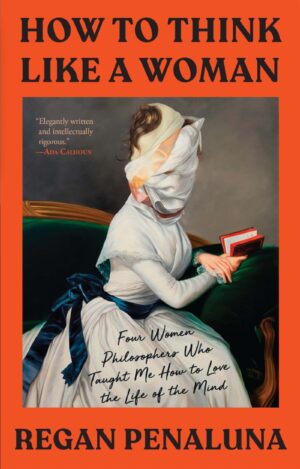
The book is based on a rigorous and thorough examination of the life and work of four 17th and 18th-century feminist philosophers. #Damaris Masham#, #Mary Astell#, #Mary Wollstonecraft#, and #Catharine Cockburn# were «influential but scandalously overlooked» (to use the words of one reviewer), and Reagan Penaluna brilliantly explains how discovering information about them helped her understand her difficulties as a female philosopher in contemporary US #academia. Eventually, she left the university and specialised in science communication. Successfully. Her book How to Think Like a Woman dashingly addresses some key questions about women’s equality. You will enjoy reading it even if you are not into the history of philosophy.

Prejudices
Mentioning equality might seem outdated today. Plenty of information about extraordinary women from the past and the present is available to the new generations. The imperative of equal opportunities has been built into the language and employment policies in several countries far beyond the #Global North#. Because of this, the author’s personal experience is essential. That women are in no way inferior to men has become common sense by now, but the #misogynist mentality has not died out. This is one of the many hypocrisies that mark the contemporary world, and we all experience it from time to time.
The experience of Regan Penaluna is particularly important because, as her recollection delicately reminds us, philosophy is not like any other field of activity. It concerns the most outstanding human quality: reason. One event is particularly telling. Regan Penaluna, a graduate student in Boston, USA, attended a philosophy lecture in which a renowned philosophy professor invited the students to consider the possibility that women aren’t as smart as men. Suggesting that this is the true reason why women have not achieved the highest levels of thought (p. 1-2).
Of course, this is «just» repeating the millennia-old prejudice of philosophers. #Aristotle claimed that women were destined to be ruled by men; #Baruch Spinoza# wrote that women «have not by nature equal right with men» (p.26); #August Comte# believed that women were intellectually inferior to men. #Darwin argued that man can attain «to a higher eminence, in whatever he takes up, then woman can attain» (p. 29), and in 1873 a professor of medicine at Harvard, relying on Darwin’s arguments, wrote against girls’ higher education in the United States. Until 1869, women were barred from enrolling at Cambridge, and until 1920, from Oxford.
Far from being a thing from the past, these prejudices essentially define what is specific about the female mind.
This is one of the many hypocrisies that mark the contemporary world, and we all experience it from time to time.
What sex is the mind?
Penaluna’s critics straightforwardly reject her assumption that it is possible to «think like a woman.» There is no single way of thinking like a woman, claimed one reviewer. «Most women think it is irritating that they are assumed to think alike.» In other words, the mind has no sex. While this view is essentialist, Penaluna invites her readers to take a historical perspective. A perspective through which we, different women who, of course, do not think alike, all have in common the prejudice with millennia-long tradition that we face in our culture as women. This is what obliges us to «think like a woman.» The beauty of Penaluna’s book is that it guides the reader from one to the other. From what she believed at the beginning, that intelligence was something you were born with, to what she learnt along her studies and events described in her book, that «intelligence could also be accumulative, a function of effort and curiosity, a construct dependent upon a community and its norms» (p. 11). In these terms, at the end of the book, she claims, «I am a woman thinker.» A thinker whose intellect «wasn’t shaped in the glory of transcendent questions but rather in response to the insidious systems of oppression» (p. 249).
Change the Canon
Uncovering the stories about the feminist pioneers Damaris Masham, Mary Astell, Mary Wollstonecraft, and Catharine Cockburn, Penaluna importantly contributed to the knowledge about Western #feminism. She exposed the «double standards» of their male contemporaries, #Enlightenment philosophers who promoted ideals of freedom and equality but did not extend those ideals to women.
Her book also presents many outstanding women thinkers from other parts of the world. For example, Nana Asma`u bint Usman’dan Fodio from the Sokoto Caliphate (1804-1903), a #Sunni Muslim caliphate in West Africa. With a population of around 10–20 million people, this was the most populous empire in West Africa, and its boundaries united the parts of present-day Cameroon, Burkina Faso, Niger, and Nigeria. Nana Asma`u was the daughter of the founder of the Caliphate and a #Sufi Islamic preacher, a scholastic Sufi sect that held women worthy of learning. Nana Asma`u had a reputation as a leading scholar of the Caliphate, and she wrote extensively on women leaders and women’s rights. She left behind a large body of work, many historical narratives, and also poems that became tools for teaching.
Reaching beyond the white middle-class feminism is Penaluna’s most groundbreaking achievement. In her own words, she explored the early women philosophers in order to place them alongside the more famous white male European thinkers. Her goal was to expand the canon itself. Yet, eventually, she realised this was not enough. «We need to rethink the concept of a canon itself» (p. 250) and include the undisciplined parts of intellectual history. Create a history of thought that is «dynamic and feral like a great cat.»