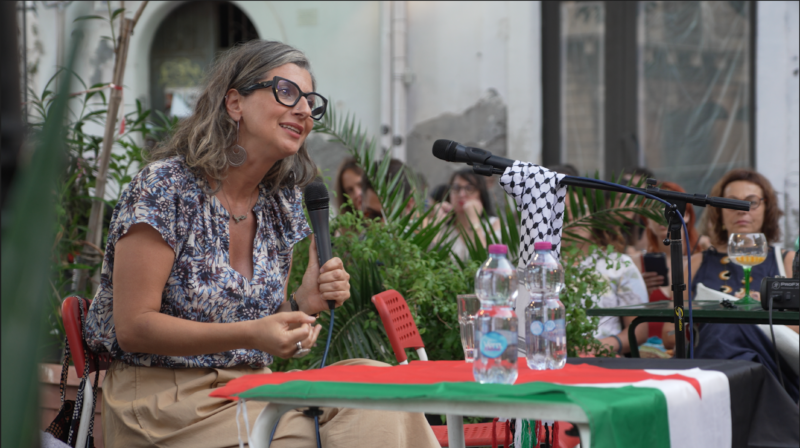
She simply commented, «I think I’ve hit a raw nerve.»
For her latest report, From Economy of Occupation to Economy of Genocide, Italian jurist #Francesca Albanese#, the UN Special Rapporteur for the Palestinian Territories, has been just blacklisted by the United States, which called for her removal. But ultimately, it’s nothing new. Since 2024, she has been banned from #Israel. And since 7 October, when her lectures started packing out bookstores, theatres, and universities around the world, the police have been deployed in riot gear to guard the audience. Or to stop the event. «But what does Guterres, the UN Secretary General, say?” she was asked in a TV interview. She hesitated for a moment. Then she said, «I’ve never heard from him.»
After examining the conduct of Israel and #Hamas, accused of all sorts of crimes in her previous reports, Francesca Albanese has now moved from telephoto to wide-angle: framing the context. Because in a #conflict, there are always more than two sides: the two fighting each other, plus all those who enable them to fight. And it’s not just about arms dealers. When it comes to crimes such as those under the jurisdiction of international tribunals – #war crimes#, crimes against humanity, up to the potential #genocide that, according to the Court of Justice, ruling of 26 January 2024, might be going on in #Gaza, it’s clear that we are not talking of individual actions, but of structural ones. We are talking of a system: a system that involves an entire country. And even more. An entire country, and its allies.

Allies of all kinds. From #Lockheed Martin# to Airbnb.
As Antonio Cassese, one of the founding fathers of the International Criminal Court, used to say: In the end, in war someone cooks, someone sweeps, and someone kills.
And so, from Israel and Hamas, Francesca Albanese moved on to everyone else.
To all of us.
That’s why the reaction was so harsh.
But actually, the report is in keeping with a series of studies that have become more and more popular in recent years: as the Occupation, which dates back to 1967, has gradually changed in nature, from a military to both a military and civilian enterprise. The pioneers were the studies on the #Supreme Court# by David Kretzmer, one of Israel’s leading constitutional scholars: on how laws, and above all, the judges who construe and apply the laws, have supported, for example, the expansion of settlements, through the requalification of property titles, or the complex body of permits and authorisations that is now the cornerstone of a new apartheid. And later on, the studies on architecture and landscape by another Israeli, Eyal Weizmann. Or those on the economy by yet another Israeli, Shir Ever. Because over time, it has become apparent that the M16s are only one of the many weapons of the Occupation. And not the key one. And it is typical of today’s wars that they are again total wars. That is, wars are no longer between two armies, nor between an army and guerrillas, but wars in which the two sides, very often asymmetrical, as in the case of Israel and Hamas, target civilians intentionally. But not to win hearts and minds. As in Vietnam. Rather, to destroy hearts and minds. To force surrender.
And perhaps, escape. Voluntary relocation.
Despite increasingly advanced, increasingly precise weapons, appearance is misleading. Today’s wars are absolute: in their objective and their means.
Everything is a target. And everything is a weapon.
Everything is a target. And everything is a weapon.
Since 7 October, while Gaza vanished from the map, with over 60,000 dead and 15,000 missing, a figure the Lancet has already warned has to be tripled, in the #West Bank#, in the meantime, the IDF has attacked refugee camps, and settlers have raided everything else. The government approved 57 new settlements and outposts: more than one in five residents is now a settler. So, says Francesca Albanese, the issue isn’t just who demolishes and helps demolish, but also who builds and helps build, replacing one country with another: one people with another. Physically, with bulldozers and cement, but also immaterially. With a narrative that turns the entire land into Israel. Like Airbnb.
Which, in the settlements, offers you a relaxing weekend as if nothing had happened.
The private sector largely features in the economy of the Occupation. The report mentions 48 companies, but there could be as many as 48,000. All companies that profit from illegality. Starting with those in the military field, of course. Since 7 October, Israel has increased its already high defence spending by a further 65%, up to $46.5 billion, attracting a growing number of suppliers. Especially tech experts. Experts in #CCTV cameras, biometric surveillance, smart checkpoints, drones, wiretaps, satellite imagery, and more, including #AI. Software that generates data for the troops: like the famous Lavender, the algorithm that identifies Hamas militants – and assesses collateral damage. And here, names become familiar. NSO, set up by IDF veterans of the 8200 élite unit, with its #Pegasus spyware, later unleashed against journalists and activists around the world, but also IBM, HP, and Microsoft, which in Israel has its main research centre outside the United States. And it’s no secret: the IDF itself explained how essential Google has been in Gaza.
Actually, all the names are familiar. Because in an Occupation that has turned, indeed, into a mixed military and civilian entity, everything is potentially dual-use. Like the bulldozers. Which pave Israel’s roads, but also flatten homes in the West Bank. The Caterpillar D9, now remotely driven, neutralises the zones the infantry is about to storm – that is, it razes all to ground. The armoured buses for settlers are Volvos. And it’s the German Heidelberg that extracts the limestone used for the settlements.
Meanwhile, the Spanish Ferrocarilles has contracts for trains, trams, and transportation: the infrastructure that makes life easier for Israelis, and a headache for Palestinians, trapped among so many off-limits areas that it takes three hours to get from #Ramallah to #Jerusalem, which is 9 miles away. Over 70% of Israel’s gas comes from the American Chevron. And the pipeline from its Leviathan field, off the coast of Egypt, is one of the untold reasons for the naval blockade of Gaza. And what about agribusiness? The Mexican Netafim? Or the Chinese Tnuva? At first glance, they are simply farms only, on land and with water that are being stolen from the Palestinians.
We have the laws. Where are the judges?
And then, there are all those that Francesca Albanese calls «enablers.» Like financial operators. Since 7 October, the Norwegian Government Pension Fund has raised its investments in Israel by 32%, while banks like BNP Paribas and Barclays, and insurers like Allianz, have bought the bonds issued by Israel to pay for the war. Not even charities are immune. Israel Gives, Christian Friends of Israeli Communities, and Dutch Christians for Israel: many of their projects are for the settlers. And then there are the universities. Like the MIT of Boston, with its labs directly on the payroll of the Ministry of Defence in Tel Aviv.
Not to mention the media. That would need an entire report.
Nothing is neutral, says Francesca Albanese. This is a joint criminal enterprise.
In which every action is a cog.
Every action is essential to other actions.
And it’s not just a matter of moral, or at most, political, complicity: it’s a legal issue.
These aren’t questionable business decisions. No. These are crimes.
There are the UN Guiding Principles on Business and Human Rights. And similar standards exist in the OECD. Which among its 51 members includes Israel. But above all, both the laws of war and international criminal law also apply to so-called non-state actors: by which we mean not only insurgents and guerrillas, but «anyone who causes adverse impacts on human rights.» And it is the responsibility of states to prevent and punish any unlawful conduct, even outside their own territory. The case law is clear. It is not easy, of course. These are challenging trials against powerful companies. But the Dutch who sold nerve gas to Iraq were convicted. And so were the French who backed militias to protect a cement factory in Syria.
Since 2020, the UN has had a database of the 97 companies that profit from the settlements, says Francesca Albanese. Isn’t it time to use it?
We have the laws. Where are the judges?