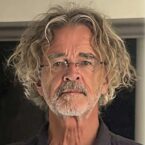
It is March in Greece. The world-renowned Israeli filmmaker Eyal Sivan is a guest at the Thessaloniki Documentary Festival. A retrospective of his many films is being screened here. Alongside Amos Gitai and Avi Mograbi, Sivan is regarded as a dissident amongst Israeli filmmakers. He tells me that he wants to provoke with his films, to get people to react. Sivan is used to opposition, for for every person who supports him, there are ten who criticise him. Many people hate the outspoken filmmaker from Israel’s upper middle class. He has received a bullet in the post with the message ‘you’ll be next’. When a director friend lost his life whilst making a pro-Palestinian film, he became afraid for himself and his family. But he can withstand accusations and hateful remarks, for as festival director Dmitri Eipides writes in the Thessaloniki festival catalogue: ‘He dares to portray the Palestinian side as something less one-dimensional than the word “enemy”; dares to speak of Israel beyond the rhetoric of the establishment and ideological terms of a “chosen people”; dares to expose the propaganda machine.’
Dismantle the establishment’s narrative
Sivan grew up in Jerusalem with Zionist parents, but moved to Paris in his twenties. He has made over ten controversial documentaries, and continues to make his mark with essays and as editor of the political journal South Cinema Notebooks. His films largely focus on perpetrators – he believes propaganda films merely show the results and not the causes. He wants to leave the audience feeling uneasy. With his first film about Palestinians in a refugee camp, Agabat-Jaber (1987), he found that the film did little more than confirm the audience’s desire to be compassionate humanitarians. Such films tend to conceal the perpetrator. Since then, he has sought to unsettle the audience, with films such as The Specialist: Portrait of a Modern Criminal (1999) and Jaffa, the Orange Clock (2009).
The Specialist deals with the Israeli trial of Adolf Eichmann, the Nazi bureaucrat who organised the deportation of Jews to the concentration camps. Sivan claims the trial was politically motivated, and at times he illustrates this by manipulating the numerous archive recordings. He found most of the archive material tucked away in an old toilet. In Sivan’s editing, a ‘reflection’ of the audience is superimposed onto the glass cage of the defendant, and a judge is superimposed into a sequence of images. He believes the trial, which lasted six months, should have lasted three days, but that the Israelis wanted to put a face to evil. Sivan examines what is omitted when history is written.
Why did Israeli intelligence not capture Eichmann until 1960, when they had known of him as early as 1955? The Israeli judiciary defied international extradition demands and hanged the man almost fifty years ago – the only execution under civil law carried out in Israel. Did Israel use the trial politically to write its own history?
Sivan believes that today’s accomplices in Israel are those who fail to criticise: ‘When you come from an apartheid state, from the white upper class, with total freedom to criticise, if you, as an intellectual or artist, do not make use of the opportunity to criticise – then you are a true accomplice.’ Sivan takes it upon himself to dismantle the old victim narrative that ‘legitimises’ the attacks on the Palestinians.
And it is the perpetrators who are exposed in Sivan’s film about Jaffa, where – according to experts Sivan interviews – the Israelis long ago drove out the Palestinians to take over the orange groves. The familiar brand has been falsified in the name of nationalism. The one-sided identity of Israeli nationalism is also in the spotlight in the film Izkor – Slaves of Memory (1990), in which Sivan examines the impact on the country’s schoolchildren of the myth of the chosen people and Israel’s enemy stereotypes in the classroom.
Community must be the goal
Sivan thrives in the editing room poring over old archive footage, something that has also taken its toll on his back, resulting in surgery and daily exercise. He says that the work is a struggle, like on a battlefield – where you don’t stop to think about whether you’re tired or hungry. This is confirmed by a phone call from his wife, who, during our meeting, urgently urges him to stop and come home. But other journalists are waiting in the corridor.
– You refer to Hannah Arendt, Walter Benjamin and Michel Foucault; do you find motivation in ethics and philosophy?‘My commitment comes from reading reality,’ replies Sivan.
What is the Israel you’re constantly working in like? What drives you to work so hard for political change?
– We have a memory that tells us we were born out of Auschwitz, but the perspective is also that we are heading back to Auschwitz. Israel has an apocalyptic view of reality. The country’s vision is not about life itself, but about its destruction. Expanding with new settlements over the past 50 years is no solution, but utter nonsense. The only thing that will save the Jewish community in the Arab world is integration and participation. Unfortunately, Israel in particular clings to the myth that someone wants to exterminate them; they are ready to strike back no matter the cost, says Sivan, continuing:
– The Israeli state offers young people no future. The country is instead geared towards the paranoid, those who wish to be persecuted, in order to prove that they were right. For 60 years, Israel has constructed the idea that someone wants to destroy us, that we will disappear. We are talking about a nation that now has almost 200 nuclear bombs. The catastrophic aspect of Israel’s attitude towards Iran today is that it could end in suicide.
– Israel is capitalising on the moral credit once bestowed by six million corpses – that it has been victims, is victims, and will continue to be victims. Memory can thus be a terrible weapon. One can end up in a massive conflict that is no longer grounded in reality, says Sivan.
– Do you consider yourself a political filmmaker?
– Is there anyone who isn’t? Those who deny it are perhaps the most political of all.
Sivan is reluctant to call himself a dissident, because he believes he does not take the same risks as the oppressed do. He himself campaigns for a one-state solution in Israel, unlike the Norwegian government. He believes the two-state policy is flawed:
– For 75 years, people have been talking about a divided state as a good solution. 75 years show that it isn’t. Now we must ask how we can build a community. Jews and Arabs already live together in their everyday lives; community must be the goal.
A new Oslo Agreement
In his new film Common State – Conversations (2011), he brings together 25 intellectuals, activists, academics, Jews and Arabs to discuss the one-state solution. On a split screen, the English subtitles appear to converse with one another, even though the dialogue is in Hebrew and Arabic. These are some of the arguments put forward in the film: ‘In the 12th century, 97 per cent of Jews spoke Arabic as their mother tongue’, ‘I have both Jewish and Palestinian culture within me’, ‘My best friend is Palestinian; our conversation flows and is spiritual’, ‘No settler has ever given anything up voluntarily’, ‘I need a’, ‘we need a’, ‘we co-exist’ and ‘we must in Arabic’); ‘returning home is the central issue, the rest is just footnotes’, ‘the two-thirds living in the diaspora must also be able to decide’, and ‘we must accept one another as equal partners.’
Sivan believes that multiculturalism is the way forward:
– The problem lies in the Jews’ belief in a unique identity. Why can’t one accept diversity? This is, after all, precisely what those in power are exploiting today. If one is one, then one is also against something. But if one is diverse, it becomes more complicated to have an enemy.
How do you envisage the one-state solution being implemented?
– The international community must intervene and establish an international force in the country with the necessary authority. This is about more than just Israel and Palestine; it is about the future of the entire region. All Palestinians must be granted the right to equal citizenship. We must accept diversity of language in society, and both nurseries and schools must begin to mix Arabs and Jews. The country must have a single army and a single police force, rather than all these different militia groups that currently exist. In a unified state, the government can only have members who are committed to this solution. The occupation must be abolished.
Sivan believes there is a need for a new Oslo Agreement:
– We need a new agreement on how the whole country can be made accessible to everyone. Although the old Oslo Agreement was extremely unfair, and what followed was a disaster, it did have its advantages. A shift in mentality took place.
After all, Norway did more than other European countries, but it simply should not have pretended that it was a negotiation between equal partners. Over the last 30 years, the US has acted as a third party, but it is part of the conflict. Countries such as Norway, Switzerland and Finland wield a completely different kind of power through their neutrality.
See © Norwegian LMD