
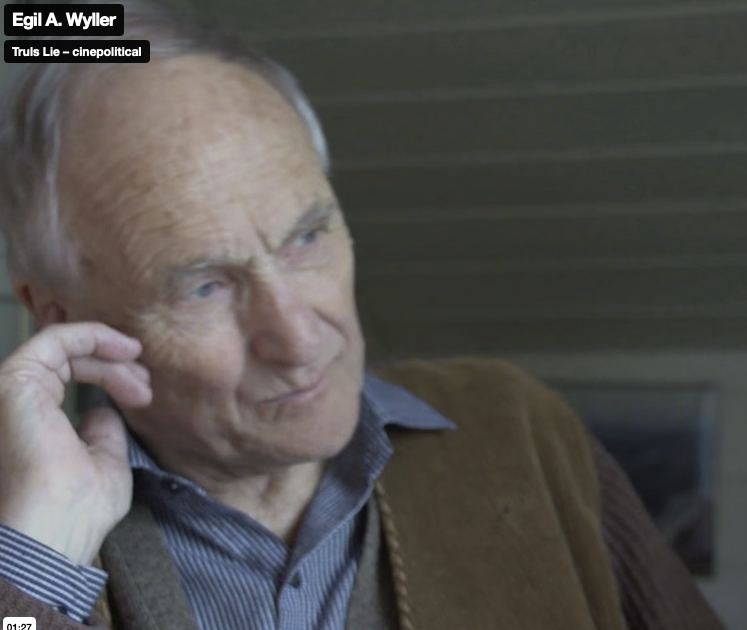
As Heidegger and Hegel have said before Egil A Wyller, he finds that thought comes from outside. We humans may sometimes feel that our thoughts are learnt, that language and practice have been bestowed upon us along the way, that thinking does not come from within us or is not entirely independent of how we have been socialised. Some people, however, are more intelligent and have experiences that make them more susceptible and receptive to profound reflections. Wyller is one of them; he has pushed the boundaries far, towards the very process of meaning-making as such, far beyond the usual aesthetic and ethical considerations – even though he has written extensively on these topics as well. Wyller’s life’s work ultimately became a 20-volume collection, entitled Henological Series – the doctrine of unity or the doctrine of the One.
In the recently published Kierkegaard and Norway, Wyller is described as ‘a sharp and distinctive communicator’ and is praised for his lectures and writings ‘on Kierkegaard as a henological thinker’ in the 1980s and 1990s. As a Christian Platonist, he, like Kierkegaard before him, focused particularly on Socrates and Christ. He managed ‘in his own way to bring together cultural criticism, pietism and humanism within his all-encompassing philosophy of love’, as stated in the commemorative book on Kierkegaard’s influence in Norway. Nevertheless, Wyller tells me that he is relatively uninterested in many of the other interpreters of Kierkegaard featured in this book, such as the ‘cultural-radical’ readings of Georg Brandes (1842–1926) and Eivind Tjønneland. They point to the ‘cultural-radical’ aspect in the well-known dispute Kierkegaard waged against the church in Copenhagen. Tjønneland also suggests that had Kierkegaard had a greater understanding of the aesthete’s romantic irony, he would never have needed to go through a religious phase. When I ask him about Joachim Garff, who wrote the major biography SAK, in which Kierkegaard is interpreted purely in literary-aesthetic terms, this does not seem to interest Wyller either. Instead, the conversation moves towards the deeper existential questions.
The Meaning of Life
In 1958, a young Norwegian philosopher, Gunnar Skirbekk, published the book Nihilism?, which Wyller reviewed at the time. (2) In the book, Skirbekk asks about the meaning of it all: Who is this God who fills his heart with his absence? He finds no God in the hereafter; Skirbekk remains in this world, which he experiences as evil. ‘Everywhere this emptiness, unreal, banal,’ writes Skirbekk. ‘In the exchange of views, the debaters function as discussion machines […] no disruptive thoughts seem to enter. No original thoughts, no genuine feelings. But always the same words … Love, God, Truth, Anxiety. Words raped by so many perverse individuals that their very quality has been worn away.’ According to Wyller, this book was a reckoning with a decaying Norwegian intellectual life. The time was long overdue for Norwegian thinkers to finally embrace European existentialism, as Skirbekk asks himself in despair: ‘Why am I alive? Why me, of all people? And right here? … I must have answers, must be told. I must have an explanation …’
Wyller himself found the explanation for it all in Plato. The Bible meant nothing to him, but later, at the age of 35, Christianity came to him – which, through the Gospel of John, he experienced as a ‘tidal wave’ in his mind. Unlike a number of other philosophers who devoted themselves to critical negations, Wyller, in his own words, turned his attention here to the positive. Both in his love for his wife, and also in his love for philosophy, the Bible and Jesus. He makes this clear in his two main mottos: ‘I love, therefore you are’ and ‘I am loved, therefore I am’.
Wyller criticises several of his contemporary philosophers, whom he believes have failed to recognise the positive power of love. Wyller felt, for example, that Martin Heidegger paid far too little attention to the Other. Another is the recently deceased Asbjørn Aarnes, who, despite his thinking on the Other through Levinas, in Wyller’s view did not open himself up sufficiently to the divine. Aarnes and Wyller edited the book series ‘Ide og Tanke’ for many years, but after several decades of friendship, they drifted apart in the final years before Aarnes’ death. According to Wyller, they were more different than he had thought: he did not share his friend Aarnes’s interest in all things Nordic or his fascination with Levinas’s thinking on the face of the Other. Wyller explains that he does not look at all the faces on the bus at all, but on rare occasions he might catch a glimpse of the face of God in a face.
The other front
Back in 1956, the young Aarnes and Wyller, together with their elderly professor A. H. Winsnes, chose to side with the prosecution in the trial against Agnar Mykle and the publication of The Song of the Red Ruby. At the time, Wyller wrote: ‘Lock the pornographers up again! Lock up their publishers and distributors too! […] Surely we have room for two or three hundred in our fine Norwegian prisons!’ He tells me that this was written in a humorous vein – despite feeling indignant, he did not believe they should be punished. At the time, public opinion sided with the prosecution against this new ‘licentiousness’ and the explicit sexual descriptions. In hindsight, however, it was the liberals who were proved right.
The value-conservatives from the Norwegian philosophical community were called ‘The Other Front’, after A. H. #Winsnes’s 1932 book. They sought to preserve humanism in the face of an ever-increasing scientification of life. They also frequently debated with Arne Næss, who represented a logical-positivist ‘First Front’. Wyller says he does not feel entirely at home with the label ‘The Other Front’, as he believes he consistently criticised rigid views. At the same time, like Skirbekk, he is concerned about the nihilism that accompanies Enlightenment thought, where rationality and declining spirituality can create a sense of meaninglessness. Although meaning abounds everywhere, the point is that, on a deeper level, it will feel irrelevant.
But times are changing. ‘Den Annen front’ included the former Minister of Culture, Lars Roar Langslet, who later expressed regret that Mykle ended up in court. As Wyller says, a cultural debate about whether Mykle stood for high-quality literature or merely wrote ‘reportage’ about live models should have been sufficient.3
Unparalleled sensitivity
On his 80th birthday, Wyller said in an interview with Vårt Land that he regarded his work as that of a Gregers Werle from #Ibsen’s The Wild Duck. Does he still hold such an ‘ideal demand’, Werle’s strict demand for truth?
– Yes, it is a matter of seeking the truth. I hold fast to that.
In 1999, Wyller wrote of Werle: ‘We quickly realise that he himself knows neither what truth is nor what life is. He does not know what truth is, because he knows only lies. He does not know what life is, because he acts against it. He dreams of an ideal: to become a dog that dives beneath the water to bring all the wounded wild ducks to the surface, but he has little success in this.’4
When I quote this, he exclaims:
– There are many weaknesses in me that I must admit, that I must face up to. I have not only had good qualities, just like Gregers Werle.
At the same time, Wyller describes Werle as a highly receptive mind in the world of human beings: ‘Everything in him is sensitivity, but unbridled sensitivity.’ But this sensitivity, which could neither advise Hjalmar nor comfort Hedvig, ‘can only be “shaken” and “shake” others, and, if heeded, drive one to despair, for it is itself desperate.’ Gregers’ inner compulsion is a feeling that is ‘incurably egocentric. ‘Gregers does not love people’, but rather takes revenge for ‘wrong done to him, revenge for the barren, ruined life.’ As Wyller points out, Werle, like many such ‘philosophers’, cannot truly comfort people, because he does not really have love within him. Wyller’s insight, gained after a long life, is that without love ‘one does not understand’, and indeed cannot really act. If the pursuit of truth gets the upper hand, critical negations take over entirely.
For Wyller, Ibsen’s truth-seeking Brand is the thesis itself, and the truth-experiencing Peer Gynt the antithesis (ultimately, he sees the synthesis of these in The Emperor and the Galilean). Youthful idealisation and the daring that experiences the groundless, the onion without a core. In Norway, like others, he stands in Ibsen’s shadow, but he hopes at least that the doctrine of unity – which I would today interpret as a deeper sense of love – might be taken up by some younger philosophers. Yet he himself has long felt overlooked and ignored by the ‘official’ philosophical community. Could his Christian outlook possibly have been an obstacle to his work being read by intellectuals? He believes so.
Søren Kierkegaard
Works of Love is the philosophical magnum opus of Søren Kierkegaard, whose 200th anniversary we are marking this year, according to Wyller. In his book series, he has translated this volume into Norwegian, adding an analytical afterword.5 He expresses disappointment that the work has received so little attention in Norway, not least in this centenary year.
It is rather ‘the Athens of thought’ and Socratic philosophy that attract attention. Critical negativity takes precedence over ‘the Jerusalem of faith’. According to Wyller, Kierkegaard himself was ‘almost torn to pieces by standing at the crossroads of Athens and Jerusalem.’6 Today, it is rather the practice of negativity that finds its outlet in rebellion, in the pursuit of the new, in constant dwelling on the ephemeral.
With Kierkegaard, Wyller seeks rather the enduring, the long-term thoughts. He goes beyond Socrates, who ‘constantly remained in the negative’,⁷ but also Plato, who in his search for the positive ‘merely fell back from logical to mythical consciousness’. Wyller instead follows what Kierkegaard wrote in Philosophical Fragments: ‘Within the framework of Christianity as a religion revealed in the person of Jesus Christ … to direct the eros of one’s thought towards a higher, positive object.’ For Wyller, neither Socrates nor Plato managed to approach Kierkegaardian eternity, as ‘the religious horizon of classical Greece did not permit any Greek such a lofty aspiration in the name of thought.’
But are these lofty aspirations really the preserve of Christianity? I myself am by no means a Christian, yet I have been reading Kierkegaard for many years. Kierkegaard referred to around half of his twenty volumes as edifying writings: ‘Love is the Foundation, Love is the Building, Love builds.’ It is about the individual’s relationship with their fellow human beings, with the Other – love is ‘a quality by which, or in which, you are for others.’ One need not be a Christian to realise this.
In Works of Love, the point is that ‘by their fruits shall the tree be known.’ 8 By discussing the ability to show trust – as opposed to mistrust, suspicion and doubt – Wyller reminds us that although the loving person may seem gullible and naïve when he or she exposes themselves to being deceived, the person who is open to everything can, in reality, never be deceived.
As Kierkegaard wrote in the book, it is one thing to be deceived oneself by thinking well of a bad person, but to think ill of a good person is to deceive the Other. Yet the trusting person is less vulnerable to the world’s lies and deceit, because the filth does not stick or take hold. And rather than constantly allowing oneself to remain in a state of despair – in which Kierkegaard himself was entrenched – it is loving to hope for the best, to never give up on the fellow human beings one so desperately needs.
In contrast, the unloving wallow in pettiness, envy and schadenfreude – often in that Peer Gynt-like, corrosive sorcery. Without the ‘Act of Self-Sacrificing Devotion’ – here interpreted by Wyller as Solveig – we humans must ‘beware of seeking our own interests, for in love there is no distinction between “mine” and “yours”’.
True love is thus essentially a spiritual matter – it is only by losing oneself that one gains God. Here I would add that ‘God’, for many of us, can also be interpreted as a deeper psychological insight. The all-encompassing reality can be experienced as something ‘beyond’, but after a lifetime of reading and deep reflection, of life experiences and linguistic contemplation, of a diversity of lived practices and inherited patterns of thought, one senses the unity, or the whole – not necessarily as ‘God’.
Goodness
Many people today will find Christian ‘goodness’ suspect. During our lengthy conversation, 88-year-old Wyller can also come across as somewhat childishly enthusiastic. But perhaps, like Kierkegaard, he has no ‘understanding of evil’ or is not versed in ‘the art of slander, backbiting and lies’? Is it Dostoevsky’s The Idiot sitting before me? Has he become the man who interprets most things in the best possible light, who is ‘in’ the world but ‘of’ eternity, and therefore believes and hopes for everything?
In Kierkegaard’s Works of Love, he grapples with despair: ‘for the power of despair, however much it may be extolled, is nevertheless powerlessness; its highest point is precisely its downfall. […] Despair is the absence of the eternal.’9 One might think that many have foundered here, that they do not dare to take the ‘leap of faith’. But like Wyller’s many colleagues in Norway, including Skirbekk, they have probably taken a run-up and jumped – even if they do not necessarily land quite on the other side.
Skirbekk saw all the evil taking place in the world; he therefore dismissed the existence of God. Yet one can still look to the good that Kierkegaardian mercy and reconciliation can bring about. Sincerity (‘the heart’) can be combined with good deeds. Rather than today’s international hunt for enemies – and the way, for example, ‘the Others’ are so easily labelled ‘terrorists’ – there is still something to be learnt from the old Kierkegaardian concept of love. Before one ends up ‘proud, conceited, arrogant, self-satisfied’, one could learn to repay evil with good. But for Wyller, purity of heart is the fundamental hedonistic principle: to will the one thing. As Kierkegaard writes, this involves, over a long period, ‘persisting in thinking a single Thought […] with increasing passion and growing humility’.
It is not so common today to practise such self-denying inner life and selfless outward conduct. Most people probably do not find an explanation in Kierkegaard’s Works of Love. But there is not necessarily anything sentimentally ‘soft’ (as Wyller puts it) in the Sermon on the Mount’s words on reciprocity: ‘Forgive, and you will be forgiven.’ The insight is first to see the beam in one’s own eye, rather than looking for the speck in others’. Finding fault with others is a long-standing practice that Socrates was not alone in pursuing. One need only glance at this year’s book Kierkegaard and Norway, in which Brandes takes Ibsen’s Brand to task: ‘Almost every crucial thought in this play is expressed by Kierkegaard, […] Ibsen aspires to the honour of being called Kierkegaard’s poet.’ 10 The accusation of intellectual theft led Ibsen to refrain from mentioning Kierkegaard thereafter. I do not know whether Brandes ever read Kierkegaard’s statement that he who hunts for hypocrites is the greatest hypocrite of all.
Spiritual Death
In 2001, he wrote that ‘Here we must distinguish between death as natural death, and “the other” death, which is perdition or annihilation […] namely, metaphysical, spiritual death.’ 11 Spiritual death has motivated far more people than just Kierkegaard and Wyller to seek a higher meaning in life through reflection. Does Wyller believe in an afterlife?
– There is life after death, yes, but I have no opinion on what form it might take. Good deeds will continue to have an effect, but one hopes that the bad ones will eventually be forgotten. I do not believe in a continued physical existence – a resurrection for the ordinary person. But I do believe that there is a spiritual force that bears my name and bears my mark. As to whether the soul lives on in another realm, I have not formed any deeper opinions on the matter. How the future will unfold is hidden in God’s hands.
– You’re not afraid of dying?
– No, not in the slightest. I can’t know what will happen when the time comes, or whether I’ll feel anxious, but I have no sense that I’ll be facing a punishing judge.
Footnotes:
1 See Thor Arvid Dyrerud and Marius Timman Mjaaland, Kierkegaard and Norway, Forlaget Press, 2013.
2 Tidehvervstanker, Henological Series, Volume 17, Andresen & Butenschøn and Spartacus Forlag. The book cover to which Wyller alludes states: ‘Henology means the doctrine of unity, and for the author this is understood as a philosophy of love concerning God, the world and humankind, with regard to recognition, being and action. As he himself says: ‘The purpose of this series of writings is to show that it is possible to maintain a perspective of unity even in a turbulent and fragmented age such as ours, without thereby narrowing the open diversity of existence.’
3 See articles and contributions in Morgenbladet, September 2007.
4 ‘A View of Unity in Ibsen. From Brand to When the Dead Awaken’, Henological Series, 13.
5 Søren Kierkegaard, Works of Love, trans. by Wyller, Henological Series, 12.
6 ‘Between Dürer and Kierkegaard. Modern European Intellectual Life’. Henological Series, 11.
7 See above.
8 All quotations here are from Kierkegaard’s works.
9 Søren Kierkegaard, Works of Love, Gyldendal, Copenhagen, 1963.
10 Kierkegaard and Norway, see above.
11 Thoughts on the Times, see above.