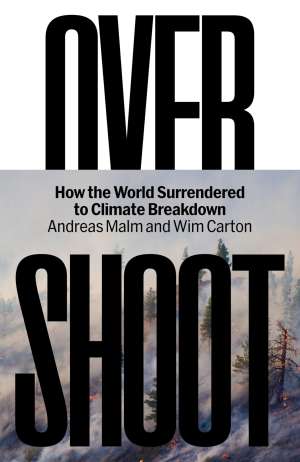

The world is falling apart, but the Italian philosopher Leonardo Caffo claims all is not lost yet. In minutely structured argumentation, Caffo shows that the solution has always been there, at the hand’s reach, yet it was so radical that those who might have voiced it have been silenced and stigmatised at the start.
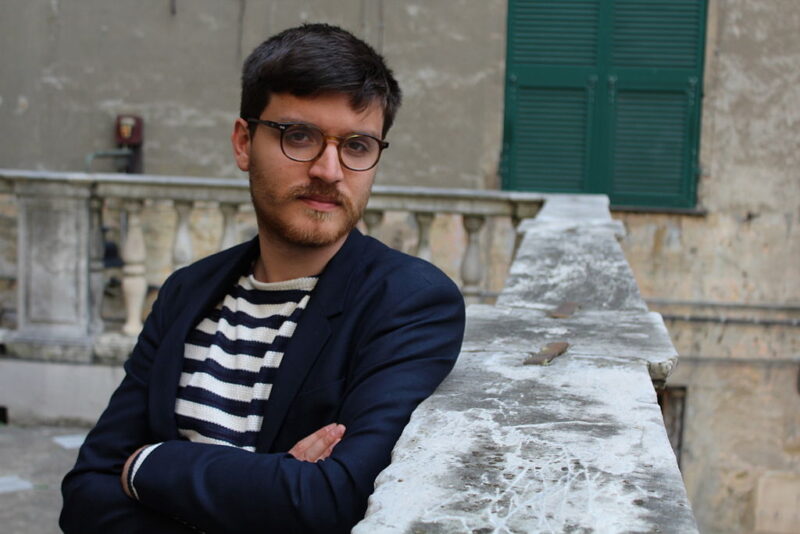
«Anarchic condition»
Contemporary scholars in the humanities and social sciences often claim that our main problem is multinational companies that undermine the power of the state. Run by persons who have not been elected and guided by the interests of private owners and not the community, these companies are responsible for wars as well as for the ruthless exploitation of people and natural resources. The right thing to do, thus, would be to empower again the state that has been failing in all respects, from #education to #public health#. But what if the solution, just the opposite, is to let it fail for good? Caffo is convinced that it is so indeed. In place of «old failed systems», he proposes the «anarchic condition»: «the idea that the best possible form of social life is one freed from any form of #statism or institutional governmentalism» (p. 6).
In place of «old failed systems», he proposes the «anarchic condition»
Autonomy of morals
As the source of what he names «the theoretical revolution of anarchy on the West» (p. 11), Caffo defines #Immanuel Kant#, in particular the Critique of Practical Reason (1788) and his belief in the power of human #reason to set its own moral laws, regardless of any external conditioning. For Kant, acting morally means being able to justify our actions reasonably without relying on any external or dogmatic element. State, claims Caffo, presents exactly the collapse of #ethics into #metaphysics that Kant wanted to avoid: «I do this only because there is a law that tells me to do it» (p. 12). This shows how wrong and superficial is the common perception of anarchy as chaotic. No, claims Caffo, anarchy does not mean the absence of order or morality but the capacity to find order and morality according to one’s own intellectual principles (p. 13). The idea that we should not expect the solution to come from the outside but to look for it inside ourselves might, claims Caffo, appeal to the young generations exactly because it is so different from what social media proposes.
On savages and monsters
The image of a big A drawn in a circle on the street graffiti, omnipresent and ephemeral, represents the idea of anarchy today. It has been, however, developed within a respectable intellectual tradition by thinkers such as #Pierre-Joseph Proudhon# and #Thomas More#, #Jean-Jacques Rousseau# and #Josiah Warren#, #Lev Tolstoj#, and #Max Stirner#. Caffo convincingly refutes other misperceptions too. For example, contrary to the idea that anarchy is not realisable because we could never truly conceive of complex societies in the absence of states and governments, Caffo shows that in the history of #humanity, there have been hundreds of examples of anarchic societies only that have been stigmatised as «primitive». Even today, numerous micro-communities exist around the world, defined as «tribes» by colonialist views, which adopt ways and methods of anarchy to organise their lives, from the #Yanomami in the Amazon forest on the border between Venezuela and Brazil to the #Guayaki, a small tribe of nomadic hunters from Paraguay (p. 17).
One of the main stigmas against the anarchy is its presumed #violence. Violence as a political tool has had a special role throughout the Italian post-WW2 history and is hardly comprehensible from the outside. But regarding the anarchist ideas, Caffo’s explanation seems to the point: «The only way to stop the liberator is to quickly transform them into a monster» (p. 13). The brutal force used to suppress the protests against the #G8 meeting in Genova in July 2001 and the groups of presumed «anarchists» such as the «black block» have been discussed, for example, in Diaz – Don’t Clean Up This Blood by Daniele Vicari (2012). Caffo contributes another, more marginal but just as telling case of #Alfredo Cospito#, a prominent member of the Turin anarchist world, who is in prison because he was held responsible for the explosion, on 2 June 2006, of two bombs placed in front of the former barracks of the Military police students in Fossano in the province of Cuneo. The Turin judiciary sentenced him to twenty years for the attempted massacre (even if he caused neither deaths nor injuries), and the Supreme Court reconfigured the crime as a massacre against the State with a request for a life sentence. At present, he serves a sentence reduced to twenty-three years. What Cospito actually did, explains Caffo (p. 40), was that he literally placed two firecrackers, the kind that are fired on New Year’s Eve from the balconies, in a dustbin at a safe distance from the barracks.
What could be the motive for massacring a person’s life for something like this is a mere rhetorical question. The history of the state as an instrument of control and punishment has been thoroughly explored by Foucault and many other scholars. However, claims Caffo (p. 34), this history of biopolitical machines and coercive institutions, of police cells and economic capital, of stories of emancipation through work that ennobles humans, and then nightmares of missed freedom, has a counter-history: the anarchy. The idea that an alternative path can and must be traced.
One of the main stigmas against the anarchy is its presumed violence.
Freedom Forever
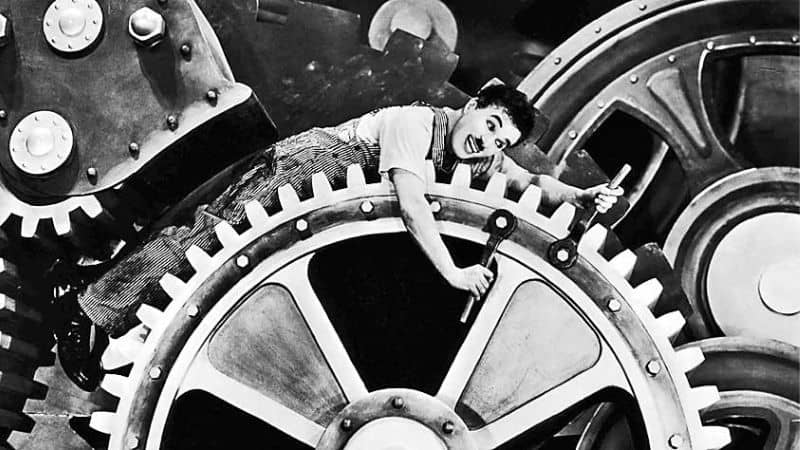
In the first French sound film, Freedom Forever (À nous la liberté, 1931), #René Clair# created a vision of a world in which automated machines are used to replace workers in the factories, so the people are free to dedicate themselves to the pastime activities such as fishing and singing. A few years later, #Charlie Chaplin#, using entire passages from this film, turned the utopian premise of René Clair into a dystopian vision. In his comedy Modern Times (1936), the workers are subjected to ever harder work under the dictate of the inhuman rhythm of machines. Chaplin’s vision prevailed in reality as well as in film history (Clair, instead of filing a suit for plagiarism, declared to be honoured that Chaplin found inspiration in his work).
Now, with Caffo’s latest book, we have a plausible explanation for the apparently mysterious oblivion of Clair’s utopian musical. The book also provides a series of arguments as to why it is high time to return to Clair’s vision. Let me sum up just the two of them. With the concept of the universal basic income, this vision became feasible. According to Caffo (p. 55), if we all had something to live on, then we could transform the pastime into the only plausible model of life. But this solution is also, for Caffo, unavoidable. «After the last war, for borders or energy, for a new pandemic or rising seas, (…) those who will remain alive will only be able to do one thing: play, anarchists by necessity.»